Disc Golf Bag Buying Guide by Capacity: How Many Discs You Really Carry (and the Right Bag for It)
Bag sizes explained by real disc count — 8, 12, 18, 25+ — with the weight, comfort and price trade-offs at each size and a recommended bag for each tier.
This post contains affiliate links. If you buy through them we may earn a commission at no extra cost to you. Learn more.
Table of contents
- Step 1: Count what you actually throw
- Step 2: Understand what capacity costs
- Step 3: Pick your tier
- 8–10 discs: shoulder sling — Latitude 64 Slim
- 12–17 discs: small backpack — Prodigy BP-3 V3
- 18–20 discs: standard backpack — Dynamic Discs Trooper
- 20–25+ discs: large backpack — Dynamic Discs Ranger
- Sizing mistakes we see constantly
- The short version
- Frequently Asked Questions
Every disc golf bag listing leads with a number: “holds 18 discs”, “25+ disc capacity”. It’s the first spec and the one most people get wrong, because they buy for the collection they own (or hope to own) instead of the discs they throw. This guide is built around that one question — how many discs will actually be in the bag on a Saturday — and then walks through the trade-offs at each size, with one recommended bag per tier.
For the full roundup of bags at every price, see Best Disc Golf Bags. This page is about picking the size first.
| Product | Our rating | Capacity | Empty weight | Style | Price | Buy |
|---|---|---|---|---|---|---|
| 8–10 discs Latitude 64 Slim Bag | 4.0/5 | 8–10 discs | ~1 lb | Shoulder sling | $18–$25 | Check Price |
| 12–17 discs Prodigy BP-3 V3 Backpack | 4.0/5 | 17 discs | ~2 lb | Backpack | $50 | Check Price |
| 18–20 discs Dynamic Discs Trooper Backpack | 4.5/5 | 18+ discs (+3–4 top) | 1 lb 11 oz | Backpack | $38–$45 | Check Price |
| 20–25+ discs Dynamic Discs Ranger Backpack | 4.5/5 | 20 discs + 2 putters | Not published | Backpack | $175–$194 | Check Price |
Step 1: Count what you actually throw
Take your last three rounds and list the discs you threw. Not the ones you carried — the ones you threw. For most players the list looks something like:
- 1 putter (plus 1–2 identical backups)
- 1–2 midranges
- 2–3 fairway drivers
- 0–2 distance drivers
- 1 utility disc (an overstable approach disc, a roller disc)
That’s 6–11 discs thrown, 8–14 in the bag with backups. Add four for the disc you’re trying out and the two extra putters for practice, and 12–18 is the honest number for most regular players. Tournament players with specific shot needs get to 20–25. Very few people throw 30 discs in a round; they carry 30 because the bag has room.
Step 2: Understand what capacity costs
Capacity itself is nearly free — a $40 bag holds 25 discs. What changes as bags get bigger is everything around the discs:
| 8–10 discs | 12–17 discs | 18–20 discs | 20–25+ discs | |
|---|---|---|---|---|
| Style | Shoulder sling | Small backpack | Standard backpack | Large backpack / cart |
| Empty weight | ~1 lb | 2–3 lb | 2–4.5 lb | 4–5+ lb |
| Loaded weight | 4–5 lb | 7–10 lb | 10–13 lb | 13–18 lb |
| Price range | $15–$30 | $40–$90 | $40–$230 | $75–$450 |
| Typical player | Casual, quick rounds | Regular, curated bag | Weekly league | Tournament |
Two things jump out. First, loaded weight roughly triples from the smallest tier to the largest — and every pound is carried for two to three miles a round. Second, the 18–20 disc tier has the widest price range, because that’s where the market is: it’s where the $40 Trooper and the $229 GRIPeq BX3 both live, and the difference between them is comfort and durability, not room.
Step 3: Pick your tier
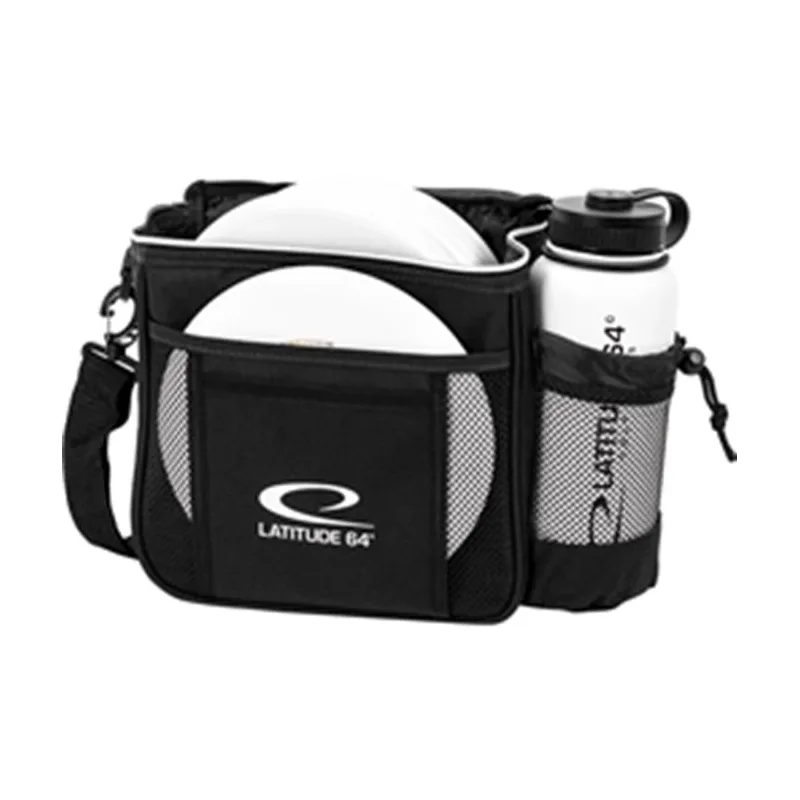
Latitude 64 Slim Bag
4.0/5$18–$25 approx. street price
- Capacity: 8–10 discs
- Empty weight: ~1 lb
- Style: Shoulder sling
Pros
- Putter pocket and drink holder for $20
Cons
- Single strap; no padding
8–10 discs: shoulder sling — Latitude 64 Slim
The right bag for a beginner with a starter set and two extra putters, for quick nine-hole rounds, or as a second “trunk bag”. Slings are light, cheap and fast — you don’t take them off to grab a disc. They stop being pleasant somewhere around 10 discs, when the weight on one shoulder starts to matter over 18 holes. The Latitude 64 Slim ($20) has a putter pocket and a drink holder, which is all a sling needs.
Don’t buy a sling as your main bag if you already own 12 discs. You’ll replace it within a season.
Prodigy BP-3 V3 Backpack
4.0/5$50 approx. street price
- Capacity: 17 discs
- Empty weight: ~2 lb
- Style: Backpack
Pros
- Weatherproof; sized so 15 discs don't rattle around
Cons
- Outgrown quickly if your collection keeps growing
12–17 discs: small backpack — Prodigy BP-3 V3
The underrated tier. A small backpack sized for 12–17 discs is lighter and tidier than a half-empty 25-disc bag, and its discs don’t shift around. It’s the right size for a player who has settled on a curated bag and isn’t collecting. The Prodigy BP-3 V3 ($45–$55) adds ripstop nylon, taped zippers, a waterproof bottom and two 32 oz bottle holders — weatherproofing you usually only get at twice the price.
The obvious risk: if your collection is still growing, you’ll outgrow it. If you’re not sure, go one tier up.
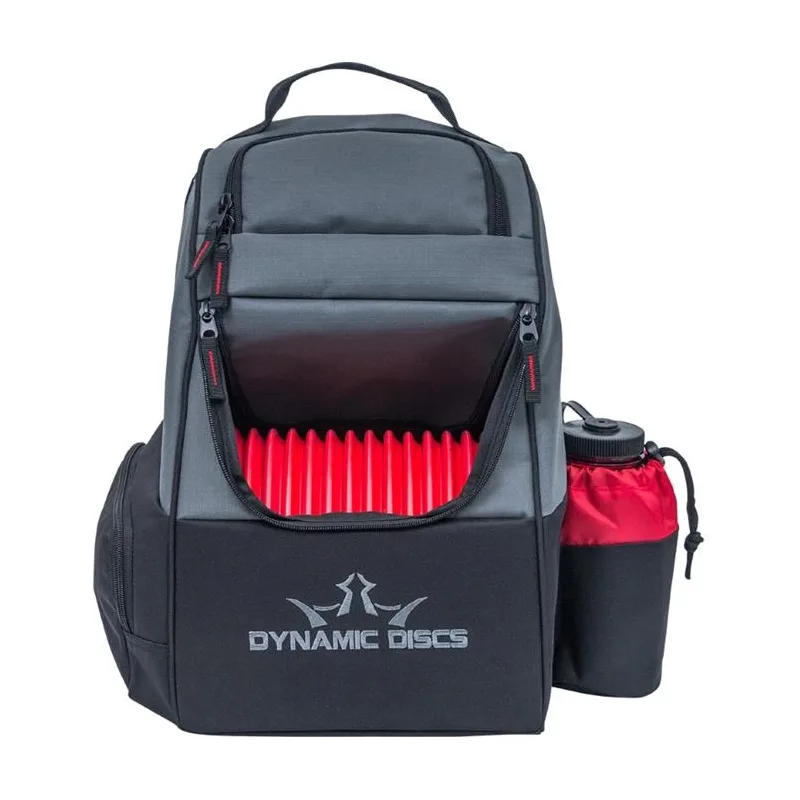
Dynamic Discs Trooper Backpack
4.5/5$38–$45 approx. street price
- Capacity: 18+ discs (+3–4 top)
- Empty weight: 1 lb 11 oz
- Style: Backpack
Pros
- 18+ discs, under 2 lb, padded straps, stands upright — for $40
Cons
- Few pockets; basic water resistance
18–20 discs: standard backpack — Dynamic Discs Trooper
This is the size most players should buy, and the Trooper ($40) is the bag most players should buy in it: 18+ discs in the main compartment plus three or four more up top, 1 lb 11 oz empty, padded straps and back panel, and a low center of gravity that keeps it upright on slopes. It’s the bag we recommend in the main roundup and review in full here.
At this size you also have the widest range of upgrades. The MVP Voyager Lite ($89–$95) adds a rigid frame that stays open on the ground and 900D ripstop; the GRIPeq BX3 ($189–$229) and Upper Park Shift ($154) are the premium options. Same capacity — you’re paying for comfort, structure and years of durability. The Innova Adventure Pack is the Trooper’s $40 rival with more room and less padding; we compare them in Trooper vs Adventure Pack.
Dynamic Discs Ranger Backpack
4.5/5$175–$194 approx. street price
- Capacity: 20 discs + 2 putters
- Empty weight: Not published
- Style: Backpack
Pros
- Nine compartments, a two-putter On-Deck pocket and a removable disc divider
Cons
- No empty weight published by the maker or any retailer
- $175, against $40 for a 25-disc Adventure Pack
20–25+ discs: large backpack — Dynamic Discs Ranger
For tournament players, disc collectors who play with their collection, or anyone who carries rain gear, a scorebook, two bottles and snacks. The Ranger ($174.99) holds 20 discs plus two putters in an On-Deck side pocket, across nine compartments, with a removable divider and a collapsible stool holster that doubles as a second bottle holder. It is what we recommended the Dynamic Discs Commander for until the Commander became unbuyable — not in the maker’s line, out of stock at Infinite Discs, no buy box on Amazon as of 13 October 2026.
The honest caveat at this tier is the price of the jump. Dynamic Discs publish no empty weight for the Ranger and neither does any retailer, so the one number that matters most in this guide is the one you cannot get for it; and at $175 it costs four times the Innova Adventure Pack, which holds 25 discs for $40 with thinner straps. If the straps and the warranty are not what you are buying, stay a tier down.
Above about 25 discs, the honest recommendation stops being a bag. A cart (MVP Rover, Rovic, Bag Boy; $140–$350) carries 30+ discs and often a cooler with no weight on your back, at the cost of being awkward on hilly, rooty or muddy courses. If your home course is flat and you carry a lot, look at carts — we rank the ones still in production in best disc golf carts. If it isn’t, the Ranger tier is the ceiling.
Sizing mistakes we see constantly
- Buying a 25-disc bag for 10 discs. It slumps, discs slide sideways, and you carry two pounds of empty bag every round. Buy the tier you’re in.
- Buying a sling for 15 discs because it’s cheaper. One shoulder, 10 lb, three miles. You’ll hate it by hole 12.
- Confusing capacity with quality. Two 18-disc bags can differ by $190. The expensive one isn’t bigger — it’s built from 1000D nylon with YKK zippers and a frame, and it’ll last a decade.
- Buying the bag before the discs. If you’re still assembling a first set, read how to choose your first disc golf set first. Three discs don’t need a bag; six do.
The short version
- Count the discs you throw. Add four.
- Under 10: sling. 12–17: small backpack. 18–20: standard backpack (the Trooper, for most people). 20+: large backpack, and think about a cart past 25.
- Within a tier, price buys comfort and durability, not room. Spend more only if you play a lot.
Then go read the full bag roundup for the best bag at each price in your tier.
How we evaluated this gear
We have not physically tested every product on this page. Ratings are based on manufacturer specifications, PDGA-approved flight data, and hundreds of aggregated owner reviews and community discussions (r/discgolf, retailer reviews, club forums). Where we describe how something "feels" or "flies", that reflects the consensus of experienced players, not a lab test. We update ratings when the consensus changes.