How to Choose Your First Disc Golf Set: A No-Nonsense Buying Guide
What to buy for your first disc golf round — how many discs, which types, what weight and plastic, and what to skip — with a $30 and a $100 shopping list.
This post contains affiliate links. If you buy through them we may earn a commission at no extra cost to you. Learn more.
Table of contents
- Step 1: Buy three discs, not twelve
- Step 2: Understand the four flight numbers (briefly)
- Step 3: Don’t buy a distance driver
- Step 4: Pick the right weight
- Step 5: Base plastic is correct for a first set
- Step 6: Buy a second putter
- Which set?
- Two shopping lists
- What to buy next (and when)
- Frequently Asked Questions
Disc golf has one of the lowest costs of entry of any sport — most US courses are free, and a complete first set of discs costs about as much as a pizza. The only way to get it wrong is to buy too much: too many discs, too fast, too heavy, too expensive. This guide is the short version of what experienced players tell every beginner who asks “what should I buy?”
If you just want the answer: pick one of the two sets below, add a second putter, and go play. The rest of this page explains why.
| Product | Discs included | Plastic | Typical weights | Price | Buy |
|---|---|---|---|---|---|
| Safest first set Innova DX Disc Golf Starter Set | 3 (Leopard, Shark, Aviar) | DX (base) | 160–175 g | $20–$32 | Check Price |
| Set to grow into Dynamic Discs Prime Burst Starter Set | 3 (Escape, Truth, Judge) | Prime Burst (base) | 170–176 g | $25–$35 | Check Price |
Want the short version?
Our First Bag Builder turns this guide into a shopping list: pick how much you throw and your budget, and it gives you the molds, plastic and weights to ask for.
Step 1: Buy three discs, not twelve
You need exactly three kinds of disc to play a full round:
- A putter for the last 30 feet and for straight, controlled shots.
- A midrange for 150–250 foot shots that need to go where you aim.
- A fairway driver for the tee.
That’s it. Every major manufacturer sells a three-disc set built on this formula for $25–$35, and those sets are the correct first purchase for almost everyone. (Our beginner set roundup compares the five worth buying.)
The temptation is the 10- or 12-disc bundle for $50, which looks like a better deal. It isn’t. New players who own twelve discs throw three of them and can’t tell the other nine apart, and the bundles are usually padded with distance drivers that a beginner can’t use. Learning what one midrange does takes dozens of rounds; owning four different mids just delays that.
Step 2: Understand the four flight numbers (briefly)
Every disc from a major brand has four numbers on it — speed, glide, turn, fade — for example 6/5/−2/1 on the Innova Leopard.
- Speed (1–14): how hard you need to throw it to make it fly as designed. Beginners should stay under 9.
- Glide (1–7): how long it stays in the air. More is easier.
- Turn (+1 to −5): whether it drifts right (negative) during the fast part of the flight, for a right-handed backhand throw. Negative turn helps beginners fly straight.
- Fade (0–5): how hard it hooks left at the end. Less is easier.
The perfect beginner disc has low speed, high glide, a little negative turn and low fade. Our disc types explained guide goes deeper, but for your first set that’s all you need to read a listing.
Step 3: Don’t buy a distance driver
This is the mistake almost everyone makes. Distance drivers (speed 10–14) look like they should go farther, and for an experienced arm they do. For a new arm they go shorter than a fairway driver, because the disc never reaches the speed it’s designed for: it dumps left (or right, for lefties) almost immediately.
A speed 6–8 fairway driver — a Leopard, a Discraft Stratus, a Latitude 64 Diamond — will fly straighter and farther for you than any Destroyer for at least your first season. Add a distance driver when you can throw a fairway driver 250 feet on a flat line. Not before.
Step 4: Pick the right weight
Discs are sold by weight, typically 150–175 g (PDGA maximum is just over 175 g for standard-diameter discs). Lighter is easier: a 160 g driver needs less arm speed to fly properly than a 175 g one. For a beginner:
- Drivers: 150–165 g if you can choose.
- Midranges: 165–175 g.
- Putters: 170–175 g — a bit of weight helps them hold a line and resist wind.
Starter sets usually come in a fixed 165–175 g range because it’s cheaper to produce. That’s fine. If a listing lets you pick, choose the lighter end for the driver.
Step 5: Base plastic is correct for a first set
Each brand sells the same molds in several plastics. Base plastic — Innova DX, Discraft Pro D, Dynamic Discs Prime, Latitude 64 Retro — is cheapest, grippiest, and wears fastest. Premium plastic (Star, ESP, Lucid, Opto) lasts for years, costs twice as much, and is more stable, which is the opposite of what a beginner wants.
Buy base plastic first. As it beats in, the discs will get more understable and easier to throw straight. When you eventually lose a disc or wear one out, you’ll know which molds you love and can buy those in premium plastic.
Step 6: Buy a second putter
Here’s the one extra we do recommend. Putting is the part of disc golf that improves fastest with practice, and practicing with one putter means walking to the basket after every throw. Two or three identical putters — $9–$12 each in base plastic — turn ten minutes in the yard into real practice. Whichever set you buy, add one more of its putter. (The Innova Aviar and the Dynamic Discs Judge are both excellent first putters.)
Which set?
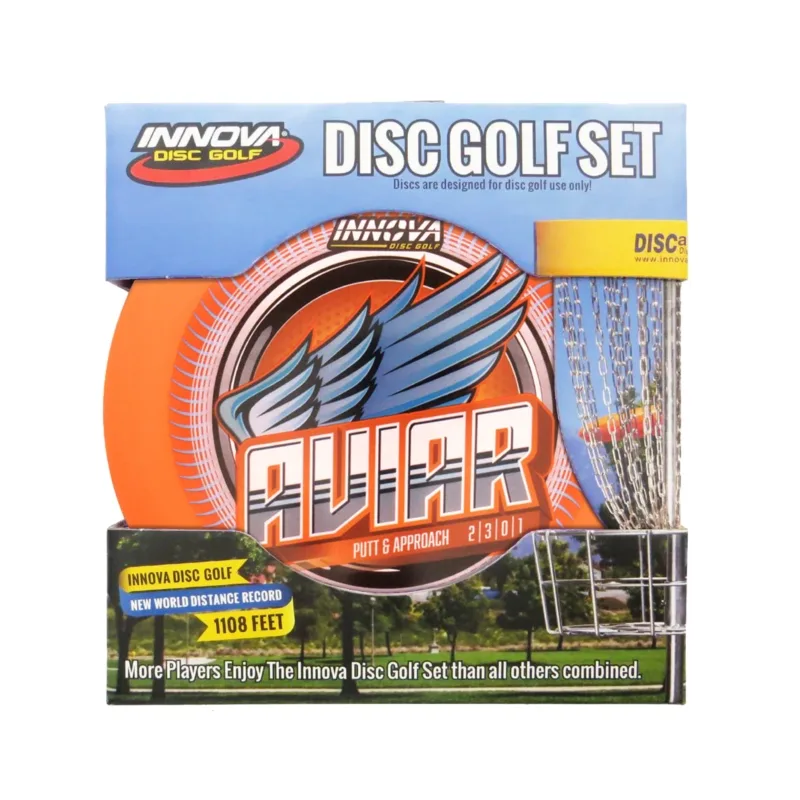
Innova DX Disc Golf Starter Set
4.5/5$20–$32 approx. street price
- Discs included: 3 (Leopard, Shark, Aviar)
- Plastic: DX (base)
- Typical weights: 160–175 g
Pros
- Leopard, Shark and Aviar — the most proven beginner trio in the sport
- Cheapest way to get three PDGA-approved discs from a major brand
Cons
- DX plastic wears fast (which is fine for a first set)
Innova DX Starter Set if you have no throwing background. The Leopard (6/5/−2/1), Shark (4/4/0/2) and Aviar (2/3/0/1) are the gentlest, most proven trio in the sport, and every one has an obvious premium-plastic upgrade later. Innova also sells the same idea in Champion plastic for about $10 more; we explain why that is the wrong way round for a beginner in DX vs Champion Starter Set.
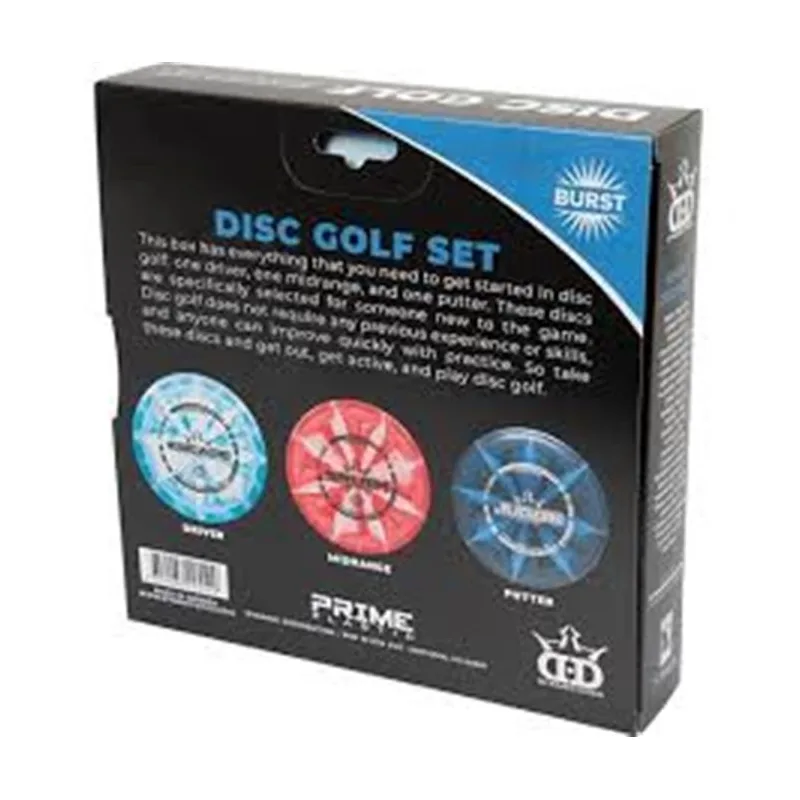
Dynamic Discs Prime Burst Starter Set
4.5/5$25–$35 approx. street price
- Discs included: 3 (Escape, Truth, Judge)
- Plastic: Prime Burst (base)
- Typical weights: 170–176 g
Pros
- Escape, Truth and Judge stay in bags for years
- Usually includes a mini marker
Cons
- Escape (speed 9) is a little fast for a first driver
Dynamic Discs Prime Burst Starter Set if you already throw a frisbee well or come from a throwing sport. The Escape (9/5/−1/2), Truth (5/5/−1/1) and Judge (2/4/0/1) stay in intermediate bags for years; the Escape is a little fast for a true beginner but rewards a decent arm.
Buying for a child? Weight matters more than mold: discs under about 130 g fly properly for a small arm and standard sets don’t go that light. Our best disc golf sets for kids covers the sets that do.
Both are compared in detail — along with Discraft, Latitude 64 and a budget bundle — in Best Beginner Disc Golf Sets. And if you’re curious about the brand rivalry, Innova vs Discraft explains the differences without taking sides.
Two shopping lists
The $40 list (everything you need):
- Three-disc starter set — $30
- One extra putter, same mold — $10
The $110 list (everything you’ll want by month three):
- Three-disc starter set — $30
- Two extra putters — $20
- Dynamic Discs Trooper backpack — $40 (see best disc golf bags)
- Bright mini marker — $4 (best mini markers)
- A small towel — $5–$10 (a wet disc slips; this is the cheapest fix in the sport — see best disc golf towels)
What to skip for now: distance drivers, premium plastic, gloves, a basket, and anything with more than three discs in the box. All of those become good purchases later. None of them are good first purchases.
What to buy next (and when)
- After ~10 rounds: a second midrange or fairway driver with different numbers, so you can learn what stability feels like. A Discraft Buzzz (5/4/−1/1) is the most common second mid in the world for a reason.
- When you can throw 250 ft flat: your first distance driver, in the lightest weight you can find.
- When you’re playing weekly: a practice basket. Our portable basket guide starts at $115.
- The first time a disc lands in water: a retriever. A $20 pole pays for itself the first time it saves a $15 disc, and most players buy one only after losing two.
- When it gets cold or wet: a towel first, then maybe gloves.
Start small. The players who buy three discs and throw them 500 times get good; the players who buy twelve and throw each 40 times stay confused. Three discs, two putters, go play.
How we evaluated this gear
We have not physically tested every product on this page. Ratings are based on manufacturer specifications, PDGA-approved flight data, and hundreds of aggregated owner reviews and community discussions (r/discgolf, retailer reviews, club forums). Where we describe how something "feels" or "flies", that reflects the consensus of experienced players, not a lab test. We update ratings when the consensus changes.