MVP Rover V2 Review: The Cheapest Disc Golf Cart Worth Buying — and the Version Trap
MVP Rover V2 review: under 14 lb, $140–$170, welded one-piece frame. What it does, what owners actually complain about, and how to tell a V2 from the older Rover.
This post contains affiliate links. If you buy through them we may earn a commission at no extra cost to you. Learn more.
Table of contents
For most of the last decade, “which disc golf cart?” had one answer, and it was a ZÜCA. That answer expired on 30 September 2026, the last day of ZÜCA’s normal operations per its own farewell page. The carts that remain fall into three shapes — a box you sit on, a push cart you steer, and a dolly you pull — and the cheapest of the three, by a wide margin, is the MVP Rover.
The Rover is not trying to be a ZÜCA. It is a two-wheel frame with a platform and a strap: you set the backpack you already own onto it and pull. That is the entire product. At $139.95 at Infinite Discs and $159.95 direct from MVP (checked September 2026) it costs roughly a third of what a box cart with a seat costs, weighs a third as much, and solves the one problem most players actually have, which is that a loaded backpack is 15–20 lb hanging off two shoulders for four hours.
What follows is what MVP publishes, what retailers list, and what owners report — including the two complaints that come up often enough to be worth planning around. We have not pulled a Rover around a course ourselves.
| Product | Our rating | Price | Buy |
|---|---|---|---|
| Best value cart MVP Rover Cart V2 | 4.5/5 | $140–$170 | Check Price |
| Best push cart Rovic RV1D 2.0 Disc Golf Cart | 4.5/5 | $150–$260 | Check Price |
| Not ranked — sold out everywhere Rogue Iron Sports V3 Cart | 4.0/5 | $349 ($374 with the towel bundle) |
What a two-wheel pull cart actually does
A pull cart takes the weight off your back and puts it on wheels behind you. What it does not do is carry anything your bag doesn’t already carry, stand up as a chair, or make a steep hillside easier. On flat and gently rolling courses it is close to frictionless; on rooty, rutted, or steep ground you will occasionally be lifting it over things, and two small wheels are the part of the design that shows its limits there.
The trade-off against a push cart is control. A three-wheel push cart like the Rovic goes in front of you where you can see it, has a parking brake so it doesn’t roll away on a slope, and carries a console you can put a scorecard and a phone in. You pay about $70 more and carry 3 lb more for that. The trade-off against a box cart is obvious: a box cart is also a seat and a cooler, and it weighs twice as much.
If you are not sure which shape you want, our disc golf carts guide sets the five carts still in production side by side.
The V2 change, and how to tell which one you’re buying
The current Rover is the V2, and the change is not cosmetic. MVP describes the V2 frame as “a welded one-piece frame design that eliminates hardware failure points” — which is a manufacturer’s way of saying the original bolted its frame together at joints that could work loose or break. That matches what turns up in owner reviews of the older cart, where the recurring advice to new buyers is to check every bolt before the first round.
Here is the trap. MVP’s Pro Shop calls it the “V2 Rover Cart” and Infinite Discs calls it the “Rover Cart V2”, but the Amazon listing is titled “MVP Disc Sports Rover Disc Golf Cart — Black”, with no version anywhere in the title and a rating that pools years of reviews of both designs. That 4.1-out-of-5 average across 164 ratings is not a verdict on the cart you would receive today. If the welded frame is the reason you’re buying, order from a listing that names the V2, or ask the seller.
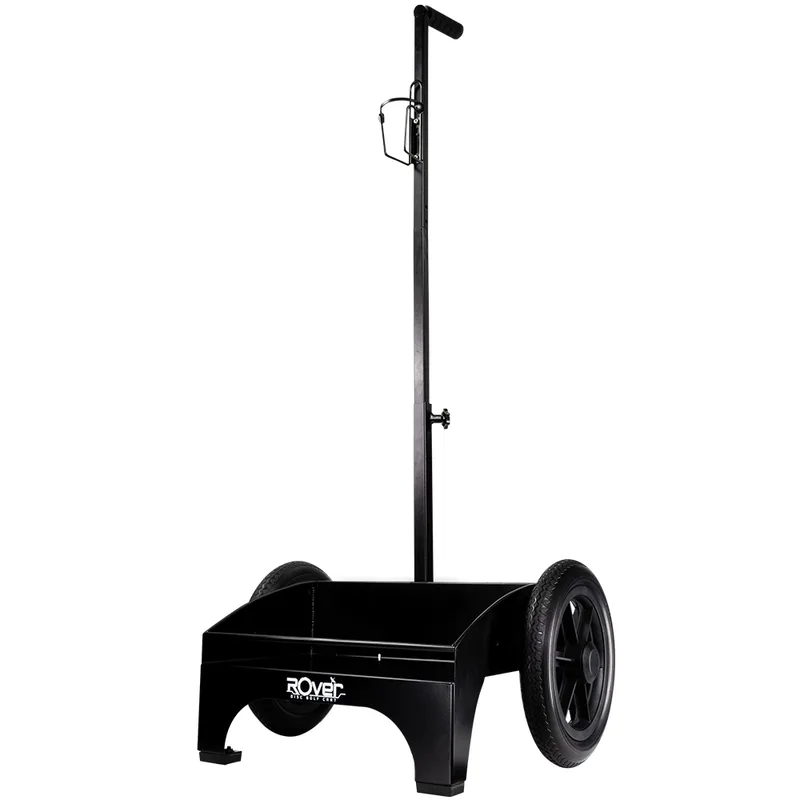
MVP Rover Cart V2
4.5/5$140–$170 approx. street price
- Type: 2-wheel pull cart
- Weight: Under 14 lb (MVP)
- Seat: No
- Warranty: Limited lifetime per Infinite Discs; MVP publishes no terms
Pros
- Under 14 lb by MVP's own figure — the lightest cart in this guide, and the cheapest from a major brand
- V2 frame is welded in one piece, which removes the bolted joints owners of the original broke
- No-flat polyurethane tires; quick-release multi-directional handle; bottle mount uses standard bike thread spacing
- Handle detaches and it stores about a foot tall — it fits in a small car
- Replacement frames are sold separately, so a bent cart isn't a dead cart
Cons
- Two wheels, pulled behind you — a dolly for your bag, not a push cart
- No seat, no brake, no storage beyond the bottle holder
- The front support bar and the bottle holder hardware are the recurring owner complaints
- Platform tops out at about 10.25″ × 15.5″ — measure your bag first
What owners complain about
Three things come up repeatedly, and none of them is the frame.
The front support bar. This is the bar the bottom of your bag rests against, and it is the single most common failure in owner reports of the older Rover — attached with hardware rather than welded, and reported as breaking early. Infinite Discs’ listing for the V2 specifically describes a “raised front support bar and thumb screw system”, which reads like a direct response to that complaint, though MVP doesn’t say so in those words.
The bottle holder. Two separate issues: owners report receiving the wrong hardware to mount it, and — more consistently — that it sits low enough to be awkward to reach while walking. The mount uses standard bike thread spacing, which is the quiet good news here: any bike bottle cage fits, so a $10 part solves it if the stock one annoys you.
Assembly. The cart arrives nearly built; you fit the wheels and the handle, and the tools are in the box. Reports of that taking minutes are consistent. What is equally consistent is the advice to go around every fastener afterwards.
For a $150 cart from a brand that sells replacement frames separately, none of these is disqualifying. They are the difference between a cart you set up carefully once and a cart that annoys you in month three.
Will your bag fit?
MVP sizes the platform at about 10.25″ × 15.5″ and says the Rover is optimised for its own Voyager series — our MVP Voyager Lite review covers the bag that pairing was designed around. In practice the constraint is the footprint of your bag’s base, not how tall it is or how many discs it holds. Standard dual-strap backpacks in that footprint sit on it; wide tour bags and box-shaped bags do not.
If you are buying the bag and the cart together, work out the bag first — how much bag you need by disc count — and then check its base against that figure.
Where to buy it, and the return policy to read first
Prices as of September 2026: $139.95 at Infinite Discs, $149.95 on Amazon, $159.95 at MVP’s Pro Shop. MVP also notes that it does not ship the Rover outside the United States. Amazon’s listing carries free returns, which matters more here than the $10.
The part worth reading before you click is MVP’s own return policy: 14 days, unused only, the buyer pays return shipping, and you choose between a refund minus a 10% restocking fee or full value in store credit. For a cart whose main risk is that your bag doesn’t fit it, that is a strict window — “unused” and “assembled to see if the bag fits” are not obviously the same thing. That is the argument for buying it where returns are free, even if that is not the cheapest line on the page.
The alternatives, if the Rover is the wrong shape
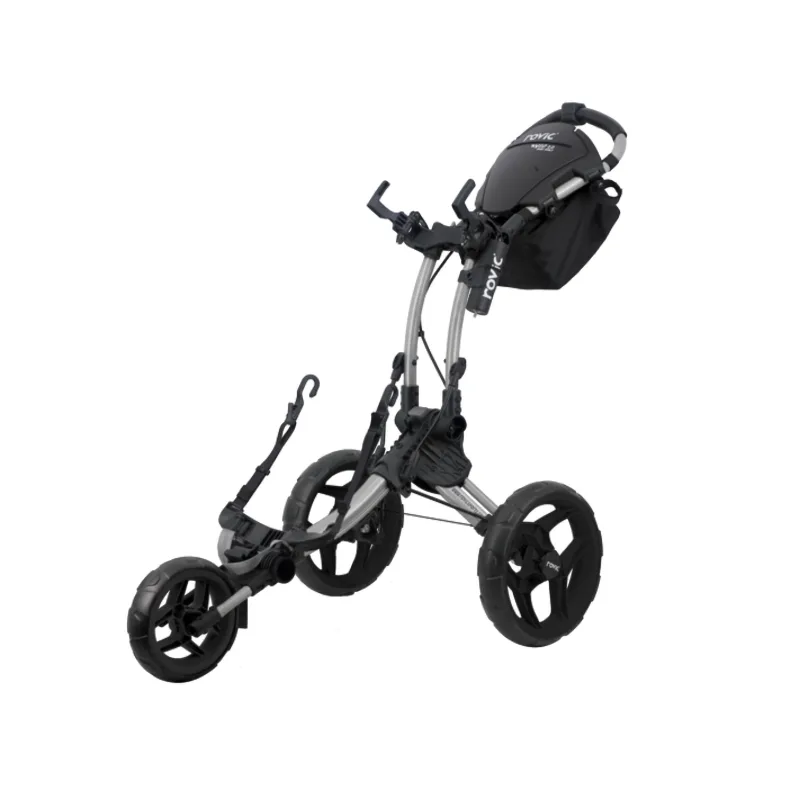
Rovic RV1D 2.0 Disc Golf Cart
4.5/5$150–$260 approx. street price
- Type: 3-wheel push cart
- Weight: 17 lb
- Seat: No
- Warranty: 3 yr frame / 1 yr parts
Pros
- Three-wheel push cart from Clicgear, the ball-golf cart specialists — 17 lb, aluminum, airless tires
- Parking handbrake, storage console, XL cup holder, umbrella mount
- Folds to 13″ × 15″ × 24″ in seconds; 3-year frame / 1-year parts warranty
- Takes any dual-strap backpack bag
Cons
- No seat
- Backpack bags only — no shoulder bags, no ZÜCA-style boxes
- Few disc golf–specific reviews yet for the 2.0 (the 1.0 is well liked)
The Rovic RV1D 2.0 is what you buy when the missing brake is the thing that bothers you. It is a Clicgear design — a company that has made ball-golf push carts for years — so it folds properly, has a console and a handbrake, and comes with a 3-year frame warranty instead of an unpublished one. It costs about $70 more and weighs 3 lb more, and it only takes dual-strap backpacks.
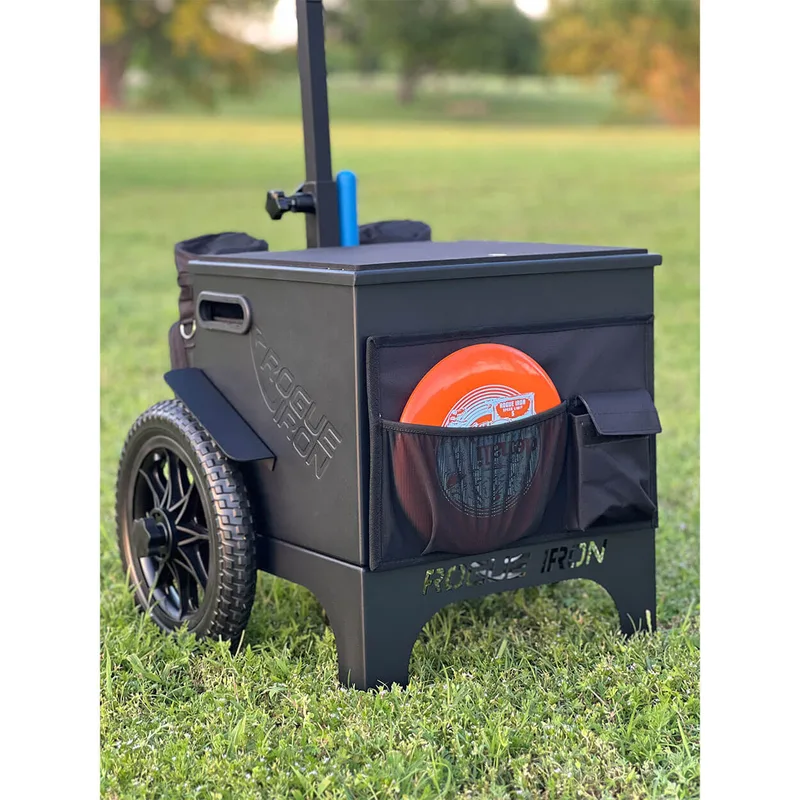
Rogue Iron Sports V3 Cart
4.0/5$349 ($374 with the towel bundle) approx. street price
- Type: Box cart with seat
- Weight: ~22–25 lb
- Seat: Yes
- Warranty: Rogue Iron limited
Where to buy: Nowhere, right now. Rogue Iron sell direct and all eight variants have been sold out since 30 September 2026 — re-checked 24 October, still 0 of 8. It is not stocked by any retailer and not on Amazon. The new version their own page promised for late October has not shipped.
Pros
- ZÜCA-style box cart — sit on it, store discs inside, cooler built in
- Seat cushion and water bottle holders included; ~22–25 lb
- The natural replacement for a Trekker or Backpack Cart LG now that ZÜCA is gone
Cons
- Sold out in all eight variants as of 30 September 2026, and Rogue Iron's own page says a new version — not a restock — launches in late October
- Heavier and bulkier than a push cart
- Smaller brand; fewer dealers than ZÜCA had
- Box carts drag rather than push
The Rogue Iron V3 is the cart to look at if what you actually want is the ZÜCA experience: a box you sit on, with discs inside and a cooler. It is double the price and double the weight of a Rover, and it drags rather than pushes. With ZÜCA gone it is the nearest thing to a Trekker still being made — but you cannot buy one. On 30 September 2026 all eight variants were sold out at Rogue Iron and at its dealers.
And here the version trap repeats itself, which is the reason this review exists at all. Rogue Iron told us on 29 September that they “plan to have it back in stock late October”, but their product page says they “hope to launch the new version in late October”. So late October brings a V4, not a V3 restock. If you are waiting for a seat cart, wait for that announcement and read the spec — and apply exactly the lesson below about the Rover: when a maker replaces a cart, the old one does not get cheaper, it just gets harder to identify. If you need a seat sooner, Dynamic Discs still sells the ZÜCA-built LG cart for $270 with returns accepted, and our carts guide has the detail.
Who should buy the Rover
Buy it if you already own a backpack you like, your courses are mostly flat, and the problem you want solved is your shoulders. It is also the right first cart for anyone unsure whether they want a cart at all: at $140 it costs less than the difference between two box carts, stores in a closet, and does not commit you to anything.
Skip it if you want to sit down between holes, if you carry a wide tour bag, or if your home course is genuinely rough — in the first two cases nothing about the Rover will grow into what you want, and in the third the wheels are the wrong size for the ground.
For the full picture of what is left in the cart market after September 30, see our guide to the best disc golf carts, and if the bag itself is the weak link, start with the best disc golf bags.
How we evaluated this gear
We have not physically tested every product on this page. Ratings are based on manufacturer specifications, PDGA-approved flight data, and hundreds of aggregated owner reviews and community discussions (r/discgolf, retailer reviews, club forums). Where we describe how something "feels" or "flies", that reflects the consensus of experienced players, not a lab test. We update ratings when the consensus changes.