Innova Roc vs Mako3: The Same Disc on Paper, Opposites in the Air
Roc (4/4/0/3) vs Mako3 (5/5/0/0): identical 21.7 cm shells, one beaded and one not. Which Innova midrange fades, which flies dead straight, and which to buy first.
This post contains affiliate links. If you buy through them we may earn a commission at no extra cost to you. Learn more.
Table of contents
- Head-to-head
- The spec sheet says they are the same disc
- The bead is the difference you will actually feel
- Flight: one of these fades and one does not
- Where Innova’s numbers and the owners’ numbers part company
- Weights, and the one place the Roc wins outright
- Where to buy, and what we found this week
- Which one should you buy?
- Our pick
- Frequently Asked Questions
Put an Innova Roc and an Innova Mako3 on a table and you cannot tell them apart by size. Innova’s own spec pages give both discs a 21.7 cm diameter and a 1.2 cm rim width, and Infinite Discs lists both with a 180 g maximum weight. They are the same company’s midrange, the same shape, within a few dollars of each other.
In the air they do opposite things. The Roc fades left, hard and on purpose. The Mako3 does not fade at all. Innova has sold both for years without ever framing them as rivals, which is why players keep asking which one to buy — the spec sheet refuses to answer.
This comparison goes through the flight, the one physical difference that actually separates them, where Innova’s published numbers part company with the people who own the discs, and which of the two belongs in your bag first.
We have not flight-tested either disc. The dimensions, weights, plastics and approval dates below come from Innova’s own disc pages; the stability ratings, skill-level ratings and owner flight numbers come from Infinite Discs, where the Roc has 173 ratings and the Mako3 has 362. Where those two sources disagree, we say so rather than picking one.
| Product | Our rating | Flight numbers | Stability | Rim | Skill level | Plastic options | Price | Buy |
|---|---|---|---|---|---|---|---|---|
| Dead straight, any arm Innova Mako3 | 4.5/5 | 5 / 5 / 0 / 0 | Stable | Beadless, 1.2 cm wide, 1.4 cm deep | Everyone | DX, XT, Champion, Star, GStar, Halo Star | $7 (DX) – $22 (Halo Star) | Check Price |
| Dependable fade Innova Roc | 4.5/5 | 4 / 4 / 0 / 3 | Overstable | Beaded, 1.2 cm wide, 1.3 cm deep | Intermediate and advanced | DX, Pro, KC Pro, Glow, Champion, Star, GStar | $9 (DX) – $20 (Star) | Check Price |
Head-to-head
| Innova Mako3 | Innova Roc | |
|---|---|---|
| Flight numbers (Innova) | 5 / 5 / 0 / 0 | 4 / 4 / 0 / 3 |
| Flight numbers (owner average) | 5 / 4.3 / −0.2 / 0.1 | 4 / 4.1 / −0.1 / 2.5 |
| Stability | Stable | Overstable |
| Diameter | 21.7 cm | 21.7 cm |
| Height | 2.1 cm | 2.0 cm |
| Rim width / depth | 1.2 cm / 1.4 cm | 1.2 cm / 1.3 cm |
| Bead | No | Yes |
| Max weight | 180 g | 180 g |
| DX weight range | 150–175 g | 150–180 g |
| Skill level (Infinite Discs) | Everyone | Intermediate, advanced |
| PDGA approved | 18 September 2009 | 1 January 1987 |
| Owner rating | 4.72 from 362 | 4.74 from 173 |
The spec sheet says they are the same disc
This is the part worth sitting with, because it is unusual. Two midranges from the same manufacturer, both 21.7 cm across, both with a 1.2 cm rim, both legal up to 180 g. The Mako3 is a single millimetre taller and its rim is a millimetre deeper. That is the whole dimensional story.
Innova describes the Mako3 as “the faster, low profile version of the remarkably straight flying Innova Mako”, and that phrase misleads a lot of people. Low profile is relative to the original Mako, not to the Roc. Against a Roc, the Mako3 is the taller, deeper disc of the two. If you are choosing between these two specifically, ignore the marketing adjective and read the numbers.
The bead is the difference you will actually feel
Since the shells match, one small ridge of plastic does most of the work: the Roc is beaded, the Mako3 is beadless.
A bead is a lip on the inside edge of the rim. It changes how the disc seats against your fingers and how cleanly it leaves the hand, and it is the single most common reason a player bounces off the Roc. Owner reviews on Infinite Discs make the point repeatedly, and bluntly: beaded discs do not perform well with a power grip. A player who power-grips their midranges and putters often cannot get along with a Roc no matter how good the disc is supposed to be.
This is also why Roc opinions are so polarised while Mako3 opinions are not. The Mako3’s beadless rim is uncontroversial; the Roc’s bead is a preference you either have or you do not. If you have never thought about beads, this is a good pair to learn on, because here it is the only variable.
Flight: one of these fades and one does not
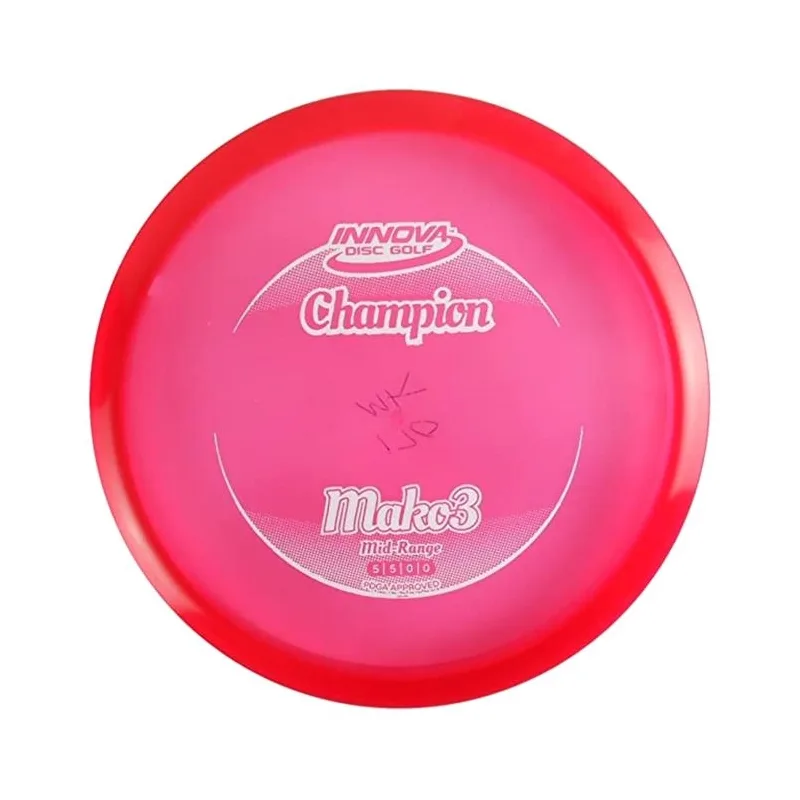
Innova Mako3
4.5/5$7 (DX) – $22 (Halo Star) approx. street price
- Flight numbers: 5 / 5 / 0 / 0
- Stability: Stable
- Rim: Beadless, 1.2 cm wide, 1.4 cm deep
- Skill level: Everyone
- Plastic options: DX, XT, Champion, Star, GStar, Halo Star
Pros
- The straightest midrange Innova makes; almost no fade at any arm speed
- Infinite Discs rates it for every skill level, beginner included
- Beadless rim suits players who power-grip their midranges
- Widest plastic range of the two, from DX up to Halo Star
Cons
- Almost no fade means almost no help in a headwind
- Innova rates its glide at 5; 362 owner reviews average 4.3
- The Amazon listing is often won by a used disc from Amazon Resale
Innova rates the Mako3 5/5/0/0 and calls it the best choice for “dead straight shots” and “one disc rounds”. That is exactly how owners describe it: thrown flat, it flies flat, and at the end of the flight it keeps going rather than turning over or hooking in. Its whole value is that it does not editorialise. On a wooded course where the gap is four feet wide and 180 feet away, a disc with no opinion is worth more than a disc with a good one.
Its weakness follows directly. A disc with no fade has nothing to lean on in a headwind, and nothing to finish a hyzer line with. Where the Roc arrives left on purpose, the Mako3 arrives wherever the air left it. That is a real limitation and the reason almost nobody carries a Mako3 as their only overstable option — because it is not one.
Innova gives it the broader plastic range of the two: DX, XT, Champion, Star, GStar and Halo Star. The DX is the cheap one to learn on; Champion and Star are the ones that keep flying straight after a season of trees.
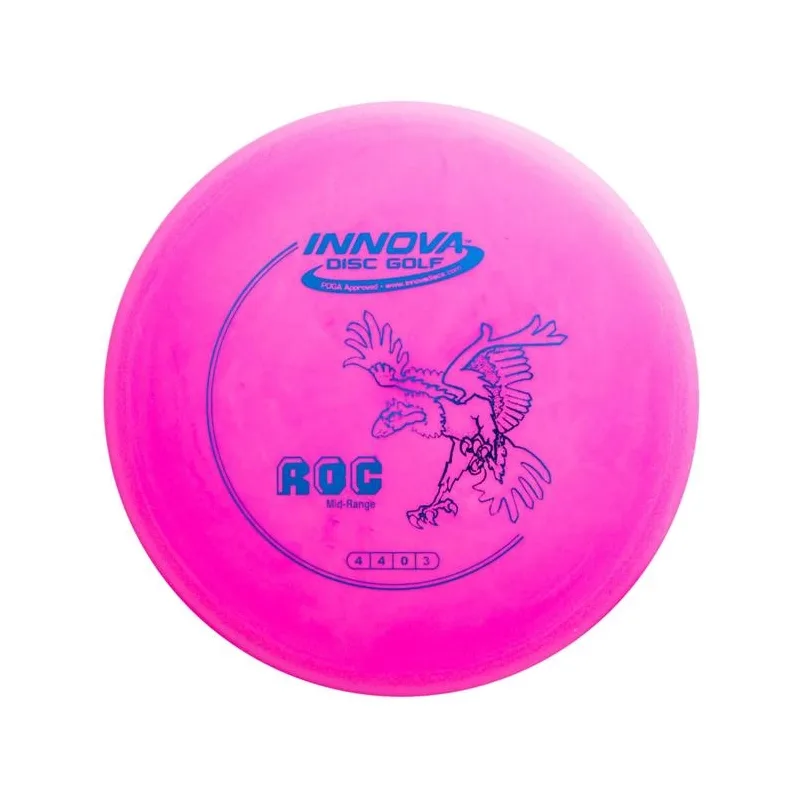
Innova Roc
4.5/5$9 (DX) – $20 (Star) approx. street price
- Flight numbers: 4 / 4 / 0 / 3
- Stability: Overstable
- Rim: Beaded, 1.2 cm wide, 1.3 cm deep
- Skill level: Intermediate and advanced
- Plastic options: DX, Pro, KC Pro, Glow, Champion, Star, GStar
Pros
- A fade you can plan a shot around, in wind and on hyzer lines
- PDGA approved on 1 January 1987 and unchanged since
- Base-plastic Rocs beat in into a famously straight disc
- Available 5 g heavier than the Mako3 in DX plastic
Cons
- Infinite Discs rates it intermediate and advanced only
- Beaded rim; players who power-grip their midranges often dislike it
- Innova rates its fade at 3; 173 owner reviews average 2.5
The Roc is rated 4/4/0/3, and the 3 is the entire point. Thrown with enough speed it tracks straight and then finishes left, reliably, in a way you can aim at. That dependability is why Innova’s own copy calls it “the number one professional mid-range disc” and “very reliable at the high speeds that pros throw”.
The same number is why it is the wrong first midrange. A fade of 3 thrown without much arm speed does not wait until the end of the flight — it arrives early, and the disc hooks left and lands short of where a beginner aimed. Infinite Discs classifies the Roc for intermediate and advanced players only, against “Everyone” for the Mako3, and that classification is the most useful single line in this comparison.
There is a second Roc that you cannot buy: the beat-in one. Innova says the disc “ages slowly, becoming an excellent slow turning disc as it wears”, and base-plastic Rocs that have hit a few hundred trees are genuinely prized. One detailed owner review on Infinite Discs explains the mechanism better than Innova does — a DX Roc loses fade faster than it gains turn, so instead of flipping over as it wears it becomes straight and stays useful. That is why players keep three Rocs at different stages rather than retiring them.
Where Innova’s numbers and the owners’ numbers part company
Infinite Discs publishes both the manufacturer’s flight numbers and the average of its reviewers’ numbers, and on these two discs the gaps are informative:
- Roc: Innova says 4/4/0/3. Owners average 4 / 4.1 / −0.1 / 2.5.
- Mako3: Innova says 5/5/0/0. Owners average 5 / 4.3 / −0.2 / 0.1.
Read together, Innova has rounded each disc toward its own sales pitch: the overstable one is sold as slightly more overstable than players find it, and the glidey straight one is sold with more glide than players find. Neither gap is scandalous and neither changes which disc you should buy. But if you have been choosing between a published 3 fade and a published 0 fade, the real-world gap is closer to 2.5 against 0.1 — still decisive, just less dramatic than the box says.
Weights, and the one place the Roc wins outright
Both discs top out at 180 g. The difference is where you can get that weight cheaply: Innova lists the Roc in DX at 150–180 g and the Mako3 in DX at 150–175 g.
That five grams matters more than it sounds. A heavy base-plastic Roc at 177–180 g is the cheapest wind tool in Innova’s midrange lineup, and you cannot assemble the same thing out of a Mako3 without moving up to a premium plastic. If you play somewhere consistently windy and want to spend nine dollars solving it, that is the answer.
Where to buy, and what we found this week
We checked both on 4 October 2026, and the honest answer is that Infinite Discs is currently the better buy on both discs — which is worth saying plainly, since Amazon is the first button on this page and we earn more when you use it.
| Infinite Discs | Amazon | |
|---|---|---|
| Mako3 | $7.39–$21.99, new | $17.99, and the buy box is a used disc sold by Amazon Resale; new offers start at $14.55 |
| Roc | $8.99–$19.99, new | $11.03 for a DX Roc, third-party seller, only 1 left in stock |
The Mako3 situation deserves the extra line. Its Amazon listing is the real one — 4.8 stars from 2,098 ratings, 100+ bought in the past month — but on the day we looked, the buy box had been won by an Amazon Resale offer in Used – Very Good condition at $17.99, while Infinite had new Mako3s starting at $7.39. Buy boxes rotate, so this may not be true the day you read it. Check what condition you are actually buying before you click. A used midrange is a perfectly reasonable purchase if you know that is what it is; it is not reasonable at full price by accident.
We re-check these figures monthly and publish them, dated, in our price index — worth a look to see whether that buy box has changed hands since this was written.
Which one should you buy?
Buy the Mako3 if:
- It is your first or only midrange.
- You play wooded, technical courses where the gap matters more than the finish.
- You power-grip your midranges and have never got on with beaded discs.
- You want one disc that behaves the same at every arm speed you will pass through.
Buy the Roc if:
- You already throw a midrange 200 feet flat.
- You play windy courses, or you want a hyzer that finishes where you planned.
- You throw forehand approaches and want something that will not flip.
- You want to beat in a DX Roc over a couple of seasons, which is a real and rewarding thing to do.
Buy both if you carry two mids. Mako3 straight, Roc for everything that needs to end left. In that order, not the other way round.
Our pick
For one disc, the Mako3 — it is the more useful disc for more players, and the skill-level ratings from the people who sell both back that up. The Roc is the better second midrange and the better disc for a specific list of jobs, and it is one of the few discs in the sport that rewards wearing it out.
If you are weighing these against Discraft’s midrange, our Buzzz vs Roc head-to-head covers the other classic pairing, and the full Buzzz review explains why that disc ended up as the default recommendation in most guides. For where midranges sit in a bag at all, see disc types explained, and for the brand picture, Innova vs Discraft.
How we evaluated this gear
We have not physically tested every product on this page. Ratings are based on manufacturer specifications, PDGA-approved flight data, and hundreds of aggregated owner reviews and community discussions (r/discgolf, retailer reviews, club forums). Where we describe how something "feels" or "flies", that reflects the consensus of experienced players, not a lab test. We update ratings when the consensus changes.