Discraft Buzzz Review: Why the Best-Selling Midrange Is Still the One to Buy
The Discraft Buzzz has been the default midrange since 2003. Flight, plastics (Z, ESP, Pro D), the SS/GT/OS variants, and how it compares to the Roc and Mako3.
This post contains affiliate links. If you buy through them we may earn a commission at no extra cost to you. Learn more.
Table of contents
Some discs are popular; the Buzzz is infrastructure. Approved by the PDGA on September 30, 2003 — built on the top of Discraft’s earlier Wasp with a new wing — it has been the best-selling midrange in disc golf for most of the two decades since, has been released in more than forty plastic variations, and is the one disc that beginners, touring pros and grumpy old-school players will all tell you to buy. Discraft included it in its beginner set for a reason.
This review covers how it flies, which plastic to get, what the SS, GT and OS versions are for, and how it compares to Innova’s Roc and Mako3.
We haven’t flight-tested the Buzzz for this review. The flight description below combines Discraft’s published flight data, PDGA specifications, and a very large body of owner reviews and community discussion — the Buzzz has more of that than almost any disc ever made, and the consensus is unusually clear.
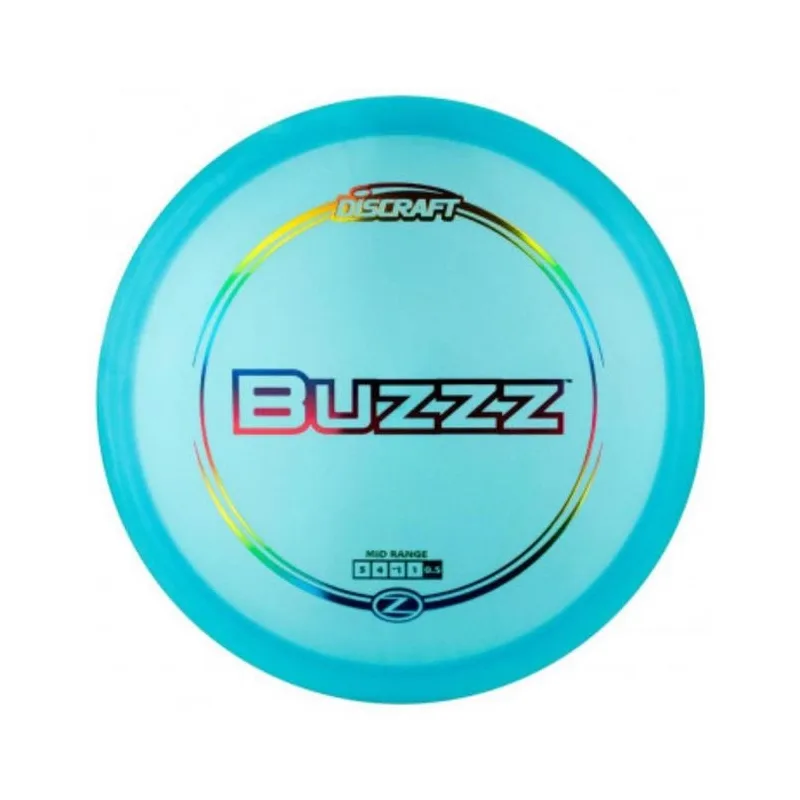
Discraft Buzzz
5.0/5$10 (Pro D) – $20 (ESP/Z) approx. street price
- Flight numbers: 5 / 4 / -1 / 1
- Stability: Neutral (Discraft 0.5)
- Plastic options: Pro D, X, Z, ESP, Big Z, Jawbreaker, CryZtal, Z FLX, ESP FLX
- Skill level: Beginner → pro
Pros
- Dead-straight flight with a gentle finish for players of any arm speed
- Works from the first round to the pro tour without changing molds
- Sold in every Discraft plastic — Pro D, X, Z, ESP, Big Z, Jawbreaker, CryZtal, FLX blends
- Comfortable, low-profile rim; great forehand disc
Cons
- Premium runs cost $17–$22, above base-plastic mids
- Over 40 plastic variants and endless special editions make choosing confusing
- Slightly domier than the Roc; players who want a flat mid may prefer the Buzzz OS
| Product | Our rating | Flight numbers | Stability | Plastic options | Skill level | Price | Buy |
|---|---|---|---|---|---|---|---|
| Best all-round midrange Discraft Buzzz | 5.0/5 | 5 / 4 / -1 / 1 | Neutral (Discraft 0.5) | Pro D, X, Z, ESP, Big Z, Jawbreaker, CryZtal, Z FLX, ESP FLX | Beginner → pro | $10 (Pro D) – $20 (ESP/Z) | Check Price |
| More overstable alternative Innova Roc | 4.5/5 | 4 / 4 / 0 / 3 | Overstable | DX, Pro, KC Pro, Champion, Star, GStar | Intermediate → pro | $9 (DX) – $20 (Star) | Check Price |
| Straighter, cheaper alternative Innova Mako3 | 4.5/5 | 5 / 5 / 0 / 0 | Neutral / straight | DX, Champion, Star, GStar | Beginner → advanced | $7 (DX) – $22 (Halo Star) | Check Price |
Specs
| Discraft Buzzz | |
|---|---|
| Type | Midrange |
| Flight numbers | 5 / 4 / −1 / 1 |
| Discraft stability rating | 0.5 |
| Diameter | 21.7 cm |
| Rim | Low profile, slightly rounded, ~1.2 cm |
| Weights | 160–180 g (175–177 g most common) |
| Plastics | Pro D, X, Z, ESP, Big Z, Jawbreaker, CryZtal, Z FLX, ESP FLX, Z Glo, Titanium, tour series |
| PDGA approved | September 30, 2003 |
How the Buzzz flies
The Buzzz’s entire reputation is built on one sentence, and every owner review says it in slightly different words: it goes where you throw it. Released flat, it flies flat and straight for the length of a midrange shot — 150–250 feet for most players, longer for big arms — and finishes with a small, soft fade. Thrown on a hyzer it holds the hyzer; thrown on an anhyzer it holds that too, without flipping to a roller. It doesn’t fight you.
That neutrality is why it works across skill levels. A beginner throwing at 40 mph sees a straight flight with a gentle left finish; an advanced player throwing at 60 mph sees the same shape, just longer, with the −1 turn giving a touch of right drift at full power. Few discs behave this consistently across arm speeds, and none in the midrange slot is as widely trusted for it.
Its limits follow from the same neutrality. In a strong headwind, the Buzzz lifts and turns more than an overstable mid like the Roc; that’s the shot the Buzzz OS (5/4/0/3) exists for. And for pure tunnel shots with zero fade, the Innova Mako3 is fractionally straighter. Owners who bag one mid pick the Buzzz; owners who bag two usually pair it with something more overstable.
The rim deserves a mention: low-profile and slightly rounded, it’s one of the most forehand-friendly midranges made, and one of the most comfortable for smaller hands.
Which plastic?
This is where the Buzzz gets complicated, because Discraft has released it in more blends than most companies have molds. The ones that matter:
| Plastic | Feel | Durability | Stability | Best for |
|---|---|---|---|---|
| Pro D | Soft, grippy | Low | Slightly less stable, beats in fast | First Buzzz, beginners, budget ($10) |
| X | Medium | Medium | Neutral | Value pick when available |
| Z | Firm, slick when new | Very high | Slightly more stable | Wooded courses, longevity |
| ESP | Firm-grippy | High | Slightly more stable | The all-round favorite ($17–$20) |
| Big Z | Firm | Very high | Like Z | Z with a different look |
| Jawbreaker | Soft, tacky | Medium-high | Neutral | Cold weather, grip |
| CryZtal | Translucent, firm | Very high | Like Z | Collectors; same flight as Z |
| Z FLX / ESP FLX | Flexible | High | Slightly less stable | Winter rounds |
Community consensus: ESP Buzzz is the answer unless you have a reason not to. It has the grip of a softer plastic and most of Z’s durability. Z is for players who hit trees; Pro D is for a first disc or a beater. FLX and Jawbreaker are cold-weather picks.
Whichever you pick, buy the same plastic again when you replace it. Different blends of the same mold fly slightly differently — Pro D turns more, Z fades a touch more — and consistency in a midrange is the whole point.
The Buzzz family: SS, GT, OS
- Buzzz SS (5/4/−2/1, 2008): “super straight” — actually more understable than the standard Buzzz. The right Buzzz for slower arms and for turnover shots.
- Buzzz GT (2008): a groove-top rim on the standard Buzzz flight. Some players love the grip; it’s a niche pick.
- Buzzz OS (5/4/0/3): the overstable Buzzz. Flatter, fades harder, holds up in wind. The natural second mid for someone who already throws a Buzzz.
For a first Buzzz, buy the standard one.
Alternatives
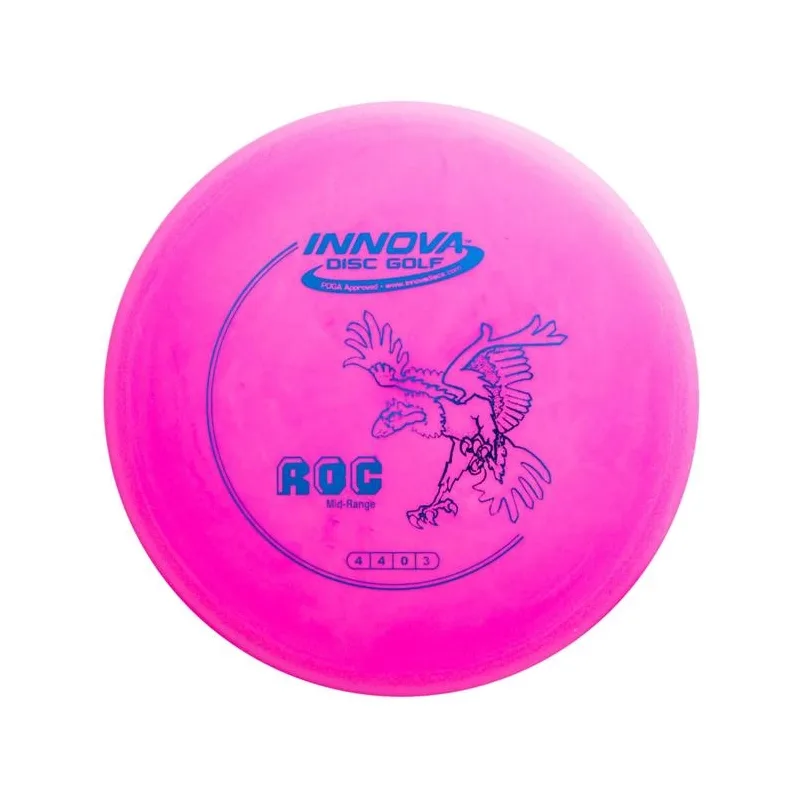
Innova Roc
4.5/5$9 (DX) – $20 (Star) approx. street price
Pros
- Innova's legendary mid; more fade and wind resistance than the Buzzz
Cons
- Needs more arm; beginners see more left finish
Innova Roc (4/4/0/3) is the Buzzz’s historic rival — a slower, more overstable mid with a harder finish and better wind resistance. It’s the disc for players who want a reliable left fade every time; the Buzzz is the disc for players who want straight. We go through it shot by shot in Buzzz vs Roc.
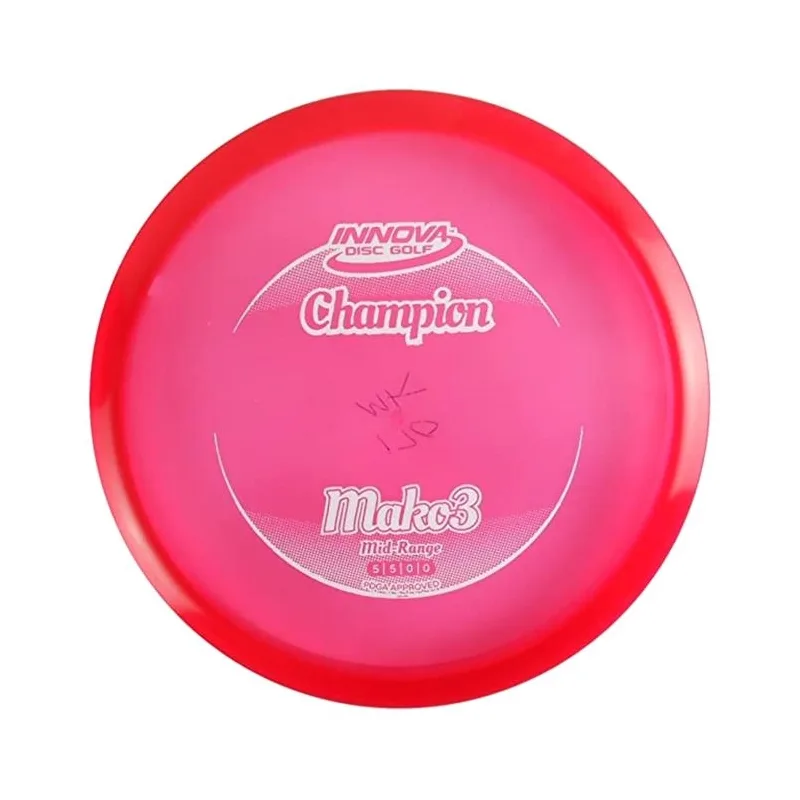
Innova Mako3
4.5/5$7 (DX) – $22 (Halo Star) approx. street price
Pros
- The straightest mid Innova makes; excellent for beginners and tunnels
Cons
- Almost no fade — less reliable in wind
Innova Mako3 (5/5/0/0) is the straightest midrange Innova makes and a great beginner mid — even less fade than the Buzzz, a touch more glide, and cheaper in DX. Its weakness is wind: with no fade to lean on, a gust takes it wherever it wants. If you are choosing between it and the Roc, their owner numbers disagree with the box in opposite directions: Roc vs Mako3 has both sets side by side.
For the broader brand context, see Innova vs Discraft; for how midranges fit in a bag, disc types explained.
Who should buy the Buzzz
Buy it if:
- You need a first midrange, or your only midrange.
- You want a disc that flies the same way at every skill level you’ll pass through.
- You throw forehand and want a mid that doesn’t wobble.
- You play wooded, technical courses where straight matters more than distance.
Look elsewhere if:
- You want a mid that fights wind and finishes hard (→ Roc, Buzzz OS).
- You want the absolute straightest tunnel disc (→ Mako3).
- You want a flat-topped mid; the Buzzz has a slight dome (→ Buzzz OS, Roc3).
Verdict
5.0/5The Buzzz is the rare disc that’s both the safe choice and the best choice. There is no player it’s wrong for and no plastic it’s bad in. Buy one in ESP, learn what a midrange is supposed to do, and you’ll understand why every guide — including our beginner set guide — keeps mentioning it.
How we evaluated this gear
We have not physically tested every product on this page. Ratings are based on manufacturer specifications, PDGA-approved flight data, and hundreds of aggregated owner reviews and community discussions (r/discgolf, retailer reviews, club forums). Where we describe how something "feels" or "flies", that reflects the consensus of experienced players, not a lab test. We update ratings when the consensus changes.