Discraft Zone Review: The Overstable Approach Disc That Ends Up in Everyone's Bag
Discraft Zone review: 4/3/0/3 flight, why it's the default forehand and headwind approach disc, which plastic to buy, Zone vs Zone OS vs Harp, and who shouldn't buy it.
This post contains affiliate links. If you buy through them we may earn a commission at no extra cost to you. Learn more.
Table of contents
Look in the bag of almost any intermediate or better disc golfer and you’ll find a Zone. Not because it’s easy — Discraft rates it “Advanced to Expert” and means it — but because it does one job that no straight putter or midrange can: it lands and stops, in wind, on a forehand, on a bad release, every time. This review covers how that flight works, which of Discraft’s dozen-plus Zone plastics to buy, how it compares with the Zone OS and Westside’s Harp, and why it’s the wrong disc for a beginner.
We haven’t tested the Zone for this review. It’s built from Discraft’s published specs, Infinite Discs’ 391 owner reviews (4.87/5 average, 90% five-star) and retailer listings, plus long-running forum consensus on how the mold flies in different plastics. Where we describe flight or feel, that’s aggregated owner reporting.
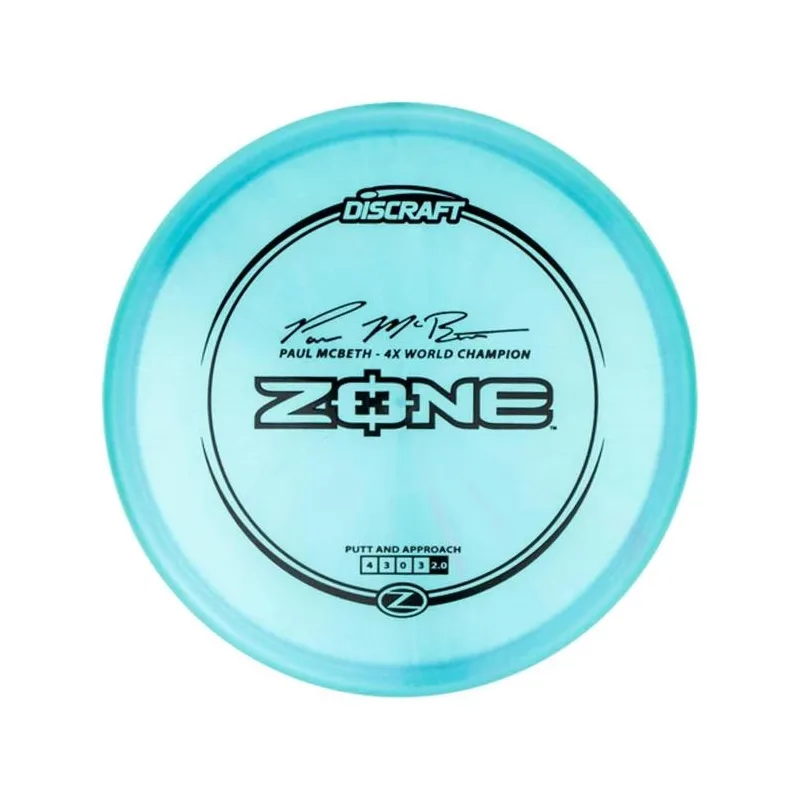
Discraft Zone
5.0/5$11 (Pro-D/Putter Line) – $25 (ESP/CryZtal/Titanium) approx. street price
- Flight numbers: 4 / 3 / 0 / 3
- Stability: Overstable (Discraft 2.0)
- Plastic options: Pro-D, Putter Line, Z, Z FLX, Big Z, ESP, ESP FLX, CryZtal, Jawbreaker, Rubber Blend, Titanium, Tour Series
- Skill level: Intermediate → pro
- Diameter: 21.1 cm
- Rim width: 1.2 cm
- Weights: 141–174 g
Pros
- 0 turn / 3 fade — the flight is the same on a bad release, in wind, or on a forehand
- Low profile and a thick 1.2 cm rim; the best forehand grip of any putter-class disc
- Rated 4.87/5 across 391 Infinite Discs reviews — 90% five stars
- Sold in every Discraft plastic; Z and ESP hold their stability for years
- Spike hyzers and skip shots that stop where you aim them
Cons
- Too overstable and low-glide for most players to putt with
- Beginners can't get it past ~200 ft — it just fades
- Beats in slowly, so it never becomes a straight disc
- Discraft's 'Advanced to Expert' skill rating is accurate
| Product | Our rating | Flight numbers | Stability | Skill level | Plastic options | Price | Buy |
|---|---|---|---|---|---|---|---|
| Best overstable approach disc Discraft Zone | 5.0/5 | 4 / 3 / 0 / 3 | Overstable (Discraft 2.0) | Intermediate → pro | Pro-D, Putter Line, Z, Z FLX, Big Z, ESP, ESP FLX, CryZtal, Jawbreaker, Rubber Blend, Titanium, Tour Series | $11 (Pro-D/Putter Line) – $25 (ESP/CryZtal/Titanium) | Check Price |
| When the Zone isn't enough Discraft Zone OS | 4.5/5 | 4 / 2 / 1 / 5 | Very overstable | Advanced → pro | Z, ESP, Z FLX | $18 – $22 | Check Price |
| Trilogy's Zone Westside Discs Harp | 4.5/5 | 4 / 3 / 0 / 3 | Overstable | Intermediate → pro | Origio, BT Hard, BT Medium, VIP, Tournament | $10 (Origio) – $25 (VIP/Tournament) | Check Price |
| What most people approach with instead Discraft Buzzz | 5.0/5 | 5 / 4 / -1 / 1 | Neutral | Beginner → pro | Pro D, X, Z, ESP, Big Z, Jawbreaker, CryZtal | $10 (Pro D) – $20 (ESP/Z) | Check Price |
Specs
| Discraft Zone | |
|---|---|
| Flight numbers | 4 / 3 / 0 / 3 (Discraft stability 2.0) |
| Class | Putter / approach, overstable |
| Diameter | 21.1 cm |
| Rim width | 1.2 cm |
| Height | 2.0 cm |
| Weights | 141–174 g |
| Plastics | Pro-D, Putter Line, Z, Z FLX, Big Z, ESP, ESP FLX, CryZtal, Jawbreaker, Rubber Blend, Titanium, Tour Series, plus special runs |
| Skill level (Discraft) | Advanced to Expert |
| Price | $11 (Pro-D/Putter Line) to $25 (premium runs), September 2026 |
Sources: Discraft, Infinite Discs.
How the Zone flies
Discraft’s own description is that the Zone is “an overstable putter excelling in headwinds with reliable fade,” and the owner reviews say the same thing in a hundred different ways: “good for headwinds, strategic fades, forehand throws, flick putts.” Thrown flat with moderate power it goes straight for a short stretch, then fades left (right-hand backhand) and lands without much skip or roll because the glide is low and the profile is flat. Thrown on a hyzer it’s a spike that lands nearly vertical and stays. Thrown on an anhyzer it flexes back to flat and finishes left anyway.
What it doesn’t do is turn. Zero turn on a 4-speed means there’s no arm speed most players have that will make it drift right, and 3 fade means it’s always coming back. That’s why the Zone is the disc for the shots where the miss matters more than the make: the 200 ft approach with water right, the upshot into a headwind, the forehand around a tree. A Buzzz might fly the line better; the Zone will never fly the wrong line.
The cost is distance and touch. Owners consistently report 200–280 ft on a flat backhand and note that beginners can’t get it past 150–200 ft, because the fade starts before the disc has any speed. A Buzzz or a Judge will go farther and land softer for a slower arm. This is why the Zone is a second- or third-year disc, not a starter-set disc.
Forehand: the reason most people buy it
Ask why the Zone is in so many bags and the first answer is forehand. The thick, low rim fits a sidearm grip like nothing else in the putter class, and the flight numbers cancel out the forehand’s built-in flaw: the off-axis wobble that flips understable discs over. A Zone thrown forehand with wobble still just fades. Pros carry it specifically for 150–250 ft forehand approaches, and intermediate players who learn forehand with a Zone tend to learn it faster because the disc forgives the wobble while they fix it.
Which plastic?
Discraft makes the Zone in more plastics than almost any disc, and the choice matters more here than for a midrange, because the point of a Zone is that it stays overstable.
- Z / Big Z ($17–$20): the default. Durable, holds its stability for years, grippy enough for most conditions. If you buy one Zone, buy this.
- ESP ($17–$22): slightly softer and grippier than Z, beats in a little faster. Preferred by players who want more feel in the hand.
- Jawbreaker / Rubber Blend ($15–$20): soft, tacky blends. Superb in cold, wet weather; wear faster and run a hair less overstable.
- Z FLX / ESP FLX ($17–$22): flexible versions that absorb impact and stick landings — a favorite for spike hyzers and wooded courses.
- Pro-D / Putter Line ($11): base plastic. Great feel new, beats in within a season into a less overstable disc. Fine for a first Zone or a “seasoned” second one; not what you want if you need the flight to stay put.
- CryZtal, Titanium, Tour Series ($20–$25): premium versions of the Z/ESP flight, usually a touch more stable, often with pro signature stamps.
How it beats in
Unlike a Leopard or a DX Teebird, a Zone in premium plastic changes slowly, and it changes in a useful direction. A new Z or ESP Zone is at its most overstable — some owners find a fresh one almost too much on calm days. After a season of tree hits it loses a little fade and gains a little glide, becoming the “seasoned Zone” that many players consider the best version: still zero turn, still reliable in wind, but with enough carry to reach 250 ft on a flat throw. It never becomes straight. That’s why a lot of experienced players carry two: a fresh one for wind and spike hyzers, and a beat one for touch approaches. Base-plastic Zones (Pro-D, Putter Line) make that journey in months rather than years.
The Zone family and its rivals
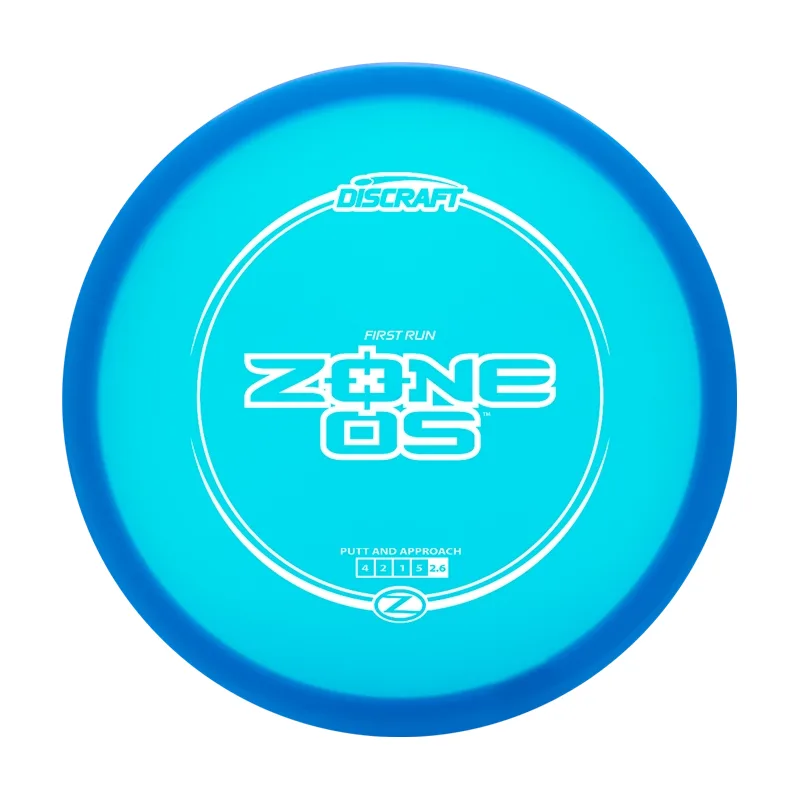
Discraft Zone OS
4.5/5$18 – $22 approx. street price
Pros
- 4/2/1/5 — the Zone with more fade and less glide, for big arms and big wind
Cons
- Overkill for most players; sold only in premium plastics
Zone OS (4/2/1/5) is the answer to “my Zone isn’t overstable enough.” Less glide, more fade, and enough resistance to hold in a gale or under a 400 ft arm. It’s a second-Zone purchase; most players will find it too much.
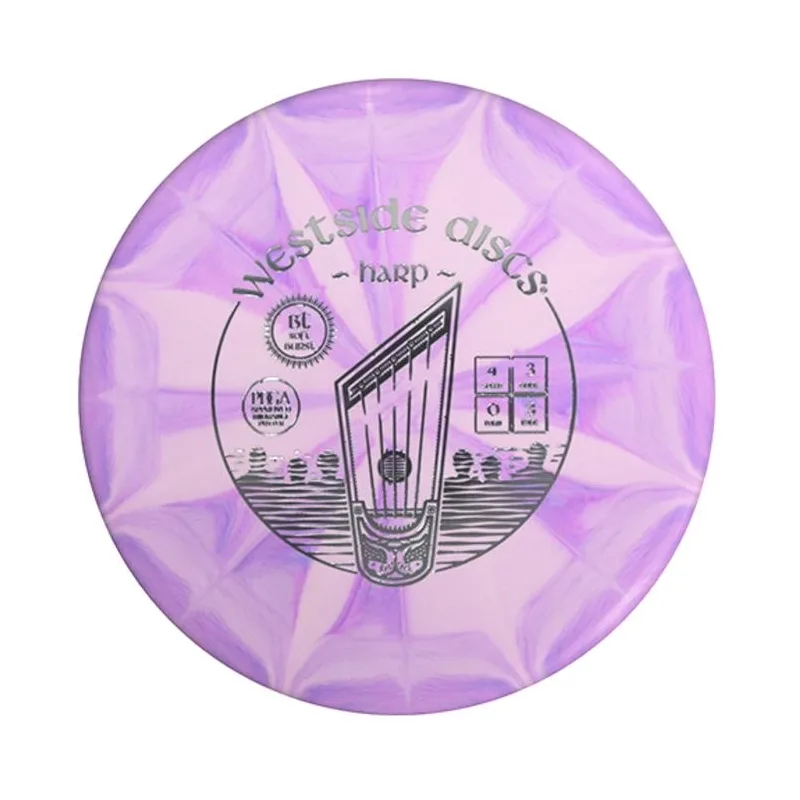
Westside Discs Harp
4.5/5$10 (Origio) – $25 (VIP/Tournament) approx. street price
Pros
- Same 4/3/0/3 numbers, but 4 mm shorter with a deeper beaded rim that some hands prefer
Cons
- Fewer plastic runs than the Zone; harder to find in shops
Westside Harp (4/3/0/3) is the Trilogy (Dynamic Discs / Latitude 64 / Westside) equivalent: identical numbers, and not an identical disc. Infinite Discs lists the Harp at 1.6 cm tall against the Zone’s 2.0 cm, with a deeper rim (1.4 cm against 1.3 cm) and a bead the Zone does not have. Players who find the Zone sits too tall in the hand often prefer the Harp; players who forehand a lot usually prefer the Zone’s wider rim. Same job, different feel — we put both sets of dimensions and owner numbers side by side in Zone vs Harp.
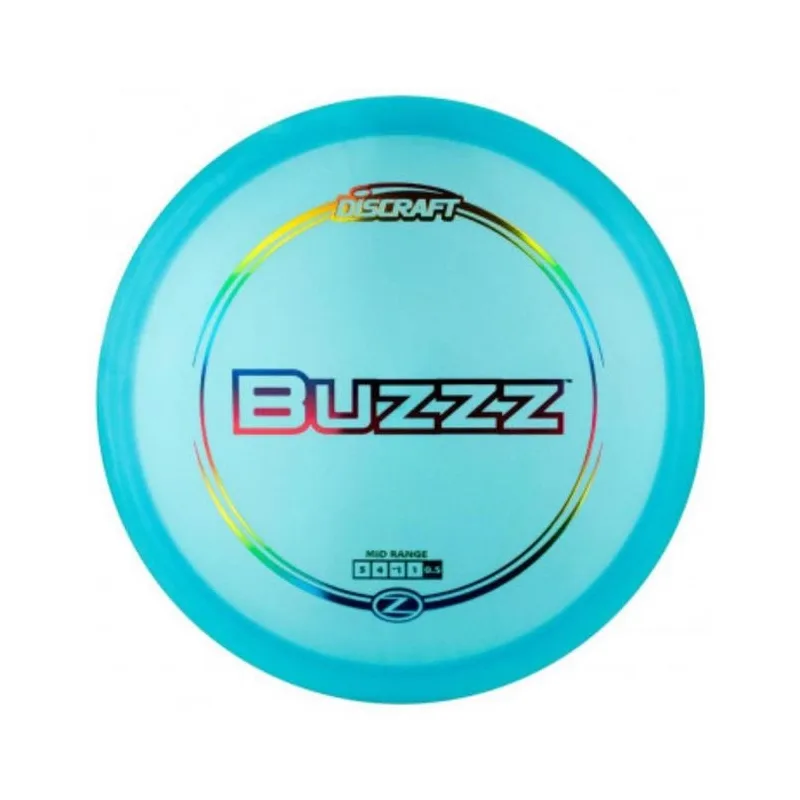
Discraft Buzzz
5.0/5$10 (Pro D) – $20 (ESP/Z) approx. street price
Pros
- 5/4/−1/1 — straight, glidey and forgiving at any arm speed
Cons
- Turns over in a headwind; doesn't stop on landing like a Zone
Discraft Buzzz (5/4/−1/1) is what most players approach with before they own a Zone, and it’s the disc to buy first — straight, glidey and forgiving at any arm speed. The Zone is what you add when you need a shot to stop. Our Buzzz review covers the other half of the pairing.
Who should buy the Zone
Buy it if:
- You throw forehand, or want to learn — it’s the standard forehand approach disc.
- You play in wind and need an upshot that doesn’t flip.
- You have a straight putter and a midrange and want the “stops where it lands” disc to complete the short game.
- You want a disc that will still fly the same in five years — buy Z or ESP.
Look elsewhere if:
- You’re a beginner (→ the putter and midrange in our beginner sets guide, then a Buzzz).
- You want a putter to putt with (→ Aviar, Judge; see Aviar vs Judge).
- You want glide and distance from a putter-class disc (→ Judge, Luna, Buzzz).
Verdict
5.0/5The Zone gets five stars for the same reason the Teebird and the Buzzz do: it defines a category, and years of imitators haven’t displaced it. It isn’t a beginner disc and it isn’t a putting putter, and it’s honest about both. What it is — the overstable, forehand-friendly, wind-proof approach disc — it is better than anything else at the price. If you’re sorting out what a “putter/approach” disc even is, our disc types guide explains where the Zone sits; if you’re weighing Discraft’s lineup against Innova’s, Innova vs Discraft has the full comparison.
How we evaluated this gear
We have not physically tested every product on this page. Ratings are based on manufacturer specifications, PDGA-approved flight data, and hundreds of aggregated owner reviews and community discussions (r/discgolf, retailer reviews, club forums). Where we describe how something "feels" or "flies", that reflects the consensus of experienced players, not a lab test. We update ratings when the consensus changes.