Dynamic Discs Judge Review: The Beaded Putter That Made Dynamic Discs
The Dynamic Discs Judge (2/4/0/1) is one of the best-selling putters in disc golf. Flight, the bead, Classic vs Lucid plastics, the EMAC Judge, and Judge vs Aviar.
This post contains affiliate links. If you buy through them we may earn a commission at no extra cost to you. Learn more.
Table of contents
Dynamic Discs was a retailer in Emporia, Kansas before it was a disc maker, and the Judge — PDGA approved December 7, 2012, one of the company’s first molds — is the disc that made the transition work. It won the Player’s Choice Disc of the Year for 2013, became the putter in DD’s starter set, and is now one of a small handful of putters that show up in bags at every level of the sport.
This review covers the flight, the bead (which is the whole conversation with this disc), the plastics, and how it stacks up against the Innova Aviar it’s most often compared to.
We haven’t run a controlled test on the Judge. The flight and feel descriptions below are built from Dynamic Discs’ published flight data, PDGA specs, and the large body of owner reviews and forum discussion around one of the most-thrown putters of the last decade.
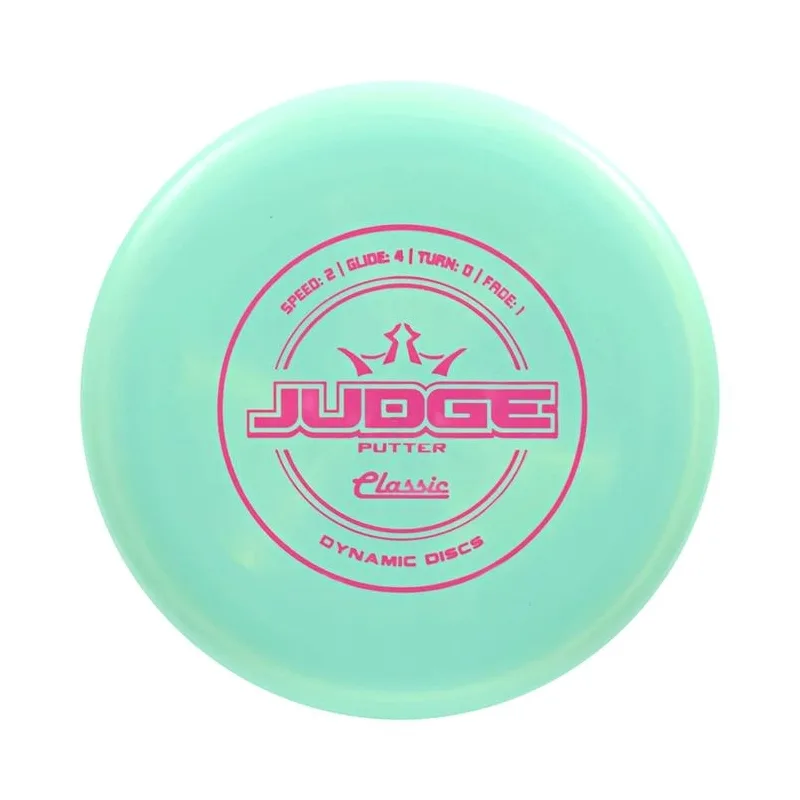
Dynamic Discs Judge
4.5/5$10 (Classic) – $18 (Lucid) approx. street price
- Flight numbers: 2 / 4 / 0 / 1
- Rim: Beaded, medium depth
- Plastic options: Classic, Classic Blend, Classic Soft, Prime, Lucid, Fuzion
- Feel: Deep, beaded, grippy
Pros
- Ultra-straight flight with more glide (4) than the Aviar — reaches the basket on soft putts
- Large bead gives a locked-in, repeatable grip for many players
- Available in Classic, Classic Blend, Classic Soft, Prime, Lucid, Fuzion and more
- 2013 Player's Choice Disc of the Year; a putter you won't outgrow
Cons
- The bead is a deal-breaker for some grips — try before committing to three
- Extra glide can carry a firm putt past the basket on downhill shots
- Slightly less predictable than the Aviar in strong headwinds
| Product | Our rating | Flight numbers | Rim | Plastic options | Feel | Price | Buy |
|---|---|---|---|---|---|---|---|
| Best beaded putter Dynamic Discs Judge | 4.5/5 | 2 / 4 / 0 / 1 | Beaded, medium depth | Classic, Classic Blend, Classic Soft, Prime, Lucid, Fuzion | Deep, beaded, grippy | $10 (Classic) – $18 (Lucid) | Check Price |
| Beadless alternative Innova Aviar Putt & Approach | 4.5/5 | 2 / 3 / 0 / 1 | Beadless, medium depth | DX, Pro, R-Pro, Star, Champion | Neutral | $9 (DX) – $17 (Star/Champion) | Check Price |
| Same feel, less bead Dynamic Discs EMAC Judge | 4.5/5 | 2 / 4 / 0 / 1 | Microbead | Classic Blend, Lucid, Fuzion (varies by run) | Slightly flatter, smaller bead | $12–$19 | Check Price |
Specs
| Dynamic Discs Judge | |
|---|---|
| Type | Putt & approach |
| Flight numbers | 2 / 4 / 0 / 1 |
| Rim | Beaded (large bead), medium depth |
| Diameter | 21.1 cm |
| Weights | 170–176 g most common |
| Plastics | Classic, Classic Blend, Classic Soft, Classic Supreme, Prime, Lucid, Fuzion, BioFuzion, tour series |
| PDGA approved | December 7, 2012 |
| Award | 2013 Player’s Choice Disc of the Year |
How the Judge flies
The Judge’s flight is best described relative to the Aviar, because that’s the comparison every buyer makes. Both are straight, stable putters with a 0 turn and 1 fade. The difference is glide: the Judge’s 4 versus the Aviar’s 3.
Inside the circle: dead straight, with a touch more float. A putt released a little soft still gets there; a putt released a little hard carries a little farther. Owners who switch from an Aviar typically describe the first few sessions as “putting long” until they adjust.
Long putts and approaches: this is where the glide pays off. The Judge holds a line for 40–60 m with a very soft finish and lands with less skip than firmer putters. It’s a genuinely good throwing putter — many players use a Lucid Judge off the tee on short holes.
In wind: adequate. The extra glide means a headwind lifts it slightly more than an Aviar; in a real gale most Judge throwers reach for something more overstable, such as a Discraft Zone or an Innova Aviar3.
Consistency: the trait owners praise most. The Judge does the same thing every time, and Dynamic Discs’ plastics are consistent from run to run — an underrated point for a disc you’ll buy three of.
The bead
Every review of the Judge is really a review of its bead — the raised ring on the bottom edge of the rim. What it does:
- Gives your fingers something to hold. For many players, particularly those who putt with a fan or modified fan grip, the bead makes the release more repeatable. That’s the whole appeal.
- Changes the feel of the release. Some players find the bead catches on their index finger and produces a nose-up or wobbly release. Those players don’t adjust; they switch discs.
There’s no way to know which group you’re in without throwing one. The good news is that the Judge in Classic plastic costs about $10. Buy one before you buy three.
If you like the Judge’s flight and hate the bead, Dynamic Discs has two answers: the EMAC Judge (Eric McCabe’s signature run with a microbead — see below) and the Warden (2/4/0/0.5), a beadless putter with a near-identical flight.
Which plastic?
| Plastic | Feel | Durability | Best for |
|---|---|---|---|
| Classic | Firm-ish, grippy | Low-medium | Putting; the classic Judge feel |
| Classic Blend | Softer, tacky | Medium | Putting — the most popular choice |
| Classic Soft | Very soft, floppy | Medium | Players who like a gummy putter |
| Prime | Base, grippy | Low | Starter set; budget |
| Lucid | Firm, translucent | High | Throwing putter; tree hits |
| Fuzion | Firm, opaque, grippy | High | Throwing putter with more grip than Lucid |
| BioFuzion | Like Fuzion, recycled blend | High | Same use, greener |
Consensus: Classic Blend for the circle, Lucid or Fuzion for the tee. Prime is what comes in the starter set and is a fine first putter, but it beats in fast. As with any putter, buy multiples in one plastic — Classic and Lucid Judges feel like different discs.
The EMAC Judge
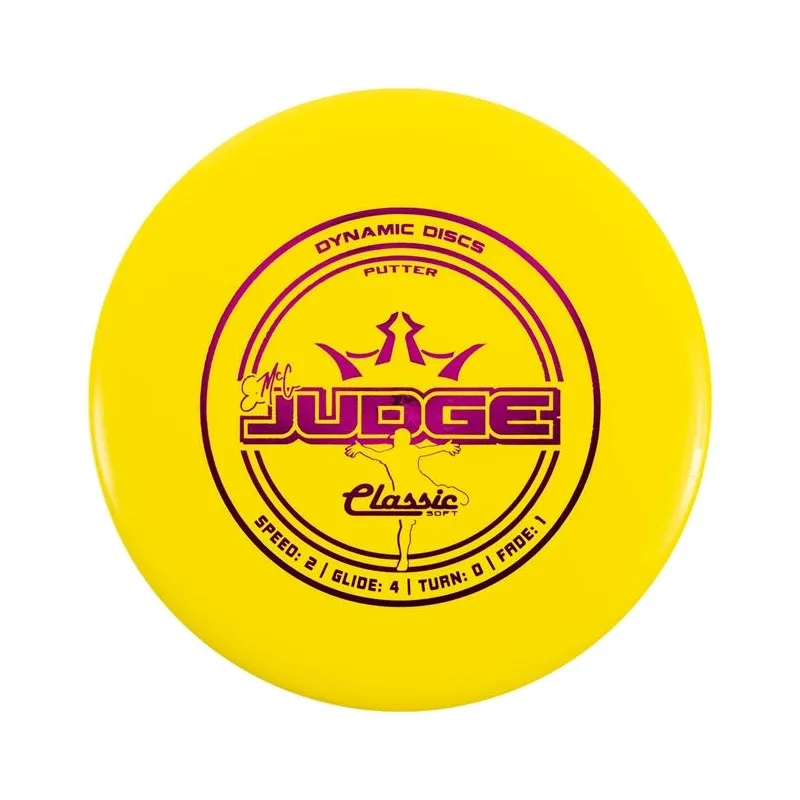
Dynamic Discs EMAC Judge
4.5/5$12–$19 approx. street price
Pros
- Eric McCabe's signature Judge with a microbead — the Judge for players who dislike a big bead
Cons
- Fewer plastics and runs than the standard Judge
Eric McCabe’s signature Judge is the same flight (2/4/0/1) with a microbead instead of the standard large bead and a slightly flatter profile. It’s the answer for players who want the Judge’s glide and feel without the full bead, and owner reviews suggest it converts a lot of bead-skeptics. It’s produced in fewer plastics and runs, so availability varies.
Alternatives
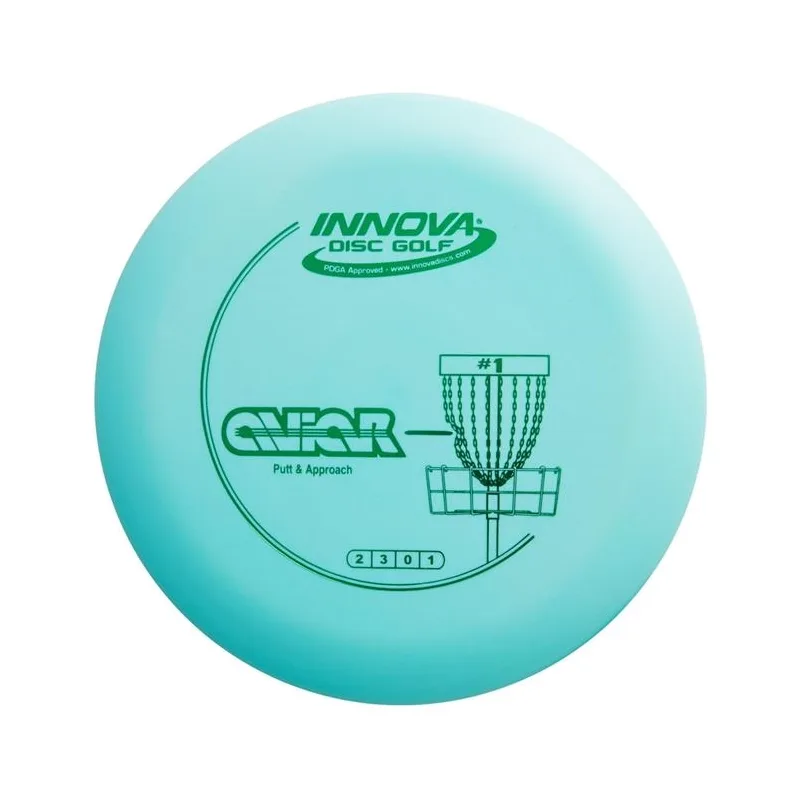
Innova Aviar Putt & Approach
4.5/5$9 (DX) – $17 (Star/Champion) approx. street price
Pros
- Beadless neutral rim; straight and predictable; cheaper
Cons
- Less glide than the Judge
Innova Aviar (2/3/0/1) — beadless, neutral, a bit less glide, a couple of dollars cheaper, and the most widely available putter in the sport. Straighter in wind; shorter on soft putts. If the bead doesn’t work for you, this is where you go. Full Aviar review and the direct Aviar vs Judge comparison.
Who should buy the Judge
Buy it if:
- You like, or don’t mind, a beaded rim.
- You want a putter with enough glide to reach the basket on soft putts and to throw off the tee.
- You came from the Dynamic Discs starter set and want the same putter in better plastic.
- You want a putter you can buy in five plastics and never change.
Look elsewhere if:
- Beads annoy your release (→ Aviar, Warden, EMAC Judge).
- You play windy, open courses (→ Discraft Luna, Aviar3, Zone for approaches).
- You want the cheapest possible practice putters (→ DX Aviar, by a dollar or two).
Verdict
4.5/5The Judge is one of the two or three putters that can honestly be recommended to anyone, and for players who like a bead it’s arguably the best of them. The bead is the only reason it isn’t universal, and the EMAC Judge and Warden exist to cover that gap. Buy one in Classic Blend, putt with it for a week, and you’ll know. For where it fits in a first set, see best beginner disc golf sets.
How we evaluated this gear
We have not physically tested every product on this page. Ratings are based on manufacturer specifications, PDGA-approved flight data, and hundreds of aggregated owner reviews and community discussions (r/discgolf, retailer reviews, club forums). Where we describe how something "feels" or "flies", that reflects the consensus of experienced players, not a lab test. We update ratings when the consensus changes.