Dynamic Discs Judge vs Discraft Luna: Same Rim, Different Flight
Judge vs Luna: identical rim depth, width and height, a millimetre apart in diameter. The bead and the flight decide it, and owners disagree with one of the numbers.
This post contains affiliate links. If you buy through them we may earn a commission at no extra cost to you. Learn more.
Table of contents
The Judge and the Luna are the two putters players most often cross-shop once they have decided the Aviar is not for them. One is the disc that built Dynamic Discs and sits in their starter set; the other is the putter Paul McBeth co-designed and actually putts with. They are usually described as opposites.
They are not. Measured, they are almost the same disc.
Infinite Discs publishes dimensions for every mould it sells, and the two sets are nearly identical: 1.4 cm rim depth, 1.1 cm rim width, 2.0 cm height and a 176 g maximum on both, with a single millimetre between them in diameter. Whatever separates these putters, it is not the size or the shape of the thing you are holding. It is the bead, and it is the flight — and on the flight, the published numbers and the owners’ numbers do not say the same thing.
| Product | Our rating | Flight numbers | Owner flight numbers | Rim | Plastic options | Price | Buy |
|---|---|---|---|---|---|---|---|
| Best for most putting strokes Dynamic Discs Judge | 4.5/5 | 2 / 4 / 0 / 1 | 2 / 4 / 0 / 0.9 (242 Infinite Discs reviews) | Beaded, medium depth | Classic, Classic Blend, Classic Soft, Prime, Lucid, Fuzion | $10 (Classic) – $18 (Lucid) | Check Price |
| Best for firm putters and wind Discraft Luna (Paul McBeth) | 4.5/5 | 3 / 4 / 0 / 2 (Discraft, updated) | 3 / 3.2 / -0.2 / 2 (139 Infinite Discs reviews) | Beadless, 1.1 cm, flat top | Rubber Blend, Putter Line, Jawbreaker, ESP, Z, Big Z, CryZtal, Tour Series | $13 (Putter Line) – $28 (Tour Series) | Check Price |
The dimensions nobody compares
Putter comparisons almost always get written from flight numbers and feel, because those are what the marketing gives you. The dimensions are published too, and here they settle an argument.
| Judge | Luna | |
|---|---|---|
| Diameter | 21.2 cm | 21.1 cm |
| Height | 2.0 cm | 2.0 cm |
| Rim depth | 1.4 cm | 1.4 cm |
| Rim width | 1.1 cm | 1.1 cm |
| Max weight | 176 g | 176 g |
| Bead | Beaded | Beadless |
Infinite Discs product pages, read 8 October 2026.
One honest caveat before anyone treats that as proof the discs feel the same: published dimensions are rounded to the millimetre, and two putters that match on a spec sheet can still sit differently in the hand, because the shape of the rim between those measurements is not captured by any of them — and because one of them has a bead. What the table does rule out is the common claim that one of these is a chunkier or deeper putter than the other. They are the same depth and the same width, to the tenth of a centimetre.
The one number the owners disagree with
This is the part worth the most to you, and it comes from a quirk of Infinite Discs’ product pages: they publish the manufacturer’s flight numbers and the average of their own reviewers’ numbers, side by side.
| Manufacturer | Owners | Reviews | |
|---|---|---|---|
| Judge | 2 / 4 / 0 / 1 | 2 / 4 / 0 / 0.9 | 242 |
| Luna | 3 / 4 / 0 / 2 | 3 / 3.2 / −0.2 / 2 | 139 |
The Judge’s owners agree with the box. Four glide published, four glide reported; a tenth of a point off on fade, which is noise. Dynamic Discs described this disc accurately.
The Luna’s owners agree on everything except glide, where they come in at 3.2 against a published 4. That is not a rounding difference, it is a fifth of the rating. And it is the one number that quietly decides whether you like a putter, because glide is what carries a putt the last two metres when you throw it slightly soft.
It is also what Infinite Discs’ own copy says in words: they call the Luna a “low-glide, beadless putter for players who putt with a lot of confidence.” The retailer selling it describes it as low-glide while the box says it glides the same as a Judge.
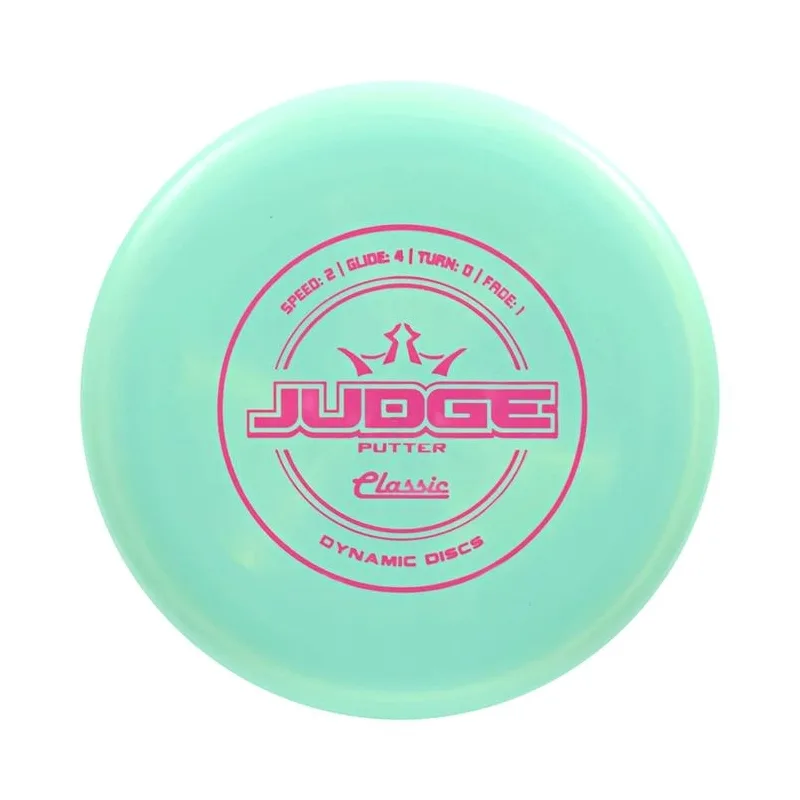
Dynamic Discs Judge
4.5/5$10 (Classic) – $18 (Lucid) approx. street price
- Flight numbers: 2 / 4 / 0 / 1
- Owner flight numbers: 2 / 4 / 0 / 0.9 (242 Infinite Discs reviews)
- Rim: Beaded, medium depth
- Plastic options: Classic, Classic Blend, Classic Soft, Prime, Lucid, Fuzion
- Feel: Deep, beaded, grippy
- Diameter: 21.2 cm
- Height: 2.0 cm
- Rim depth: 1.4 cm
- Rim width: 1.1 cm
Pros
- Owners confirm the box — 242 Infinite Discs reviews average 2/4/0/0.9 against a published 2/4/0/1
- Four glide is what carries a soft putt the last two metres into the chains
- The only one of the two sold in a basic, cheapest-tier plastic
- Highest-rated of the pair at Infinite Discs, 4.68 from 242 reviews
Cons
- The bead is a deal-breaker for some grips, and you cannot tell from a photo
- Less fade means less help holding a line into a headwind
- Extra glide can carry a firm putt long on a downhill basket
Putting: glide does the work
Put the two sets of numbers together and the practical difference is simple. A putt that leaves your hand a little soft keeps travelling with a Judge and drops with a Luna.
That is why the Judge is the easier putter to learn with, and it has nothing to do with the Judge being more forgiving in some vague way. It is one specification doing one job. New players are not short of power so much as short of consistency, and the putt that costs them strokes is the one thrown fractionally soft from fifteen feet. Four glide covers for that. Three point two does not.
The Judge is also the better-liked disc of the two among the people who bought them: 4.68 out of 5 across 242 reviews, against the Luna’s 4.45 across 139. Both are high. The gap is small and the sample is not a controlled trial, but it points the same way as everything else here.
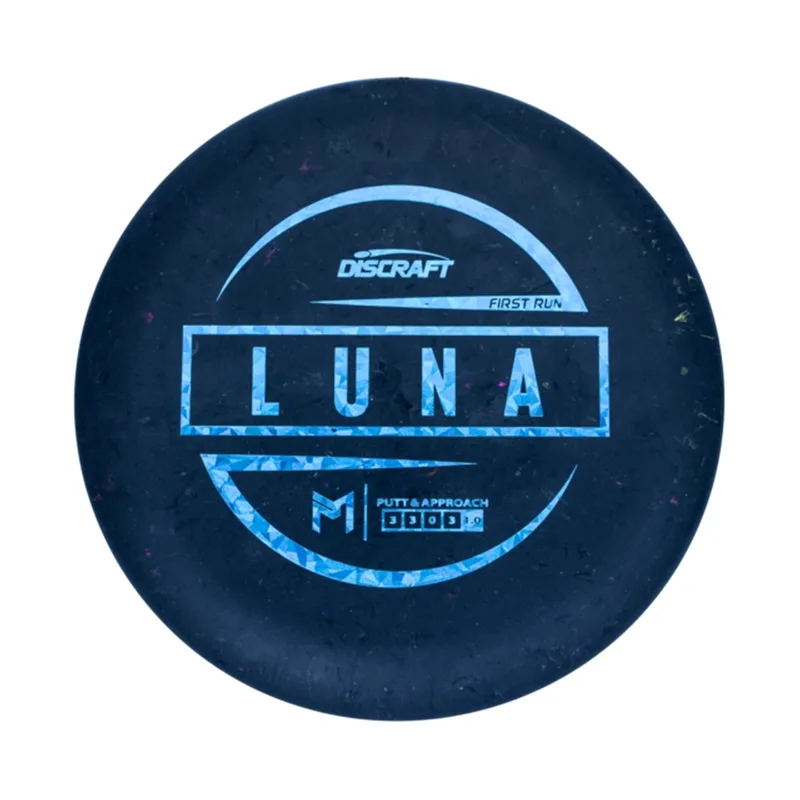
Discraft Luna (Paul McBeth)
4.5/5$13 (Putter Line) – $28 (Tour Series) approx. street price
- Flight numbers: 3 / 4 / 0 / 2 (Discraft, updated)
- Owner flight numbers: 3 / 3.2 / -0.2 / 2 (139 Infinite Discs reviews)
- Rim: Beadless, 1.1 cm, flat top
- Plastic options: Rubber Blend, Putter Line, Jawbreaker, ESP, Z, Big Z, CryZtal, Tour Series
- Feel: Flat, firm, tacky in Rubber Blend
- Diameter: 21.1 cm
- Height: 2.0 cm
- Rim depth: 1.4 cm
- Rim width: 1.1 cm
Pros
- Twice the fade of a Judge, and owners agree with that number exactly
- Flat beadless top is the better shape for throwing a putter off the tee
- Holds a line in a headwind that pushes a straighter putter around
- Paul McBeth's own putter, in more than 40 plastic variants
Cons
- Published glide is 4; 139 owners rate it 3.2, and soft putts drop early because of it
- No basic-tier plastic, so the cheapest Luna costs more than the cheapest Judge
- Flat beadless rim gives less to hook a finger against on a firm grip
- Discraft revised the flight numbers after release, so older listings disagree
Wind and tee shots: the Luna’s case
The Luna is not the lesser putter. It is a different one, and there are two situations where it is clearly the right disc.
Wind. Two fade against one is the biggest flight difference between them, and unlike the glide, this is a number owners confirm exactly. A headwind makes every disc act more overstable and pushes a straight putter off its line; the Luna is built to finish left anyway, so the wind is working with the disc instead of against your aim. If your home course is open and windy, this alone can decide it.
Throwing it. A flat, beadless top is the easier shape to grip hard, and the extra fade gives an approach shot a predictable finish instead of a long, drifting fade-out. McBeth did not design a putter he only putts with. The Judge throws perfectly well — plenty of players drive with one — but if you want one putter in the bag that does both jobs, the Luna is shaped for it.
The bead, and why nobody can decide it for you
The bead is a small ridge running under the outer rim. The Judge has a large one; the Luna has none.
There is no better or worse here, and anyone who tells you otherwise is describing their own hand. Some players hook a finger against the bead and find their grip becomes repeatable overnight. Others find it catches on release and sends putts sideways. You cannot tell which you are from a photograph, a review or a flight number.
What this means practically: buy one of each before buying three of either. Both are cheap enough that a two-disc experiment costs less than a round of golf, and this is the single variable that most affects whether you keep putting with a disc a year from now.
Plastics and price
Both are sold in a wide range, and the rule is the same for both: soft and grippy for putting, firm and durable for throwing.
- Judge: Classic Blend for putting, Lucid for throwing. Infinite Discs list it from $9.99 to $24.99.
- Luna: Rubber Blend for putting, ESP or Z for throwing. Infinite Discs list it from $12.95 to $27.99.
There is one structural difference worth knowing. Infinite Discs categorise the Judge’s plastics as Basic, Midgrade, Durable and Premium, and the Luna’s as Midgrade, Durable and Premium only. There is no cheap Luna. On Amazon on 8 October 2026 the Prime Burst Judge was $11.99 and the ESP Luna $21.99 — both in stock, both rated 4.8.
That matters more for a putter than for any other disc, because putters are the one slot where you want three identical discs rather than one. Three Judges is a $36 decision; three ESP Lunas is a $66 one.
Which one should you buy?
Buy the Judge if you are still building a putting stroke, you putt from inside twenty feet most of the time, you like a bead or have never tried one, or you want three matching putters without spending much. It is the safer first putter and the cheaper experiment.
Buy the Luna if you already putt firm and flat, your course is windy, you want a putter you will also throw off the tee, or you have tried a beaded rim and did not get on with it. Its lower real glide is a feature when you putt with pace, because the disc stops where you aimed it instead of drifting.
Buy neither if you are completely new to the sport and have not tried an Aviar — it is cheaper than both, more forgiving than either, and the disc both of these were designed as alternatives to.
Our pick
The Judge, for most people. Not because it is the better disc in the abstract, but because the gap between what it claims and what owners report is almost zero, and that is the most useful thing you can know about a putter you have not thrown. It costs less, it comes in a cheap plastic, and its four glide does real work on the putt that new players actually miss.
The Luna is the better putter for a confident stroke in wind, and it is the better disc to throw. If you already know you putt firm, buy it and do not look back — just buy it knowing that its glide behaves closer to a three than a four, whatever the box says.
Both are covered in more depth in our Dynamic Discs Judge review and Discraft Luna review, and if you are choosing a first putter rather than a second, start with Aviar vs Judge.
How we evaluated this gear
We have not physically tested every product on this page. Ratings are based on manufacturer specifications, PDGA-approved flight data, and hundreds of aggregated owner reviews and community discussions (r/discgolf, retailer reviews, club forums). Where we describe how something "feels" or "flies", that reflects the consensus of experienced players, not a lab test. We update ratings when the consensus changes.