MVP Black Hole Lite Review: The Basket Most People Should Buy First
MVP Black Hole Lite review: 24 chains, 24 lb, regulation size, $100–$130. What the light-duty chains cost you, and where the bare basket is actually cheapest.
This post contains affiliate links. If you buy through them we may earn a commission at no extra cost to you. Learn more.
Table of contents
Of MVP’s four Black Hole baskets, three have had a review on this site and the one most people actually buy has not. This fixes that.
The Black Hole Lite is the budget pick in our portable baskets guide, and the reason is simple: it keeps the geometry and drops the metal. Twenty-four chains in two tiers, 12 outer and 12 inner, on a regulation-height cage with a 25.5″ band — the same arrangement as the Black Hole Pro — with 6 mm wire, welded all-metal construction and the same one-minute, no-tools assembly. What it gives up is chain weight and band height. At 24 lb it is also the lightest full-size basket MVP makes, which turns out to matter more than the spec sheet suggests.
Two things about buying it have changed recently and both are worth knowing before you click anything. It now costs the same as the Black Hole Practice, which removes the only reason anyone bought the Practice. And on Amazon it is not sold on its own at all.
| Product | Our rating | Chains | Header band | Weight | PDGA approved | Price | Buy |
|---|---|---|---|---|---|---|---|
| Best budget MVP Black Hole Lite | 4.5/5 | 24 (12 outer / 12 inner), light duty | 1.25″ | 24 lb | No | $100–$125 | Check Price |
| Best overall MVP Black Hole Pro | 5.0/5 | 24 (12 outer / 12 inner), heavy duty | 2″ | 30 lb (35.5 lb boxed) | Yes | $135–$170 | Check Price |
| Cheapest 24-chain basket MVP Black Hole Practice | 4.0/5 | 24 (12 outer / 12 inner), light duty | None | ~24 lb | No | $100–$120 | Check Price |
What light-duty chains actually change
A basket catches a putt by absorbing its energy. Heavy, course-weighted chains absorb more; light chains absorb less and swing further out of the way. The practical result is that a firm putt which a course basket would swallow can pass through a light-chain basket, and a soft putt that would drop can rattle out.
That sounds damning and mostly isn’t, because of who buys this basket. If you are practising 5 to 10 metre putts in a garden — which is what most people with a practice basket are doing — you are not throwing hard enough for the difference to show up often. If you are drilling 10 metre putts at full pace, or you want the basket to tell you the truth about how hard you can hit it, you want the Black Hole Pro and its course-weighted chains.
The 1.25″ header band is the other half of it, and it is the more visible one. A course target has a tall band that turns a putt arriving high into a drop. The Lite’s band is shorter than the Pro’s 2″, so more of those skim over the top. You notice it on putts you thought were good.
What the Lite does not compromise is the part that teaches you anything: height, cage diameter, chain count and the two-tier layout. Practice on it transfers, which is more than can be said for the $60 baskets it sits above.
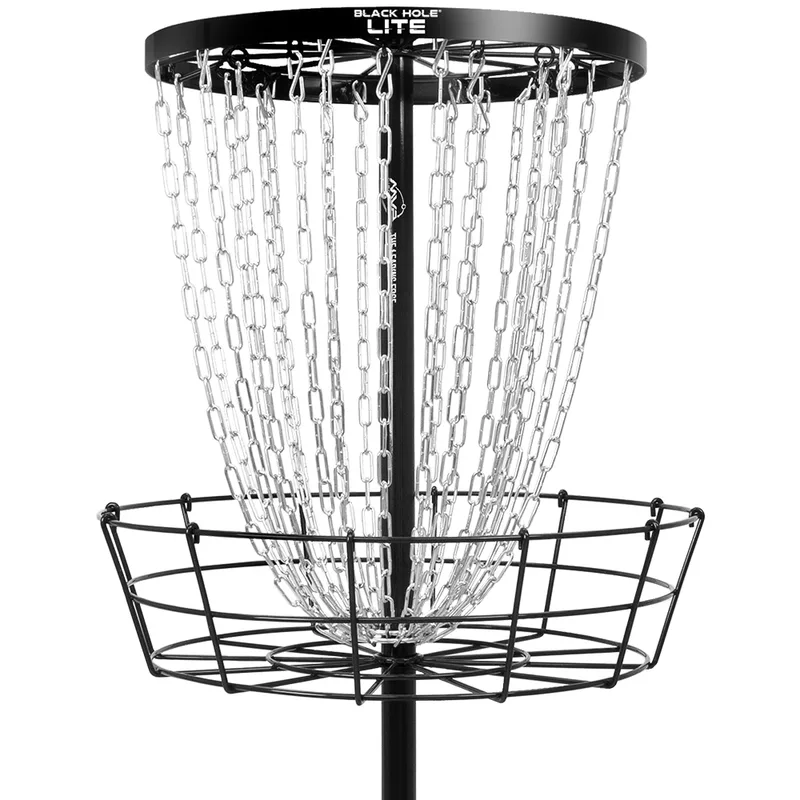
MVP Black Hole Lite
4.5/5$100–$125 approx. street price
- Chains: 24 (12 outer / 12 inner), light duty
- Header band: 1.25″
- Weight: 24 lb
- PDGA approved: No
Pros
- Same 24-chain two-tier layout and regulation geometry as the Black Hole Pro
- 24 lb — the lightest full-size metal basket MVP makes, so it actually moves
- Welded all-metal, one-minute tool-free assembly, 6 mm wire
- Costs the same as the band-less Black Hole Practice, which makes the choice easy
Cons
- Light-duty chains — firm putts cut through more often than on a course basket
- 1.25″ header band against the Pro's 2″, so high putts slide off more
- Not PDGA approved for sanctioned play
- Amazon lists the bare basket and the bundle separately, $30 apart, and it is easy to land on the wrong one
24 lb is the feature nobody lists
The Lite is six pounds lighter than the Pro and sixteen lighter than a Chainstar Lite, and that is the difference between a basket that lives where you first put it and one that moves.
It sounds trivial written down. In practice it decides how much you use the thing. A 24 lb basket gets carried to the far end of the garden for a different sight line, into the garage when the forecast turns, into a car boot for a session at the park with someone. A 40 lb basket with no carry bag does none of that, and ends up in one spot facing the same direction for a year.
For a basket whose whole job is to get used, being easy to move is not a minor spec. It is arguably why this is the right first basket rather than the Pro.
We have not putted at this basket. What we can check is that MVP, Infinite Discs and the Amazon listings agree on the specification, and that owner ratings are strong across all of them — 4.8 from 1,433 on the bare Amazon listing and 4.9 from 664 on the bundle.
The cost of being light
It would be dishonest to call 24 lb a feature and stop there, because the same property is this basket’s main weakness.
A lighter basket is easier to tip. On a slope, in wind, or when a disc hits the cage off-centre at pace, the Lite moves where a 30 lb Pro stays put — and a basket that rocks when you hit it is a basket that throws catchable putts back out. Owners who have both consistently describe this as the clearest difference in use, ahead of the chain weight. It is also the reason the Lite is the wrong basket for a windy, exposed spot and the right one for a sheltered garden.
The fix is unglamorous and it works: put it on level ground, and if it has a permanent position, weigh or stake the base. MVP’s heavier baskets have a load-distributed base doing that job with mass; on the Lite you do it yourself.
So the honest framing is a trade rather than a compromise. You are choosing between a basket that stays put and a basket that comes with you. Most people with a garden and a park nearby are better served by the second, and will use it more often, which matters more than any spec on this page. Someone setting up one permanent target in an exposed corner should buy the Pro and stop reading here.
What wears out first
Three things, in the order they show up.
The chains tarnish. Zinc-coated steel in weather discolours within a season. It is cosmetic and it does not change how the basket catches, but it is the first sign that the basket lives outdoors.
The powder coat chips at the joints. Wherever the frame is assembled and disassembled repeatedly, and wherever the base meets the ground, the coating goes and rust starts underneath. MVP’s warranty specifically excludes rust, so this is on you, and the countermeasure is bringing it under cover rather than any product you can buy.
The light chains lose their shape last. They are the part doing the work, and on a basket catching garden putts rather than tournament-pace drives they outlast the finish comfortably. Nobody we have read reports replacing them.
The two buying traps
Both checked on 2 October 2026
1. The Practice is not the cheap option any more. The Black Hole Practice is the same basket with the header band removed, and it used to cost about $25 less. It doesn’t now: Gotta Go Gotta Throw had both at $99.99 and Infinite Discs had both at $114.95. At the same money the band is free, and the band is what catches the putts that arrive high. There is currently no reason to choose the Practice.
2. There are two Amazon listings, $30 apart, and they look almost identical. The bare basket is $99.95 (4.8 from 1,433 ratings) and the same basket with its transit bag is $129.95 (4.9 from 664). Both in stock, re-checked 5 October 2026. For comparison: $99.99 bare at Gotta Go Gotta Throw, $119.99 with the bag; $114.95 bare at Infinite Discs.
So at $99.95 Amazon matches the cheapest disc golf shop on the bare basket and comes in $15 under Infinite Discs. The $30 step up buys a real bag rather than a markup. The thing to avoid is landing on the bundle while thinking you are buying the basket, which is easy, because the listings differ by four words.
Our Amazon button on this page goes to the bare basket at $99.95, because that is the product this review describes and prices. If you want the bag as well, the bundle is the better buy at $119.99 from Gotta Go Gotta Throw.
Both Amazon listings and both disc golf shops are tracked, with their check dates, in our price index.
The alternatives
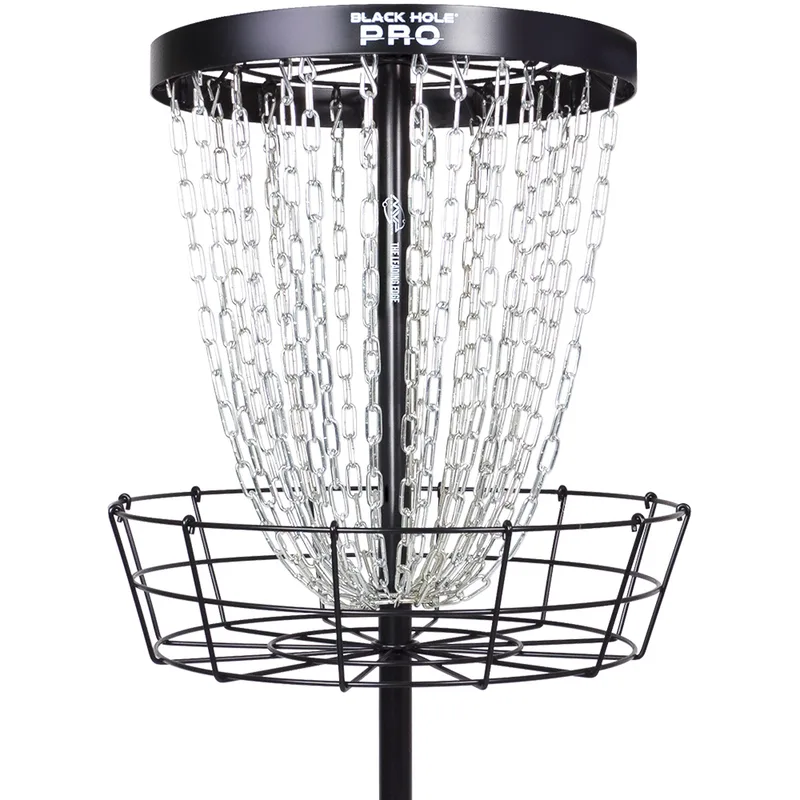
MVP Black Hole Pro
5.0/5$135–$170 approx. street price
- Chains: 24 (12 outer / 12 inner), heavy duty
- Header band: 2″
- Weight: 30 lb (35.5 lb boxed)
- PDGA approved: Yes
Pros
- Course-weighted heavy-duty chains — catches like a real course target
- 2″ header band and PDGA approval at regulation height and 25.5″ diameter
- Two-year limited warranty
Cons
- 30 lb, six more than the Lite
- About $35 more
- Powder coat will chip and rust at the joints if left out for years
The Black Hole Pro is the upgrade and it is a real one: course-weighted heavy-duty chains, a 2″ band, PDGA approval, a two-year warranty, at $135–$170. It costs about $35 more and weighs six pounds more. Buy it if the basket is going to stay in one place and you want it to behave like a course target rather than a generous approximation. Our Lite vs Pro comparison goes through the differences spec by spec.
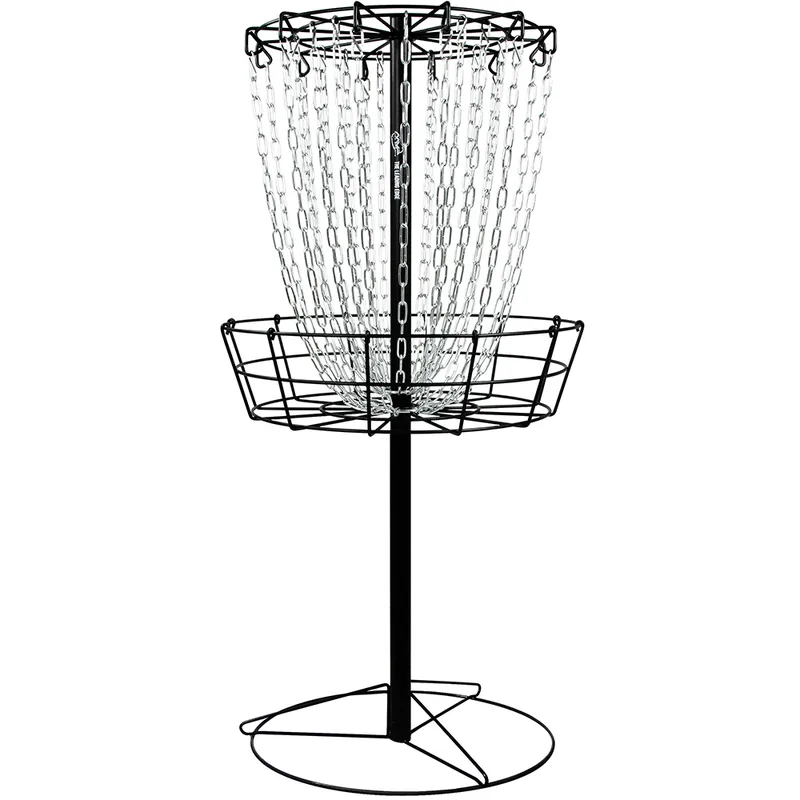
MVP Black Hole Practice
4.0/5$100–$120 approx. street price
- Chains: 24 (12 outer / 12 inner), light duty
- Header band: None
- Weight: ~24 lb
- PDGA approved: No
Pros
- Same 24 chains and regulation geometry as the Lite
- Under a minute to set up, welded metal
- The cheapest 24-chain basket from a major brand, historically
Cons
- No header band at all — the disc either hits chains or it doesn't
- Priced level with the Lite at every retailer we checked, which removes its reason to exist
- Light-duty chains, same as the Lite
The Black Hole Practice is the Lite with the band removed, and on current prices there is no argument for it. Same 24 chains, same regulation geometry, same light-duty chain spec, about the same weight — and the same price. If you find it genuinely cheaper on the day you are buying, it is still a good basket and a long way above anything at $60. Otherwise take the band.
Who should buy the Black Hole Lite
Buy it if this is your first basket, if the budget stops around $100–$130, or if you want a basket you will actually move around. It has the geometry that makes practice transfer, it is built properly rather than cheaply, and 24 lb means it gets used.
Buy the Pro instead if the basket will live in one spot and you putt hard enough to care whether firm putts are caught honestly, or if you want PDGA approval for sanctioned play.
And whichever you choose, compare the bare basket against the bundle before ordering — on this product the retailers are not selling the same thing. The portable baskets guide ranks the full category, and the under-$120 guide covers what else sits at this price.
How we evaluated this gear
We have not physically tested every product on this page. Ratings are based on manufacturer specifications, PDGA-approved flight data, and hundreds of aggregated owner reviews and community discussions (r/discgolf, retailer reviews, club forums). Where we describe how something "feels" or "flies", that reflects the consensus of experienced players, not a lab test. We update ratings when the consensus changes.