MVP Black Hole Pro Review: The Best Practice Basket for the Money in 2026
The MVP Black Hole Pro is the default backyard disc golf basket: 24 course-weight chains, PDGA approved, $150. Strengths, weaknesses, and Lite vs Pro vs Pro HD.
This post contains affiliate links. If you buy through them we may earn a commission at no extra cost to you. Learn more.
Table of contents
- Specs
- The chains: why it catches like a course basket
- The band: the one thing owners wish were different
- Build and durability
- The numbers behind “catches like a course basket”
- Assembly and portability
- The new competitor: Innova DISCatcher GO
- Pro vs Lite vs Pro HD
- What the warranty does and doesn’t cover
- Who should buy the Black Hole Pro
- Verdict
- Frequently Asked Questions
MVP Disc Sports sells more practice baskets than any other disc manufacturer, and the Black Hole Pro is the reason. It’s the basket that shows up in the background of putting videos, in league-night photos and in the “what basket should I get?” threads that appear on r/discgolf every week. This review covers what the spec sheet actually means, where it falls short, and how to pick between the Pro, the cheaper Lite and the heavier Pro HD.
We haven’t run a controlled catch comparison. This review draws on MVP’s published specifications, retailer listings and pricing (Infinite Discs, MVP’s store), and a large body of multi-year owner reviews and forum discussion. Where we describe how it catches or wears, that’s the consensus of owners, not a lab test.
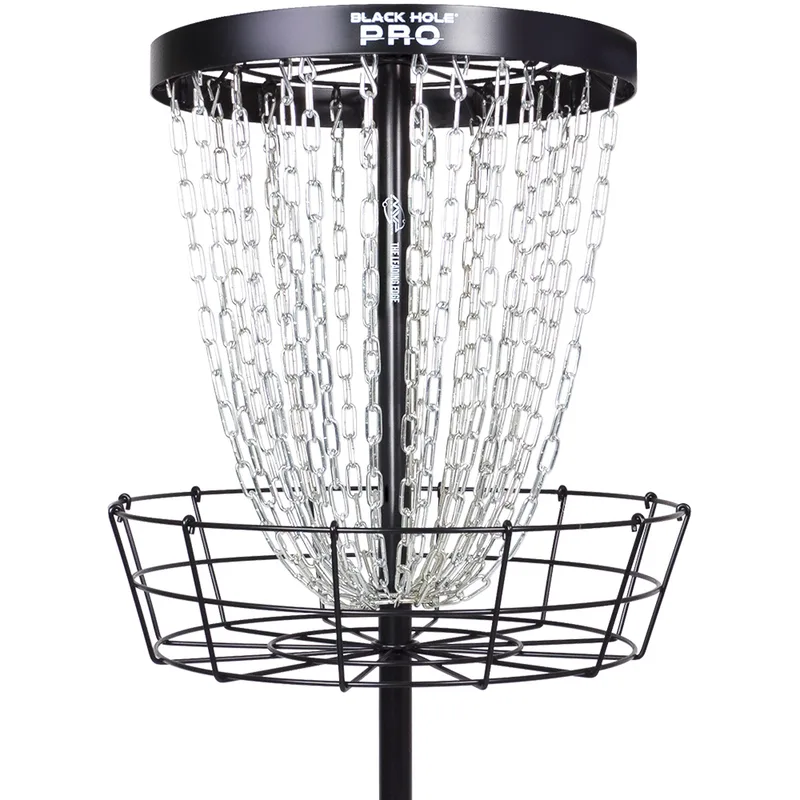
MVP Black Hole Pro
5.0/5$135–$170 approx. street price
- Chains: 24 (12/12), heavy duty
- Weight: 30 lb (35.5 lb boxed)
- Wire: 6 mm
- PDGA approved: Yes
Pros
- 24 zinc-coated, heavy-duty, course-weighted chains (12 outer / 12 inner) — catches like a course basket
- PDGA approved; 25.5″ regulation rim, standard height
- All-metal welded construction with e-coat plus powder coat
- Assembles or disassembles in under a minute, no tools
- 2-year limited warranty
Cons
- 30 lb — a set-up-and-leave basket unless you buy the Transit Bag version
- Slim 2″ header band produces fewer lucky band-ins than course baskets
- Rust at chain links and joints over years outdoors (warranty excludes rust)
| Product | Our rating | Chains | Weight | Wire | PDGA approved | Price | Buy |
|---|---|---|---|---|---|---|---|
| Best overall practice basket MVP Black Hole Pro | 5.0/5 | 24 (12/12), heavy duty | 30 lb (35.5 lb boxed) | 6 mm | Yes | $135–$170 | Check Price |
| Cheaper, lighter MVP Black Hole Lite | 4.5/5 | 24, light duty | 24 lb | 6 mm | No | $100–$125 | Check Price |
| Heavier duty MVP Black Hole Pro HD | 4.5/5 | 24 (V2), heavy duty | ~42 lb | 8 mm | Yes | $155–$190 | Check Price |
Specs
| MVP Black Hole Pro | |
|---|---|
| Chains | 24 high-visibility zinc-coated heavy-duty course-weighted chains; 12 outer, 12 inner |
| Chain tiers | 21″ outer tier, 15″ inner tier |
| Rim | 25.5″ regulation diameter, 2″ header band |
| Construction | All-metal, all joints welded; electrophoresis first stage, powder-coated shell |
| Weight | 30 lb (30 lb boxed) |
| Assembly | Under 1 minute, no tools |
| PDGA | Approved; built to PDGA height and size regulations |
| Warranty | 2-year limited (cosmetic imperfections and rust not covered) |
| Price | $149.95 at Infinite Discs; $169.95 with Transit Bag |
Source: MVP Disc Sports product page and retailer listings, September 2026.
The chains: why it catches like a course basket
The single most important spec on a practice basket is the chain assembly, and this is the Black Hole Pro’s whole argument. Twenty-four chains, split evenly between an outer and an inner tier and spaced — MVP’s words — to “eliminate weak pockets and reduce cut-throughs or pole bounces”. The chains are heavy course-weight links, not the light ones on budget baskets, so a firm putt is absorbed rather than passed through.
Owner feedback matches. The most common comment from players who own a Pro and play tournaments is some version of “it catches the way the course does”. Cut-throughs happen — they happen on course baskets too — but rarely, and mostly on very hard, very centered putts. That’s exactly the behavior you want, because it means what you learn in the yard carries to the course.
The band: the one thing owners wish were different
The Pro’s header band is a slim 2″ ring. Course baskets typically have a taller band, and a taller band produces more “band-ins” — putts that hit the top and drop. The practical effect is that the Pro is slightly less forgiving than many course baskets on high putts. Some owners consider that a feature (it trains you to hit chains, not band); others miss the lucky ones. Either way, it’s the most consistent criticism of the design, and it’s minor.
Build and durability
All joints are welded, the finish is a two-stage e-coat plus powder coat, and the whole thing is steel. Owners report years of outdoor use with the predictable pattern: the finish chips at the joints first, then chain links show surface rust. It doesn’t affect function for a long time, and MVP’s warranty covers structural failure for two years while explicitly excluding rust and cosmetic wear. A tarp or an eave in winter makes a noticeable difference.
At 30 lb the Pro is stable in wind and doesn’t walk when hit by a hard putt — which is a real advantage over 15–25 lb baskets, and the flip side of it being a chore to carry.
The numbers behind “catches like a course basket”
MVP publishes the geometry, and it’s worth reading because it explains the catching behaviour rather than just asserting it:
- 25.5″ regulation rim diameter with a 2″ header band.
- 21″ outer chain tier, 15″ inner chain tier — the two tiers sit six inches apart in diameter, which is what closes the gap a disc would otherwise slide through.
- 12 outer and 12 inner chains, equidistantly oriented, which MVP describes as giving “zero weak pockets.”
- All joints welded, with threaded tension connections that MVP says assemble “without any distracting wobble or play.”
The inner tier is the part that does the work people notice. A single-tier basket — the DISCatcher Traveler, most sub-$100 targets — has gaps between chains that a firm putt can pass through, and its chains swing freely enough to push a disc back out. Two tiers at different diameters mean a disc that gets past the outer chains meets the inner ones at a different angle, loses its remaining speed and drops. That is the whole design argument, and it is why chain count alone is a poor way to compare baskets: where the chains sit matters as much as how many there are.
Assembly and portability
Three pieces — base, pole, chain assembly — slide together and lock in under a minute with no tools. That’s genuinely quick, and it’s what makes the Pro “portable” in MVP’s description. It is not, however, a folding basket: moving it means three pieces and 35 lb, and without the Transit Bag it’s awkward. If you’ll take it to the park more than occasionally, either spend the extra $20 on the bag version or consider the 24 lb Lite.
The new competitor: Innova DISCatcher GO
Since we first published this review, Innova has released the DISCatcher GO at a $129.99 MSRP, and it targets the Black Hole Pro directly:
| Black Hole Pro | DISCatcher GO | |
|---|---|---|
| Chains | 24, two tiers | 24 heavyweight |
| PDGA | Approved | Approved |
| Weight | 30 lb | 27 lb |
| Setup | Under 1 min, no tools | Under 1 min, no tools |
| Carry bag | $20 option | Included, 11″ × 17″ × 28″ |
| Finish | Electrophoretic primer + powder coat | Zinc galvanized, heat-tinted |
| MSRP | $149.95–$164.95 | $129.99 |
Innova’s pitch takes direct aim at the Pro’s one genuine weakness: “powder coating chips, and chipped coating means exposed metal and early rust.” That is exactly the failure mode Pro owners report after a few years outdoors, and a galvanized frame has no paint to chip. MVP’s two-stage electrophoresis-plus-powder-coat is better than plain powder coat, but it is still a coating.
We are not moving the Pro off the top spot for it, and the reason is our own methodology rather than loyalty: the GO has two customer ratings at the time of writing and no long-term owner reports. This review’s rating comes from years of them. If you are buying today and want a proven basket, the Pro is still the safe answer; if you like being early and want a PDGA-approved portable that packs down smaller for $20–$35 less, the GO is the most interesting thing in the category. We’ll revisit when there’s evidence.
Pro vs Lite vs Pro HD
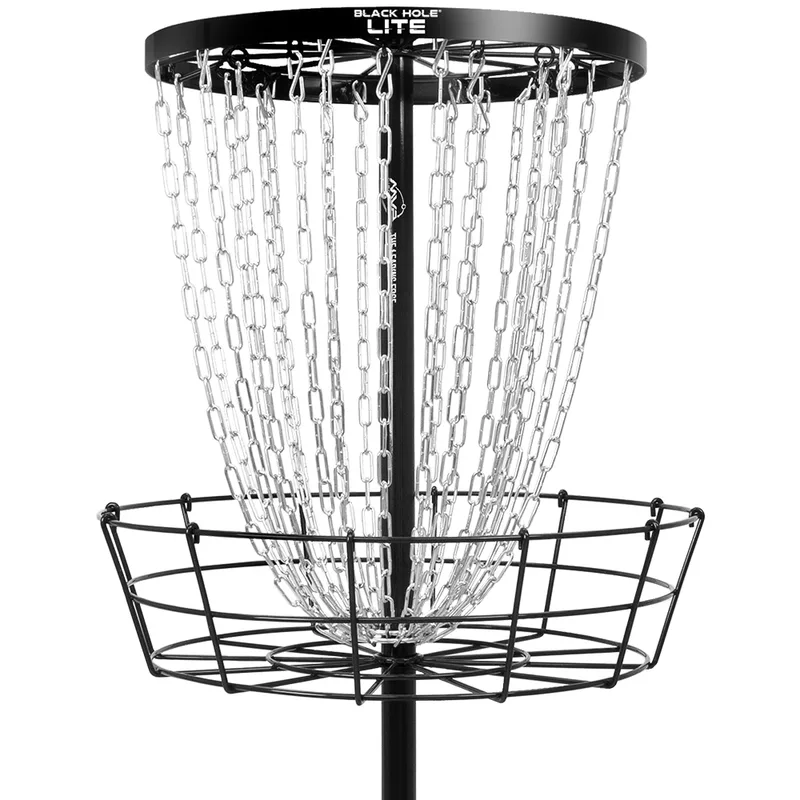
MVP Black Hole Lite
4.5/5$100–$125 approx. street price
Pros
- Same 24-chain two-tier layout at 24 lb and about $115
Cons
- Light-duty chains and a 1.25″ header band; not PDGA approved
Black Hole Lite ($100–$125): the same 24-chain, two-tier layout and regulation dimensions with light-duty chains and a shorter header band (same 6 mm wire), at 24 lb. It catches noticeably less firmly — more cut-throughs on hard putts — and it isn’t PDGA approved. The right choice if weight matters more than realism, or if $35 matters. We compare them spec by spec in Black Hole Lite vs Pro.
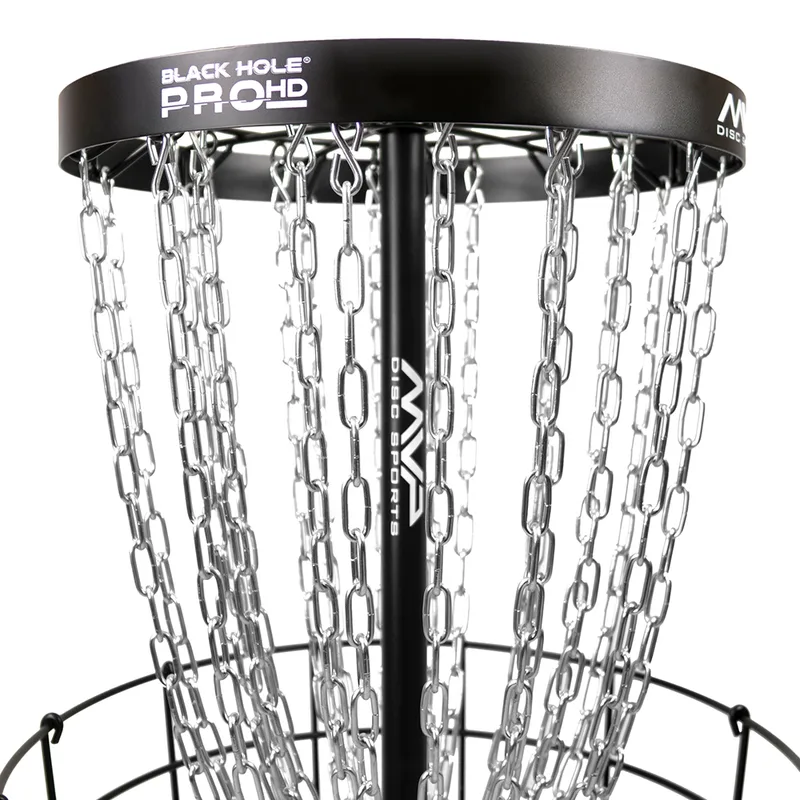
MVP Black Hole Pro HD
4.5/5$155–$190 approx. street price
Pros
- 8 mm wire throughout, about 42 lb, the most course-like feel
Cons
- $20–$30 more for a difference most players won't notice
Black Hole Pro HD ($155–$190): the Pro built from 8 mm wire throughout, at about 42 lb. Same chains (24 in the current V2; earlier runs had 30), same approval. It’s the most course-like of the three and the one to buy if the basket will live outdoors for a decade. Most players won’t feel the difference over the standard Pro.
There’s also the Precision ($135), a 12-chain, 13″-band training target for players who already own a basket, and the Practice ($115), which is the Lite without a header band — at the same price the Lite is the better buy.
MVP sells this basket under the Axiom name too, and on Amazon it is five dollars cheaper (re-checked 8 October 2026)
MVP Disc Sports owns Axiom Discs, and the baskets carry across. The Axiom Pro is a 24-chain basket, 12 outer and 12 inner, built from the same 6 mm wire to PDGA height and size regulation, in the same six pieces that assemble in under a minute.
Two sources say so outright rather than by implication. Infinite Discs’ own Axiom Pro listing states “Specs are identical to the MVP Black Hole Pro” and then prints the Black Hole Pro’s spec sheet underneath it — 24 chains, 12 outer and 12 inner, 2″ header band, 25.5″ regulation diameter, 21″ outer and 15″ inner chain tiers. And MVP’s own accessory page describes the Black Hole Transit HD case as being there to “Protect your Black Hole® Pro HD or Axiom Pro HD” — one carrying bag, both brands, named in a single sentence.
First checked 5 October 2026 and re-checked on 8 October, both on Amazon and both sold by the same retailer:
| Price | Stock | Rating | |
|---|---|---|---|
| MVP Black Hole Pro | $139.95 | In stock | 4.8 from 4,141 |
| Axiom Pro | $134.95 | In stock | 4.8 from 1,946 |
Three days apart, both prices were identical to the dollar — which is worth saying on a site that keeps finding the opposite.
Do not buy it for the five dollars. The reasons to prefer the Axiom are that it is sold in colours rather than matte black only, and that it is a second source for the same basket when the Black Hole is out of stock — which is exactly what happened one tier up on 2 October, when the Black Hole Pro HD was unavailable at $179.95 and the Axiom Pro HD was in stock at $169.95. If both are in stock and five dollars apart, buy whichever you prefer the look of.
Checked 24 October 2026: Infinite Discs have the Axiom Pro in stock at $149.95. The Amazon figures above are from 15 October and stand as a price reference — we no longer link to Amazon, for the reason given on our affiliate disclosure page.
Axiom Pro at Infinite DiscsWhat the warranty does and doesn’t cover
MVP covers the Black Hole Pro with a 2-year limited warranty. Read that against the failure modes: nothing structural usually goes wrong on a welded basket in two years, so in practice the warranty covers manufacturing defects you’d find in the first month — a bad weld, a threaded connection that won’t seat, a missing part.
What it does not cover is the thing that actually ages these baskets: rust and cosmetic wear. That’s standard for the category and not a criticism of MVP specifically, but it does change how you should treat the basket. Chain links and the base are where oxidation starts, particularly in coastal or snowy climates where salt is involved. Owners who bring the basket into a garage for winter, or who keep a cover on it, report the coating lasting years longer than those who leave it in the yard year-round. It disassembles in under a minute precisely so that you can.
Who should buy the Black Hole Pro
Buy it if:
- You want a basket that catches like a course basket, for the price of ten discs.
- It’ll mostly stay in one place — a yard, a garage, a club practice area.
- You want PDGA dimensions so practice transfers.
Look elsewhere if:
- You’ll carry it constantly (→ DISCatcher Traveler for max portability, or the Lite).
- Your budget is firmly under $120 (→ Lite).
- It’ll be outside year-round for years and you putt hard (→ Pro HD).
Verdict
5.0/5Five stars is a strong rating for a piece of powder-coated steel, and it’s earned by absence: there’s nothing about the Black Hole Pro that a practice basket buyer needs and doesn’t get. Real chains, real dimensions, real warranty, a real price. The Dynamic Discs Recruit Lite matches it nearly spec-for-spec when it’s in stock; between those two, buy whichever is cheaper that week. Everything else in our portable basket roundup is either lighter or cheaper, and catches worse for it.
How we evaluated this gear
We have not physically tested every product on this page. Ratings are based on manufacturer specifications, PDGA-approved flight data, and hundreds of aggregated owner reviews and community discussions (r/discgolf, retailer reviews, club forums). Where we describe how something "feels" or "flies", that reflects the consensus of experienced players, not a lab test. We update ratings when the consensus changes.