MVP Black Hole Pro HD Review: Two Different Baskets Share This Name
MVP Black Hole Pro HD review: 8 mm wire, 42 lb, PDGA regulation. The original had 30 chains in three tiers, the V2 has 24 in two — and both are sold as the Pro HD.
This post contains affiliate links. If you buy through them we may earn a commission at no extra cost to you. Learn more.
Table of contents
The MVP Black Hole Pro HD has one of the strongest-looking listings in disc golf: Amazon’s Choice, over 900 ratings, a 4.8 average, more than a hundred sold in the past month. It is also, in a way that matters if you are about to spend $180, two different baskets.
The original Pro HD carried 30 chains in three tiers — 12 outer, 12 middle, 6 inner. The current V2 carries 24 chains in two tiers, 12 outer and 12 inner, the same arrangement as the cheaper standard Pro. Both are sold as the Black Hole Pro HD. Retailers that stock both list them as separate products; retailers that stock one usually just call it the Pro HD. On Amazon the title says 24-Chain while the URL still reads MVP-30-Chain-Portable-Disc-Basket, which is the clearest possible sign that one product page has carried both baskets over time — along with every review either of them ever earned.
That is the thing to settle before anything else about this basket, so the rest of this review is written around it.
| Product | Our rating | Chains | Weight | Wire | PDGA approved | Price | Buy |
|---|---|---|---|---|---|---|---|
| Most durable MVP Black Hole Pro HD | 4.5/5 | 24 two-tier (V2) or 30 three-tier (original) | ~42 lb | 8 mm | Yes | $155–$190 | Check Price |
| Best overall MVP Black Hole Pro | 5.0/5 | 24 (12 outer / 12 inner), heavy duty | 30 lb (35.5 lb boxed) | 6 mm | Yes | $135–$170 | Check Price |
| Best budget MVP Black Hole Lite | 4.5/5 | 24 (two tiers), light duty | 24 lb | 6 mm | No | $100–$125 | Check Price |
What the HD actually buys you
Strip out the chain question and the Pro HD is a simple proposition: it is the Black Hole Pro built from thicker metal.
8 mm wire instead of 6 mm, through the chain rack, the cage and the base. That is the whole headline, and it is why the basket weighs about 42 lb against the Pro’s 30. Thicker wire means less flex when a firm putt hits the rack, and less of the slow bending that turns an old practice basket into a wobbly one.
Everything else is shared with the Pro and is good: welded all-metal construction, threaded tension connections so there is no play in the assembly, PDGA approval at regulation height with a 25.5″ band, a 2″ header band, and a setup that genuinely takes about a minute with no tools. Infinite Discs lists the chain tiers at 21″ outer and 15″ inner diameter, and the finish as an electrophoresed first stage under a powder-coated shell — which is a real anti-corrosion step rather than paint alone.
We have not putted at this basket. What we can check is that the specification is consistent across MVP’s own comparison table, Infinite Discs and the Amazon listing, and that the owner ratings on both versions are high.
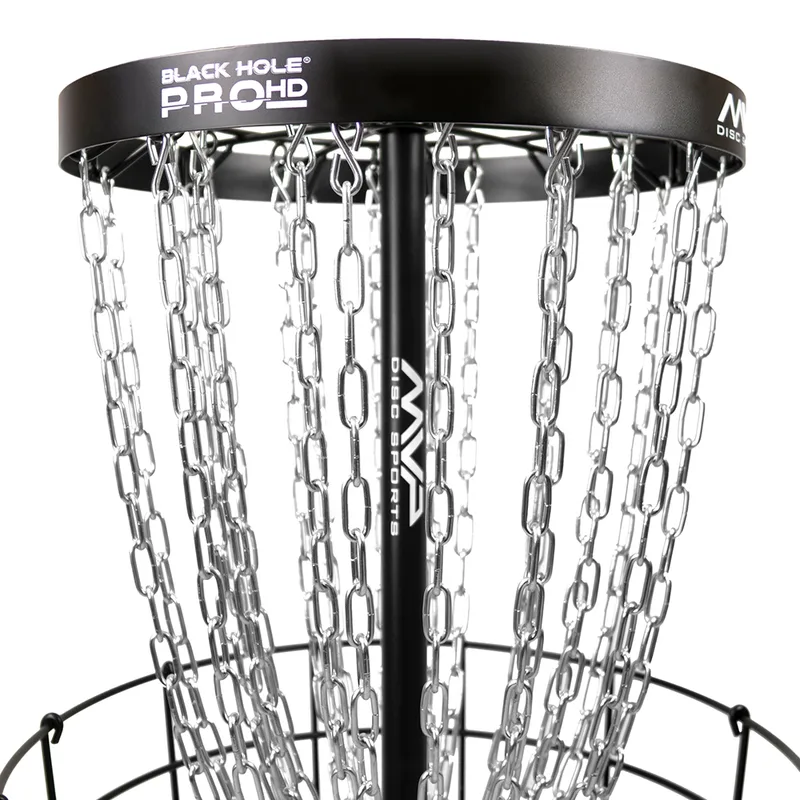
MVP Black Hole Pro HD
4.5/5$155–$190 approx. street price
- Chains: 24 two-tier (V2) or 30 three-tier (original)
- Weight: ~42 lb
- Wire: 8 mm
- PDGA approved: Yes
Pros
- 8 mm wire through rack, cage and base — the thickest of any portable basket
- Heavy-duty course-weighted chains; the closest feel to a permanent target
- PDGA approved at regulation height and 25.5″ diameter, with a 2″ header band
- Same one-minute, no-tools assembly as the Pro
Cons
- Two baskets share this name: the original 30-chain three-tier and the current 24-chain V2
- About 42 lb — realistically a set-it-and-leave-it basket, not one you carry
- $20–$30 more than the Pro for a difference only firm putters will notice
- Out of stock at Infinite Discs as of 1 October 2026; Amazon had it
If it is out of stock, MVP sells the same basket under another name (2 October 2026)
MVP Disc Sports owns Axiom Discs and Streamline Discs — Axiom’s own FAQ calls it “another brand of MVP Disc Sports” — and the baskets carry across. Infinite Discs describes the Axiom Pro HD as “similar to the Black Hole Pro HD, but with a variety of color options”, and lists the same specification we checked above: 24 zinc-coated heavy-duty course-weighted chains, 12 outer and 12 inner, an 8 mm wire frame, PDGA-approved standard size, assembly in under a minute.
On 2 October 2026 that mattered: Infinite Discs had the Black Hole Pro HD out of stock at $179.95 and the Axiom Pro HD in stock at $169.95 — ten dollars less for the same published spec, in different colours.
Axiom Pro HD at Infinite DiscsMVP’s own accessory page settles this better than Infinite’s wording does. The description of the Black Hole Transit HD case says it is there to “Protect your Black Hole® Pro HD or Axiom Pro HD” — the manufacturer sells one carrying case for both baskets and names them in the same sentence. A bag cut for one basket fits the other, which is about as close to saying they are the same object as a company is likely to put in print.
We still have not compared the two in person, so treat it as a same-spec alternative rather than a proven clone. If the Black Hole is in stock and the same money, buy the one you want the colour of.
The version question, fairly
It would be easy to write this as “MVP quietly cheapened the basket.” That is not quite what happened.
The V2 lost the middle tier of chains, going from 30 to 24. But MVP also rebuilt it: a sturdier chain rack, a deeper cage and a stronger base. A deeper cage catches spit-outs that would otherwise bounce back through, which is part of what the third chain tier was doing. So the V2 trades chain density for structure, and it is entirely possible it catches as well or better. Nobody outside MVP has published a side-by-side test, and we are not going to invent one.
What is a problem is not the redesign. It is that the two baskets share a name, a product page and a review history. If you read 900 reviews and buy with confidence, you may be reading opinions of a basket with six more chains than the one in the box. Reviews on that Amazon listing include buyers who expected 30 chains, received 24, and were annoyed about it — which is exactly what you would expect when a listing outlives the product it was written for.
So: count the tiers in the photo before you order. Three tiers means 30 chains. Two means 24. If you specifically want the 30-chain version, buy from a retailer that names them separately — Gotta Go Gotta Throw lists both — and expect to wait, because on 1 October 2026 the 30-chain was $169.99 and sold out with more stock promised.
What a regulation basket changes about practice
It is worth being clear about why chain count and band height are not just spec-sheet trivia, because it decides whether the extra $70 over a cheap basket does anything.
A practice basket is useful in proportion to how closely it behaves like the thing you will putt at on Saturday. Two properties carry most of that. The first is chain density and weight: light chains let a firm putt pass straight through, and a basket that punishes you for putting hard teaches you to putt soft. That habit then follows you to a course basket that would have caught the firm putt perfectly well. The Pro HD’s course-weighted chains exist to stop that.
The second is the band. The Pro HD’s header band is 2″ and sits at PDGA-regulation height on a 25.5″ cage. On a course target, a putt that clips the band often drops; on a basket with a shallower band, the same putt spits out. Practising on the wrong geometry trains you to aim differently from how you will aim on the course, which is the opposite of what practice is for.
That is the real argument for a PDGA-approved basket over a cheap one, and it applies equally to the standard Pro. What the HD adds on top is not better practice — it is a frame that stays square after a few thousand firm putts rather than slowly flexing out of shape.
What is actually in the box
Two things here are worth knowing before you buy, and neither appears on the specification table.
Ground stakes are included. The Amazon listing names three optional ground stakes, there to stop the basket tipping over in wind or from an exceptionally strong putt. MVP’s own specification page does not mention them at all, which is why most write-ups of this basket miss them — including, until today, ours.
And if you buy the bundle, the transit case is two bags rather than one. MVP’s description is specific: a large protective case for the cage, with two pole slots and two outer storage pockets, plus a smaller bag for the header band and chain rack that nests inside it. Both have reinforced padded handles, and the shell is heavy-duty woven nylon with a 1680D polyester lining. The bundle is a separate Amazon listing from the bare basket, so check which one is in your cart — the same trap we documented on the Black Hole Lite, where Amazon only sells the bundle.
Living with 42 lb outdoors
Two practical things come up repeatedly with baskets in this class.
Assembly is genuinely quick but the connections matter. MVP uses threaded tension connections rather than push-fit, which is why an assembled Black Hole does not wobble the way cheaper baskets do. They do work loose over a season of use and weather; checking and re-tightening them once or twice a year is the whole maintenance routine.
The finish is good but it is not a course target. The electrophoresed base layer under the powder coat is a real anti-corrosion step rather than paint alone, and it is the reason the HD is the portable basket best suited to living outside. Even so, expect chips at the joints and at the base where it meets the ground, and expect rust to start there. MVP’s warranty is explicit about whose problem that is: the two-year limited warranty carries the note that minor cosmetic imperfections and rust are not covered. Taking it down over the worst months roughly doubles the life of the finish, which is awkward advice for a 42 lb basket — and one more reason the lighter Pro suits anyone who will actually move it.
Pro HD, Pro, or Lite
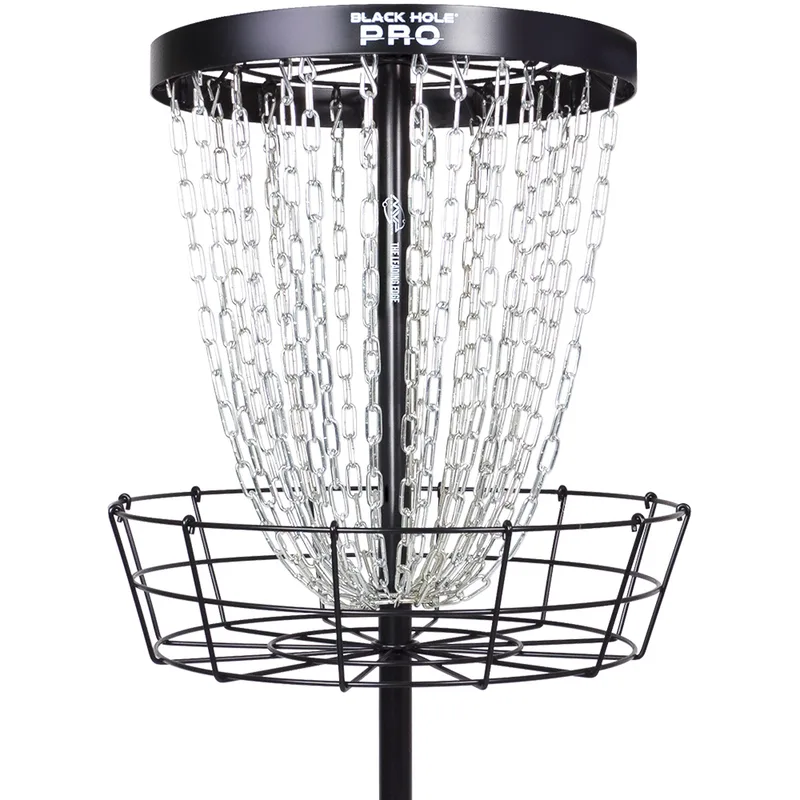
MVP Black Hole Pro
5.0/5$135–$170 approx. street price
- Chains: 24 (12 outer / 12 inner), heavy duty
- Weight: 30 lb (35.5 lb boxed)
- Wire: 6 mm
- PDGA approved: Yes
Pros
- 24 heavy-duty, course-weighted chains in two tiers
- PDGA-approved height and 25.5″ diameter
- Around 12 lb lighter than the Pro HD, so it actually moves
- 2-year limited warranty
Cons
- 6 mm wire rather than 8 mm
- Slim 2″ header band means fewer band-ins than course baskets
- Powder coat will chip and rust at the joints if left out for years
The standard Black Hole Pro is the one most people should buy. Same 24 chains, same regulation dimensions, same one-minute assembly, 6 mm wire instead of 8 mm, around 12 lb lighter and roughly $30 cheaper. The weight difference sounds trivial written down and is not: 30 lb can be carried across a garden by one person, and 42 lb is a basket you position once.
Buy the HD over the Pro in three cases. It is going to live outside permanently. You putt hard enough that frame flex bothers you. Or several people are going to hammer it daily — a club, a family, a shared practice green.
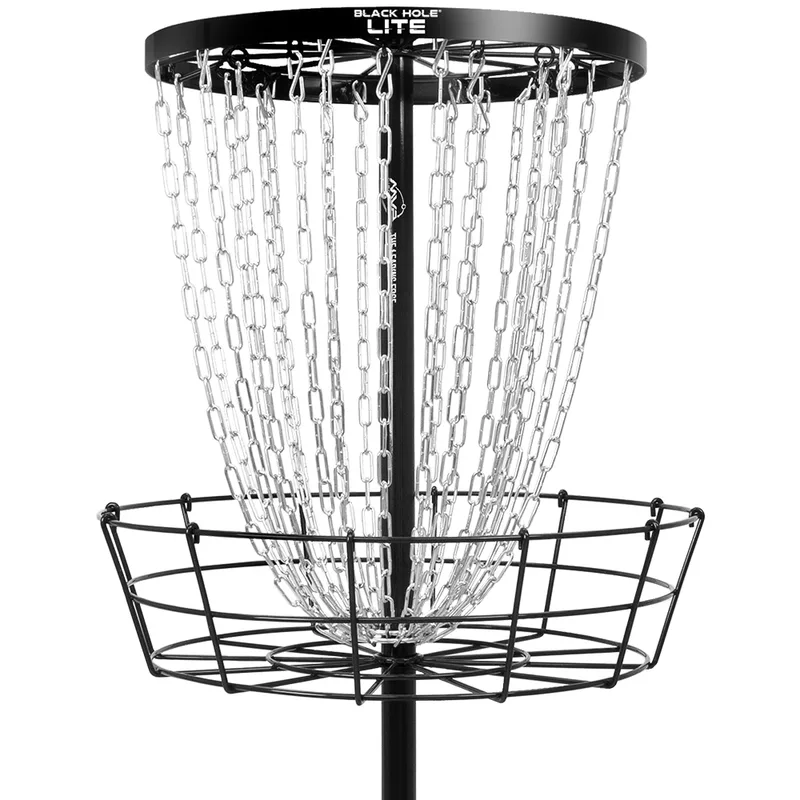
MVP Black Hole Lite
4.5/5$100–$125 approx. street price
- Chains: 24 (two tiers), light duty
- Weight: 24 lb
- Wire: 6 mm
- PDGA approved: No
Pros
- Same 24-chain, two-tier layout as the Pro for less
- 24 lb — light enough to carry to the park
- Regulation height and diameter
Cons
- Light-duty chains and a shorter band; more cut-throughs on firm putts
- Tips more easily than the Pro in wind or on slopes
- Not PDGA approved for sanctioned play
The Black Hole Lite is the basket to buy if $180 is more than you want to spend on something to putt at in the garden. Same 24-chain two-tier layout, 24 lb, regulation height and diameter — but light-duty chains and a shorter band, so firm putts cut through more often, and it is not PDGA approved. For a beginner working on 10-metre putts, none of that matters. Our Lite vs Pro comparison covers that choice in detail.
Who should buy the Pro HD
Buy it if the basket is going to sit in one spot and take years of weather and firm putting, and you would rather buy the sturdiest portable target once than replace a flexing one later. At roughly $180 it is the most basket you can buy without moving to a permanent course installation.
Skip it if you will want to move it, in which case the Pro saves you $30 and 10 lb. Skip it if you are just starting — the Lite does the job for $70 less. And whichever you choose, check the chain count in the listing photo first, because on this product the name is not enough to tell you what you are buying.
If you are still deciding how serious a basket you need, the portable baskets guide ranks all of them, and the under-$120 guide covers the cheaper end.
How we evaluated this gear
We have not physically tested every product on this page. Ratings are based on manufacturer specifications, PDGA-approved flight data, and hundreds of aggregated owner reviews and community discussions (r/discgolf, retailer reviews, club forums). Where we describe how something "feels" or "flies", that reflects the consensus of experienced players, not a lab test. We update ratings when the consensus changes.