MVP Black Hole Precision Review: A Putting Target, Not a Basket
MVP Black Hole Precision review: a 13″ band against a regulation 25.5″, 12 chains, 25 lb. What a half-width target trains, and why it should never be your only basket.
This post contains affiliate links. If you buy through them we may earn a commission at no extra cost to you. Learn more.
Table of contents
Most practice baskets are trying to be a course target for less money. The MVP Black Hole Precision is trying to be harder than one.
The number that defines it is the band: 13″ across, where a PDGA-regulation target is 25.5″. That is not a slightly smaller basket, it is roughly half the width. There are 12 chains instead of 24, hung on a 12″ chain tier, and the whole thing stands at standard regulation height. MVP calls it a precision target rather than a basket, and the distinction is the entire product.
That makes it the one item in MVP’s Black Hole range that can be a mistake to buy. If you own a regulation basket and your putting has stopped improving, it is about $135 well spent. If it is the first basket you buy, you have bought a device that mostly makes you miss.
| Product | Our rating | Chains | Band diameter | Weight | PDGA approved | Price | Buy |
|---|---|---|---|---|---|---|---|
| Best for putting accuracy MVP Black Hole Precision | 4.0/5 | 12, heavy duty | 13″ (regulation is 25.5″) | 25 lb | No (training target) | $100–$125 | Check Price |
| Best overall MVP Black Hole Pro | 5.0/5 | 24 (12 outer / 12 inner), heavy duty | 25.5″ (regulation) | 30 lb (35.5 lb boxed) | Yes | $135–$170 | Check Price |
| Best budget MVP Black Hole Lite | 4.5/5 | 24 (two tiers), light duty | 25.5″ (regulation) | 24 lb | No | $100–$125 | Check Price |
What a half-width target actually trains
A regulation basket is forgiving in a specific way: a putt that drifts six inches off line still arrives inside a 25.5″ band and the chains do the rest. You get the make, and you learn nothing about the six inches.
Take the band down to 13″ and that margin disappears. The putt has to arrive where you aimed, and when it does not, there is no chain there to rescue it. That is the whole mechanism, and it is the same idea as practising free throws on a smaller hoop or hitting into a narrow net — you shrink the target so the real one feels generous.
What it does not train is pace. Twelve chains on a narrow band behave differently from 24 on a wide one: a firm putt that a Black Hole Pro would swallow can rattle out of the Precision. If you spend a winter learning how hard to hit it on this target, you will have learned how hard to hit this target. Use it for line, keep a regulation basket for everything else.
That is the honest frame for the whole product, and it is why the order you buy in matters more than usual here.
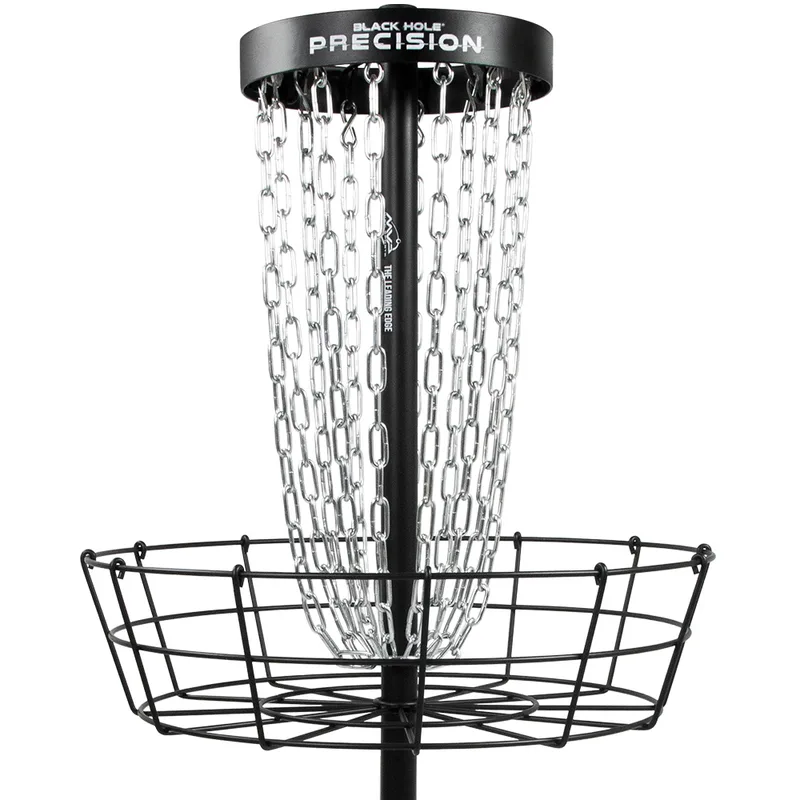
MVP Black Hole Precision
4.0/5$100–$125 approx. street price
- Chains: 12, heavy duty
- Band diameter: 13″ (regulation is 25.5″)
- Weight: 25 lb
- PDGA approved: No (training target)
Pros
- 13″ band against a regulation 25.5″ — forces you to hit the middle of the chains
- Heavy-gauge course-weighted chains and welded all-metal build, same as the regulation Black Holes
- 25 lb and a one-minute, no-tools assembly, so it actually gets moved and used
- $100–$125, the cheapest way to change what your putting practice asks of you
Cons
- Not a regulation target — frustrating as a first basket and useless for casual rounds
- Only 12 chains, so it catches differently from the basket you'll putt at on Saturday
- A second basket, not a first one
Build and setup
Underneath the unusual geometry it is a normal MVP basket, which is the good news at this price.
The chains are the same heavy-duty, zinc-coated, course-weighted spec as the regulation Black Holes — MVP has not cheapened them because there are fewer. Construction is welded all-metal throughout with threaded tension connections rather than push-fit, which is why an assembled Black Hole does not wobble while you are standing over a putt. The finish is MVP’s usual electrophoresed first stage under a powder-coated outer shell, a genuine anti-corrosion step rather than paint alone. The band is 2″ tall on a 13″ diameter, and the base is a standard load-distributed design.
Assembly is the familiar one-minute, no-tools routine, and at 25 lb this is the lightest metal basket MVP makes — 5 lb under the Lite and 17 lb under the Pro HD. For a target that is most useful in short, frequent sessions, being easy to carry out and put away is not a small thing.
We have not putted at this basket. What we can verify is that the specification is consistent between MVP, Infinite Discs and the Amazon listing, and that the owner ratings are strong: 4.8 across 330 ratings on Amazon, where it is an Amazon’s Choice pick and in stock as of 1 October 2026. Infinite Discs lists it at $134.95.
How to use it without ruining your putt
A narrow target rewards a specific kind of practice and punishes another, and the listings do not explain the difference. This is reasoning from what the equipment does rather than a coaching programme we have tested, but the logic is not complicated.
Putt from inside your make range, not outside it. The value of the Precision is the feedback on line, and feedback only works if you are missing by inches rather than feet. If your reliable range is eight metres, practise at six. Standing at twelve and raining putts past a 13″ band teaches you nothing except that twelve metres is hard.
Count differently. On a regulation basket, a sensible drill is makes out of twenty. On this one, chain contact is the unit that matters: a putt that hits chains and drops out still arrived where you aimed. Scoring only the makes on a target this narrow turns a good session into a discouraging one, and discouragement is how people stop practising.
Alternate targets rather than replacing them. The pace problem is real — 12 chains on a narrow band spit out putts a 24-chain target would hold — so the Precision works best in rotation. A reasonable pattern is line work on the Precision, then the same distance on a full basket to recalibrate how hard the putt wants to be hit. If you only own the Precision, you will drift toward putting softer than a course basket requires, which is the exact habit a cheap basket with light chains creates.
Give it a flat, boring spot. Everything that makes a narrow target useful also makes it unforgiving of a sloped lie or a wind that moves it. At 25 lb it is the lightest metal basket MVP makes, which is convenient for carrying and inconvenient for stability, so stake it or weight the base if it lives anywhere exposed.
Used this way it is a focused tool with one job. Used as a replacement for a real basket, it quietly teaches the wrong lesson about pace, which is a strange outcome for a product bought to improve putting.
Who should not buy it
This is worth being blunt about, because the listings are not.
Not a beginner’s basket. Someone learning to putt needs makes. Makes build the stroke and the confidence to commit to a line; a target that rejects near-misses gives a new player a lot of frustration and very little information. Buy a Black Hole Lite or a Pro first and come back to this in a year.
Not a basket for rounds. It is not PDGA approved and it is not regulation width. You cannot use it for a backyard round, a temporary course or anything where the basket is meant to behave like a basket.
Not an upgrade from nothing. Prices make this starker than it used to be: on 2 October 2026 Gotta Go Gotta Throw listed the Precision at $99.99 and the regulation Black Hole Lite at the same $99.99, with the Pro at $134.99. So the Precision can cost exactly what a full-size basket costs. If you are choosing between them with one budget, the regulation basket wins every time. The Precision is an addition, not a substitute.
The alternatives
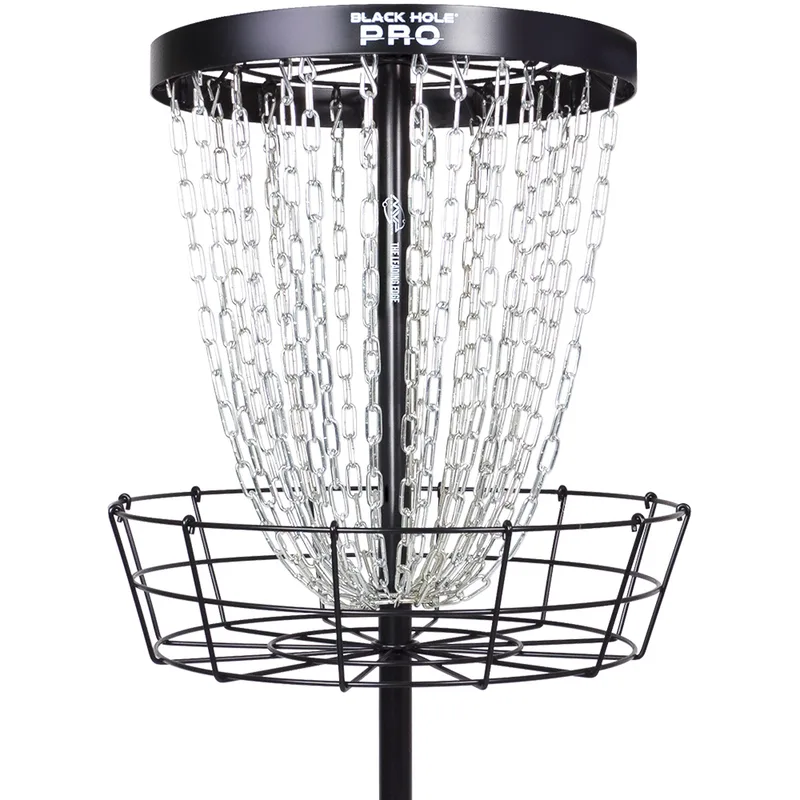
MVP Black Hole Pro
5.0/5$135–$170 approx. street price
- Chains: 24 (12 outer / 12 inner), heavy duty
- Band diameter: 25.5″ (regulation)
- Weight: 30 lb (35.5 lb boxed)
- PDGA approved: Yes
Pros
- 24 heavy-duty, course-weighted chains in two tiers — catches like a real course basket
- PDGA approved at regulation height and 25.5″ diameter
- Welded all-metal construction, assembles in about a minute
- 2-year limited warranty
Cons
- 30 lb is heavy to move often
- Slim 2″ header band means fewer band-ins than course baskets
- Powder coat will chip and rust at the joints if left out for years
The Black Hole Pro is the basket to own if you are only going to own one. Twenty-four heavy-duty chains in two tiers, PDGA approved at regulation height and 25.5″ diameter, welded all-metal, two-year warranty. It catches like the thing you putt at on Saturday, which is the entire job of a practice basket. It is 30 lb and, depending where you buy, anywhere from $0 to $70 more than the Precision — check both prices the same day.
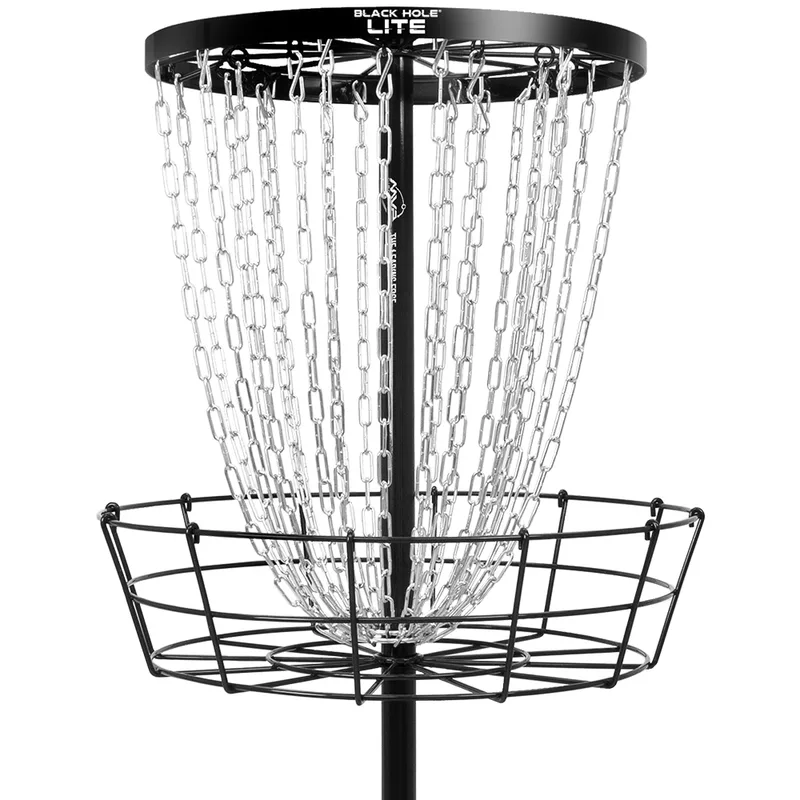
MVP Black Hole Lite
4.5/5$100–$125 approx. street price
- Chains: 24 (two tiers), light duty
- Band diameter: 25.5″ (regulation)
- Weight: 24 lb
- PDGA approved: No
Pros
- Same 24-chain, two-tier layout as the Pro for less
- 24 lb — light enough to carry to the park
- Regulation height and diameter
Cons
- Light-duty chains and a shorter band; more cut-throughs on firm putts
- Tips more easily than the Pro in wind or on slopes
- Not PDGA approved for sanctioned play
The Black Hole Lite is the cheapest sensible regulation basket: the same 24-chain two-tier layout, 24 lb, regulation height and diameter, at $100–$125. The chains are light duty and the band is shorter, so firm putts cut through more often than they should — but for a beginner working on 10-metre putts in the garden, it is the right amount of basket for the money. Our Lite vs Pro comparison covers the choice between those two in detail.
Who should buy the Precision
Buy it if you already have a regulation basket, you putt regularly, and your make percentage has flattened out. It is the cheapest change you can make to what your practice asks of you, and it is built to the same standard as MVP’s full-size baskets rather than being a cheap gimmick.
Buy it if you are a competitive player who wants a target that will not flatter a lazy line, and you have the discipline to keep using the full-size basket for pace work.
Skip it in every other case. If you are buying your first basket, the portable baskets guide ranks the regulation options, and the under-$120 guide covers the cheaper end. Come back to the Precision when a 25.5″ band has started to feel easy.
How we evaluated this gear
We have not physically tested every product on this page. Ratings are based on manufacturer specifications, PDGA-approved flight data, and hundreds of aggregated owner reviews and community discussions (r/discgolf, retailer reviews, club forums). Where we describe how something "feels" or "flies", that reflects the consensus of experienced players, not a lab test. We update ratings when the consensus changes.