Discraft Zone vs Westside Harp: Same Numbers, Different Disc in the Hand
Zone vs Harp: both 4/3/0/3, but the Harp is 4 mm lower with a deeper beaded rim — and owners rate the disc labelled very overstable as having less fade.
This post contains affiliate links. If you buy through them we may earn a commission at no extra cost to you. Learn more.
Table of contents
Two discs, one stamp. The Discraft Zone and the Westside Harp are both 4/3/0/3, both sold as putt-and-approach moulds, and both bought for the same shot: the one that has to land and stay there. Search either name and you will find somebody telling you they are the same disc in different plastic.
They are not, and the difference is not in the flight numbers. It is in the shape, and it is larger than most comparisons admit: the Harp is 1.6 cm tall and the Zone is 2.0 cm, which is a fifth of the disc’s height. The Harp also has a deeper rim in a shorter disc, so proportionally it is almost all rim, and it has a bead where the Zone has none.
Then there is the part that surprised us. Infinite Discs classes the Harp as very overstable and the Zone as overstable — and its own owners rate them the other way round.
We have not thrown either disc. This comparison is built from Discraft’s and Westside’s published numbers, the dimension and owner-rating blocks on Infinite Discs’ product pages (392 ratings for the Zone, 201 for the Harp), and retailer listings read on 20 October 2026. Where we describe feel or flight, that is aggregated owner reporting rather than our own hands.
| Product | Our rating | Flight numbers | Owner flight numbers | Height | Rim | Skill level | Price | Buy |
|---|---|---|---|---|---|---|---|---|
| Best overstable approach disc Discraft Zone | 5.0/5 | 4 / 3 / 0 / 3 | 3.9 / 3 / 0 / 3 (392 ratings) | 2.0 cm | 1.3 cm deep, 1.2 cm wide, beadless | Intermediate, Advanced | $11 (Pro-D/Putter Line) – $25 (ESP/CryZtal/Titanium) | Check Price |
| Best for small hands and firm grips Westside Discs Harp | 4.5/5 | 4 / 3 / 0 / 3 | 4 / 3 / 0 / 2.6 (201 ratings) | 1.6 cm | 1.4 cm deep, 1.1 cm wide, beaded | Advanced | $10 (Origio) – $25 (VIP/Tournament) | Check Price |
The stamps agree. The owners don’t.
Both discs leave the factory as 4/3/0/3. Infinite Discs publishes, next to that, the average of what its customers actually rate the mould at — and the two averages diverge in different directions:
| Stamped | Owners | Ratings | |
|---|---|---|---|
| Discraft Zone | 4 / 3 / 0 / 3 | 3.9 / 3 / 0 / 3 | 392 |
| Westside Harp | 4 / 3 / 0 / 3 | 4 / 3 / 0 / 2.6 | 201 |
Zone owners knock a tenth off the speed and leave everything else alone. Harp owners knock the fade down from 3 to 2.6 — and fade is the entire reason anybody buys either disc.
That is backwards from the labels. On the same two pages, Infinite describes the Harp as very overstable and the Zone as overstable. The disc with the stronger description is the one its owners report finishing softer.
We would not over-read a 0.4 difference in a crowd-sourced average: these mix plastics, weights and arm speeds, and 201 ratings is a smaller sample than 392. But it points the same way as the ratings themselves — the Zone sits at 4.87 out of 5 with 90% five-star, the Harp at 4.7 with 78% — and it is worth knowing before you buy the Harp specifically because you wanted more fade than a Zone gives you. On the evidence, you will not get it.
The shape is the real difference
This is where the two discs genuinely part company, and the numbers are unambiguous:
| Zone | Harp | |
|---|---|---|
| Height | 2.0 cm | 1.6 cm |
| Rim depth | 1.3 cm | 1.4 cm |
| Rim width | 1.2 cm | 1.1 cm |
| Diameter | 21.1 cm | 21.2 cm |
| Rim | beadless | beaded |
| Max weight | 175 g | 176 g |
Read the first two rows together. The Harp is shorter overall yet deeper in the rim, so the rim accounts for roughly 87% of its height against 65% for the Zone. In the hand that is a real difference: the Harp is a flat, deep-rimmed disc your fingers wrap into, while the Zone has noticeably more disc sitting above the rim.
The Zone’s rim is also the wider of the two, 1.2 cm against 1.1 cm — thicker under the fingers, and the reason many forehand players prefer it. The Harp gives you a bead instead.
Neither of those is better. They are the two variables that decide which disc disappears into your grip and which one you keep re-gripping, and no article can settle that for you. What this one can do is tell you that the difference exists and how big it is, because “identical discs in different plastic” is the version you will usually be told.
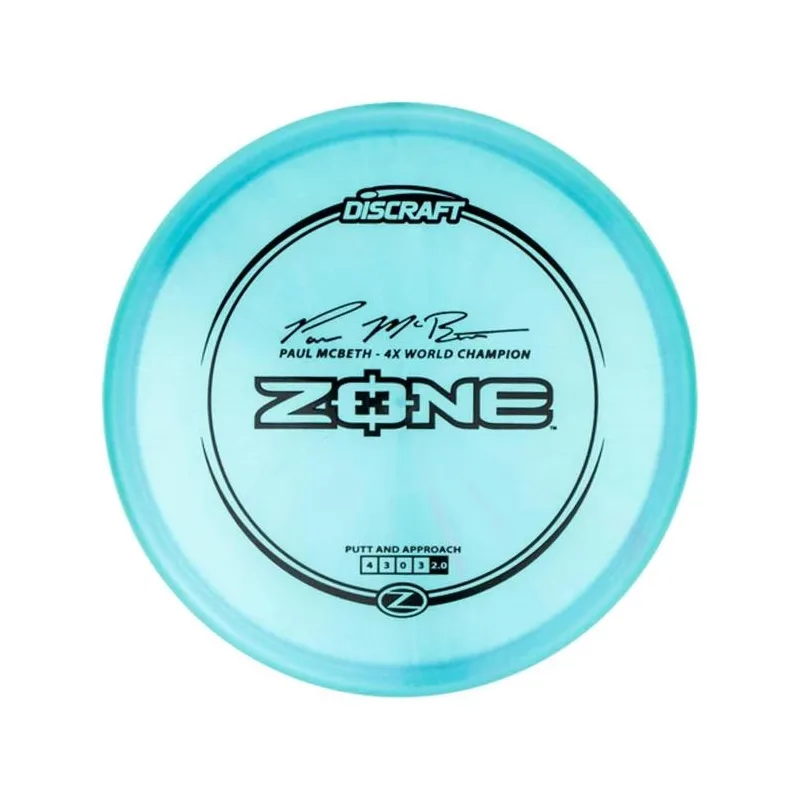
Discraft Zone
5.0/5$11 (Pro-D/Putter Line) – $25 (ESP/CryZtal/Titanium) approx. street price
- Flight numbers: 4 / 3 / 0 / 3
- Owner flight numbers: 3.9 / 3 / 0 / 3 (392 ratings)
- Height: 2.0 cm
- Rim: 1.3 cm deep, 1.2 cm wide, beadless
- Skill level: Intermediate, Advanced
- Stability: Overstable
- Plastic options: Basic, Midgrade, Durable, Premium, Rubber
Pros
- 392 owner ratings at 4.87/5, the highest-rated approach disc we track
- Owners confirm the fade at 3 — the number the disc is bought for
- More plastics than the Harp, including a rubber grade for cold hands
Cons
- 2.0 cm tall, which is a lot of disc for small hands to cover
- The premium plastics cost nearly twice what a Harp costs
Why the Zone is the default
It is the most-thrown overstable approach disc in the sport, and the evidence backs the reputation rather than just repeating it. 392 owner ratings at 4.87 out of 5, with 90% of them five stars and 0.26% one star, is the strongest rating profile of any disc we track.
Owners confirm the number the disc is sold for: fade 3, unchanged. The only adjustment they make is shaving the speed to 3.9, which matters to nobody — a tenth of a speed point is inside the noise of how hard anybody throws.
It also comes in more plastics, including a rubber grade the Harp has no equivalent for, which is a genuine advantage in cold weather. Our full Zone review covers which of Discraft’s dozen-plus runs to buy.
The case against it is its height. At 2.0 cm it is a lot of disc to cover, and players with smaller hands routinely say so.
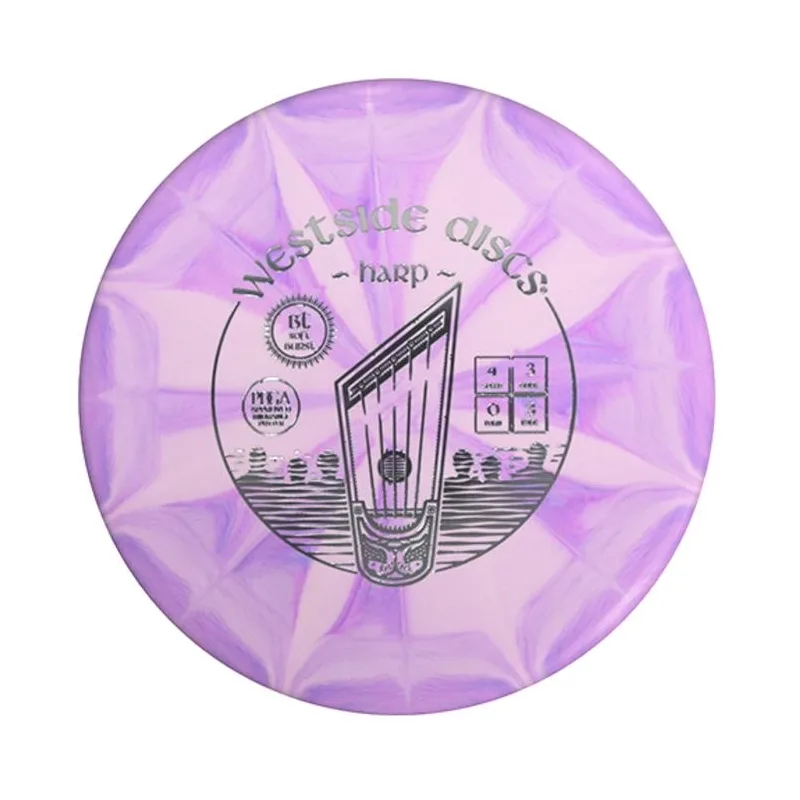
Westside Discs Harp
4.5/5$10 (Origio) – $25 (VIP/Tournament) approx. street price
- Flight numbers: 4 / 3 / 0 / 3
- Owner flight numbers: 4 / 3 / 0 / 2.6 (201 ratings)
- Height: 1.6 cm
- Rim: 1.4 cm deep, 1.1 cm wide, beaded
- Skill level: Advanced
- Stability: Very Overstable
- Plastic options: Air Bubbles, Basic, Midgrade, Durable, Premium
Pros
- 1.6 cm tall with a 1.4 cm rim — almost all rim, which suits a firm grip
- A bead, where the Zone has none
- $11.74 on Amazon against the Zone's $19.99 for a premium run
Cons
- Owners rate the fade at 2.6, below the 3 on the stamp
- Infinite rates it Advanced only, where the Zone is Intermediate and up
- Half as many owner ratings, and a lower average
Why the Harp wins for some hands
If the Zone’s profile is the problem, the Harp solves it directly: 4 mm shorter, deeper in the rim, with a bead to locate your fingers against. That is not a marginal change on a disc you grip every hole.
It is also the cheaper way into the shot on Amazon right now — $11.74 in Origio Burst against $19.99 for the Zone’s ESP run — though that gap is mostly about which plastic each listing carries. At Infinite Discs the two ranges almost overlap: Zone $10.99–$24.99, Harp $9.99–$24.99.
Two things to know before you choose it. Infinite rates the Harp “Advanced” where the Zone is “Intermediate, Advanced” — the clearest buying advice on either page, and worth respecting. And the owner fade number is the one that came in light.
Which one should you buy?
Buy the Zone if this is your first dedicated overstable approach disc, if you throw forehands, if you want the widest choice of plastics, or if the fade is specifically what you are paying for.
Buy the Harp if you have thrown a Zone and found it sat too tall or too wide in your hand, if you like a bead, or if you want the cheapest route into the shot today.
Buy neither yet if you are a beginner. Both need enough arm to carry past 200 feet before the fade reads as control rather than as the disc dumping left. Start with a Buzzz and a straight putter; our disc types guide covers the order to build a bag in.
Our pick
The Zone, for most players, and not by much. It has twice the owner ratings at a higher average, its owners confirm the fade rather than marking it down, it has a wider plastic range, and Infinite recommends it to a wider band of players.
The honest caveat is that the one thing most likely to decide this — whether a 2.0 cm beadless disc or a 1.6 cm beaded one fits your hand — is the one thing we cannot test for you. If you can hold both before buying, do that and ignore everything above.
How we evaluated this gear
We have not physically tested every product on this page. Ratings are based on manufacturer specifications, PDGA-approved flight data, and hundreds of aggregated owner reviews and community discussions (r/discgolf, retailer reviews, club forums). Where we describe how something "feels" or "flies", that reflects the consensus of experienced players, not a lab test. We update ratings when the consensus changes.