Innova Teebird Review: The Fairway Driver Every Other Fairway Driver Is Measured Against
Innova Teebird review: 7/5/0/2 flight, how it actually flies at 250 vs 350 ft, which plastic to buy, Teebird vs Leopard, Eagle and Teebird3, and who it's for.
This post contains affiliate links. If you buy through them we may earn a commission at no extra cost to you. Learn more.
Table of contents
Every disc golf brand makes a stable 7-speed fairway driver, and every one of them gets described the same way: “kind of like a Teebird.” Innova approved the Teebird in May 1999, Ken Climo threw it to world titles, and a quarter of a century later it’s still the disc people mean when they say “a straight fairway driver with a reliable fade.” This review explains what that flight looks like at different power levels, which plastic to buy, and when it’s the wrong disc for you — because for a lot of newer players, it is.
We haven’t field-tested the Teebird for this review. It’s built from Innova’s published specs, Infinite Discs’ 378 owner reviews (4.76/5 average) and retailer data, plus years of forum consensus on how the mold flies at different arm speeds. Where we describe flight, that’s the aggregate of owner reports, and we note where they disagree.
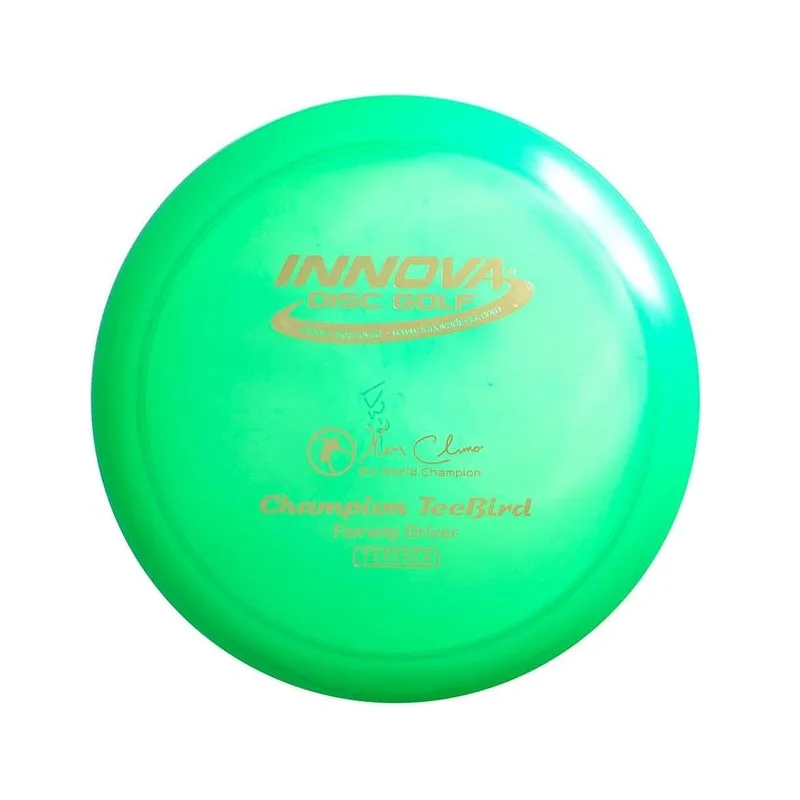
Innova Teebird
5.0/5$9 (DX) – $21 (Star/Champion/Halo) approx. street price
- Flight numbers: 7 / 5 / 0 / 2
- Stability: Stable
- Plastic options: DX, Champion, Star, GStar, StarLite, EchoStar, Halo Star, Glow, Metal Flake
- Skill level: Intermediate → pro
- Diameter: 21.2 cm
- Rim width: 1.7 cm
- Weights: 130–175 g
Pros
- Straight flight with a reliable 2 fade — the most predictable fairway driver in the sport
- Holds its line in headwinds that flip understable drivers
- Rated 4.76/5 across 378 Infinite Discs reviews; a pro staple since 1999
- Available in every Innova plastic; Star and Champion last for years
- Doubles as a forehand disc and a flex-shot disc for advanced players
Cons
- Needs roughly 250+ ft of power to fly straight rather than fade early
- Less distance than a Leopard for slower arms
- DX beats in fast and becomes a different (flippier) disc
- Glide of 5 and 0 turn means it won't rescue a bad release the way a Leopard can
| Product | Our rating | Flight numbers | Stability | Skill level | Plastic options | Price | Buy |
|---|---|---|---|---|---|---|---|
| Best stable fairway driver Innova Teebird | 5.0/5 | 7 / 5 / 0 / 2 | Stable | Intermediate → pro | DX, Champion, Star, GStar, StarLite, EchoStar, Halo Star, Glow, Metal Flake | $9 (DX) – $21 (Star/Champion/Halo) | Check Price |
| The understable step before it Innova Leopard | 4.5/5 | 6 / 5 / -2 / 1 | Understable | Beginner → intermediate | DX, Pro, Champion, Star, GStar, Halo Star | $9 (DX) – $19 (Star/Champion) | Check Price |
| Faster, flatter version Innova Teebird3 | 4.5/5 | 8 / 4 / 0 / 2 | Stable | Intermediate → pro | Champion, Star, GStar, Halo Star | $16 – $21 | Check Price |
| More fade, slightly more turn Innova Eagle | 4.5/5 | 7 / 4 / -1 / 3 | Stable / overstable | Intermediate → pro | DX, Champion, Star, GStar | $9 (DX) – $19 (Star/Champion) | Check Price |
Specs
| Innova Teebird | |
|---|---|
| Flight numbers | 7 / 5 / 0 / 2 |
| Type | Fairway driver, stable |
| Diameter | 21.2 cm |
| Rim width | 1.7 cm |
| Weights | 130–175 g (max weight depends on plastic) |
| Plastics | DX, Champion, Star, GStar, StarLite, EchoStar, Halo Star, Glow, Metal Flake |
| PDGA approved | May 3, 1999 |
| Price | $9 (DX) to $21 (Star, Champion, Halo), September 2026 |
Sources: Innova Discs, Infinite Discs.
How the Teebird flies
Innova’s description is “straight flight, high glide and good speed that make it accurate and long flying both upwind and downwind,” and for once the marketing matches the owner reviews. The Teebird’s defining trait is what it doesn’t do: it doesn’t turn. Thrown flat and at the right speed, it holds the line you release it on, glides, and fades left (right-hand backhand) at the end — moderately, not aggressively.
The phrase that matters is “at the right speed.” Owners with 300–400 ft of power describe a laser-straight disc with a gentle finish; that’s the Teebird the pros throw. Owners in the 250–300 ft range describe it as straight with a firmer fade that starts earlier; still very usable, slightly shorter than a Leopard. Below 250 ft the disc never gets up to speed, and the consensus in the four-star reviews is honest about it: it fades early and lands short-left, and a Leopard goes farther. This is why the Teebird is an intermediate disc, not because it’s hard to throw, but because it doesn’t do anything for you.
Where it separates from every understable driver is wind. A headwind that flips a Leopard into the trees barely moves a Teebird; a tailwind just makes it longer. “Outflies my Leopard; more stable in wind” is a representative Infinite Discs review, and it’s the reason most players add a Teebird to their bag before they add anything else.
What the numbers mean in practice
- Speed 7 — a true fairway driver rim (1.7 cm), comfortable in most hands and easy to release clean. It doesn’t need a distance-driver arm.
- Glide 5 — high for a stable disc. This is why the Teebird goes farther than its speed suggests and why it’s forgiving of a slightly nose-up release.
- Turn 0 — no high-speed turn. The disc goes where you point it. The flip side: it won’t rescue a throw released with too much hyzer the way a −2 Leopard will.
- Fade 2 — enough to finish reliably, not enough to hook hard. Beat-in Star or DX Teebirds drift toward 1 fade over time.
The result is a disc that rewards form. If you release clean and flat, it’s the most accurate driver you’ll own. If your release is inconsistent, it will show you.
Which plastic?
- Star ($17–$21): the default. Grippy, durable, holds its flight for years. Most owner reviews are of Star.
- Champion ($17–$21): stiffer and more transparent; runs slightly more overstable when new and beats in slowly. The forehand and windy-course choice.
- Halo Star ($19–$21): two-tone Star with a firmer rim; tends to run a touch more stable. Popular, often out of stock.
- GStar ($17–$19): Star with more flex. Nice in cold weather; slightly less stable.
- DX ($9): the cheapest and, when new, one of the best-feeling. It also beats in fast — a season of trees turns a DX Teebird from 0 turn to −1 or −2. Some players buy DX specifically to get that “seasoned” flight; if you want a disc that stays a Teebird, buy Star or Champion.
If you’re buying one, buy Star. If you play a lot of wind or throw forehand, Champion.
The Teebird family
Innova has extended the mold twice, and both are worth knowing about.
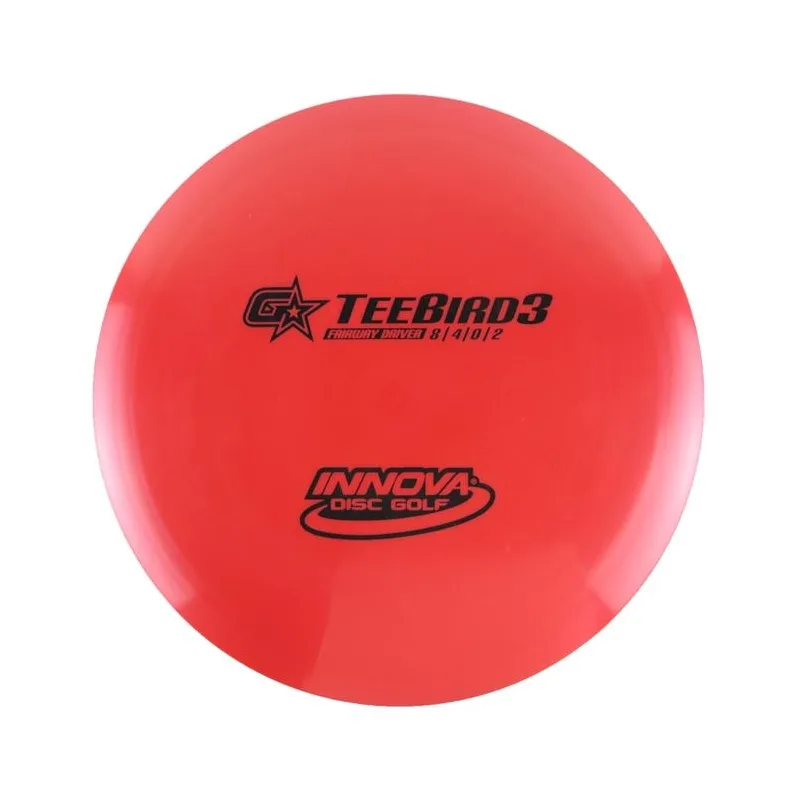
Innova Teebird3
4.5/5$16 – $21 approx. street price
Pros
- 8 speed with a lower-profile rim; same 0/2 finish, a little more distance
Cons
- Glide 4 — needs slightly more power than the Teebird to go the distance
Teebird3 (8/4/0/2) is the same stability with a slimmer, lower-profile rim: a speed higher, a glide lower. It flies flatter and, for players with the arm, a little farther; it also feels different in the hand, and a lot of long-time Teebird throwers stick with the original for its rounder rim and extra glide. If you’re choosing your first stable fairway, start with the original.
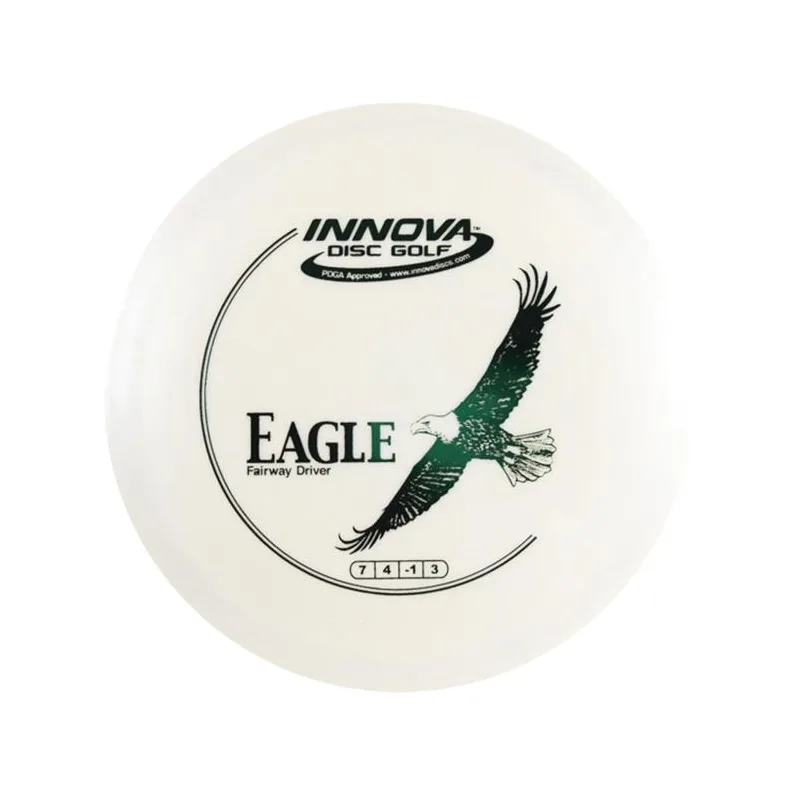
Innova Eagle
4.5/5$9 (DX) – $19 (Star/Champion) approx. street price
Pros
- 7/4/−1/3 — a touch of turn then a harder fade; a favorite for flex lines
Cons
- Less straight than the Teebird; more overstable at the end
Eagle (7/4/−1/3) is the Teebird’s older sibling with a touch of turn and a harder fade — the classic flex-shot fairway driver. It’s less straight than a Teebird and more overstable at the finish. Players who find the Teebird’s fade too gentle for their courses often prefer the Eagle.
Teebird vs Leopard
This is the comparison that actually matters for most readers. The Leopard (6/5/−2/1) is the driver in Innova’s starter set and the most-recommended first fairway driver in the sport; the Teebird is the disc it hands off to.
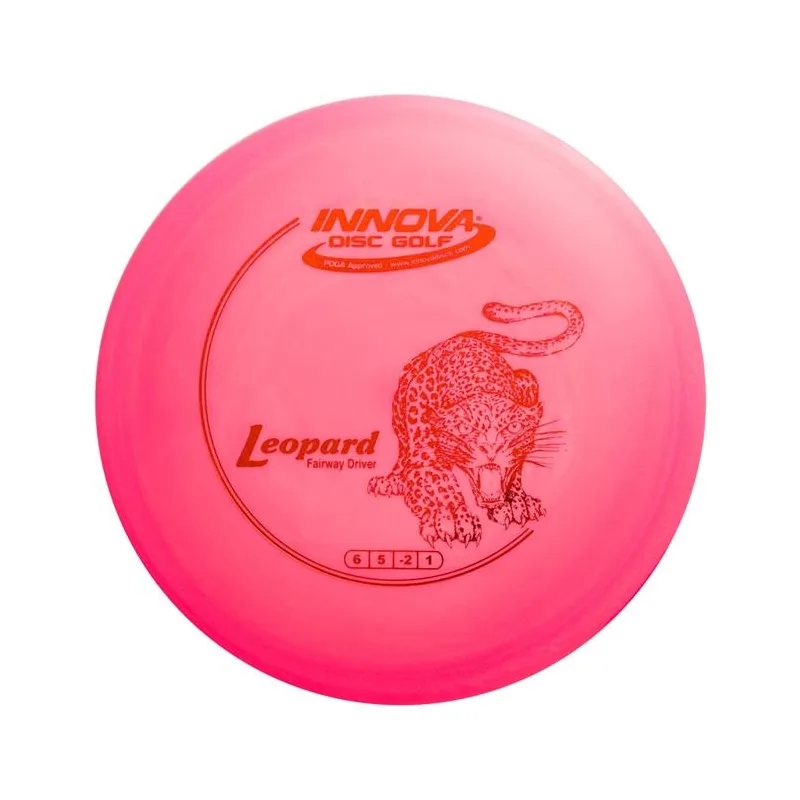
Innova Leopard
4.5/5$9 (DX) – $19 (Star/Champion) approx. street price
Pros
- Speed 6, −2 turn, 5 glide — straight and long for slower arms
Cons
- Turns over for stronger arms; weak in wind
The handoff point is simple: when your Leopard starts turning over on a normal flat throw — usually around 250–275 ft of power — you’ve outgrown it as a primary driver, and the Teebird is the next disc. Before that point, the Leopard is longer and more forgiving. After it, the Teebird is straighter, longer in wind, and more accurate. Most players end up carrying both, using the Leopard for turnover and roller lines. Our Leopard review covers the transition from the other side.
Who should buy the Teebird
Buy it if:
- You throw 250+ ft with reasonably clean form and want a driver that goes exactly where you release it.
- Your understable fairway driver has started turning over, or you play in wind.
- You throw forehand and want a fairway driver that doesn’t flip.
- You want one fairway driver you’ll never need to replace — buy Star or Champion.
Look elsewhere if:
- You’re a beginner or throw under ~250 ft (→ Leopard, or the starter-set drivers in our best beginner sets guide).
- You want maximum distance rather than accuracy (→ a distance driver; see our Destroyer review).
- You want a harder fade for hyzer lines (→ Eagle, Firebird).
Verdict
5.0/5Five stars for a disc that does one thing and has done it better than almost anything else for 25 years. The Teebird isn’t the longest fairway driver, it isn’t the easiest, and it isn’t the one to buy first. It’s the one to buy second, and the one you’ll still be throwing after the others have been replaced. If you’re sorting out where it fits among the four disc types, our disc types guide has the map; if you’re deciding between Innova and Discraft as a brand, Innova vs Discraft puts the two catalogs side by side.
How we evaluated this gear
We have not physically tested every product on this page. Ratings are based on manufacturer specifications, PDGA-approved flight data, and hundreds of aggregated owner reviews and community discussions (r/discgolf, retailer reviews, club forums). Where we describe how something "feels" or "flies", that reflects the consensus of experienced players, not a lab test. We update ratings when the consensus changes.