Innova Teebird vs Eagle: Two Speed 7 Drivers, Two Very Different Finishes
Teebird (7/5/0/2) vs Eagle (7/4/−1/3): same speed, same rim, approved two months apart in 1999. What the turn and fade actually do, and which one belongs in your bag.
This post contains affiliate links. If you buy through them we may earn a commission at no extra cost to you. Learn more.
Innova approved the Eagle on 12 March 1999 and the Teebird on 3 May 1999. Both are speed 7 fairway drivers. Both have a 1.7 cm rim and a 21.2 cm diameter, which means that if someone handed you one of each with the stamps sanded off, you would struggle to tell them apart by feel. Both spent years in Ken Climo’s bag while he won world titles.
And they do not fly the same way at all.
The gap between them is two numbers — one of turn and one of fade — and those two numbers are the difference between a disc that goes exactly where you point it and a disc that draws a long S down the fairway. Which one you want depends far less on your preference than on how hard you throw, so that’s where we’ll start.
| Product | Our rating | Flight numbers | Stability | Best for | Skill level | Price | Buy |
|---|---|---|---|---|---|---|---|
| The straight one Innova Teebird | 5.0/5 | 7 / 5 / 0 / 2 | Stable | Accurate fairway drives, utility, flex shots | Intermediate → pro | $9 (DX) – $21 (Star/Champion/Halo) | Check Price |
| Flex shots and wind Innova Eagle | 4.5/5 | 7 / 4 / -1 / 3 | Stable / overstable | Headwind drives, flex shots, power turnovers | Intermediate → pro | $9 (DX) – $19 (Star/Champion) | Check Price |
| If both fade too early Innova Leopard | 4.5/5 | 6 / 5 / -2 / 1 | Understable | Straight drives under 300 ft, turnovers | Beginner → intermediate | $9 (DX) – $19 (Star/Champion) | Check Price |
What actually separates them
The Teebird is the straight one. 0 turn means it doesn’t drift right during the fast part of the flight, and 2 fade means it finishes left without diving. Put it on a flat line and it holds that line; put it on a hyzer and it holds that. It is the disc other fairway drivers get compared to, and the reason is boring and good: it does the same thing every time.
The Eagle wants to flex. Its −1 turn lets it drift right when you throw it hard, and its 3 fade brings it back harder at the end. That combination is the textbook flex shot — release on an anhyzer angle, let the disc turn, and watch the fade drag it back across the fairway. Innova lists the Eagle’s best uses as “first headwind driver, flex shots, power turnover shots,” and all three depend on that same pairing of early turn and late fade.
Glide is the quiet difference. The Teebird has 5 glide, the Eagle 4. One point doesn’t sound like much, but glide is how long the disc stays in the air once it slows down. At the same power the Teebird carries noticeably farther and floats to the ground; the Eagle comes down sooner and harder. That makes the Eagle easier to control on tight lines and shorter on open ones.
And here is the part that trips people up. On paper the Eagle is the less stable disc — it has turn, the Teebird doesn’t. In the air, for most players, it’s the opposite. High-speed turn only happens if the disc actually reaches high speed. Below roughly 300 feet of power the Eagle’s −1 never shows up, so what you see is a speed 7 disc with 3 fade: it flies straight for a moment and then finishes left, earlier and shorter than a Teebird would. Plenty of intermediate players buy an Eagle expecting the S-curve they saw on video, throw it 280 feet, and conclude that the numbers are wrong. The numbers are fine; the flight chart assumes a pro arm.
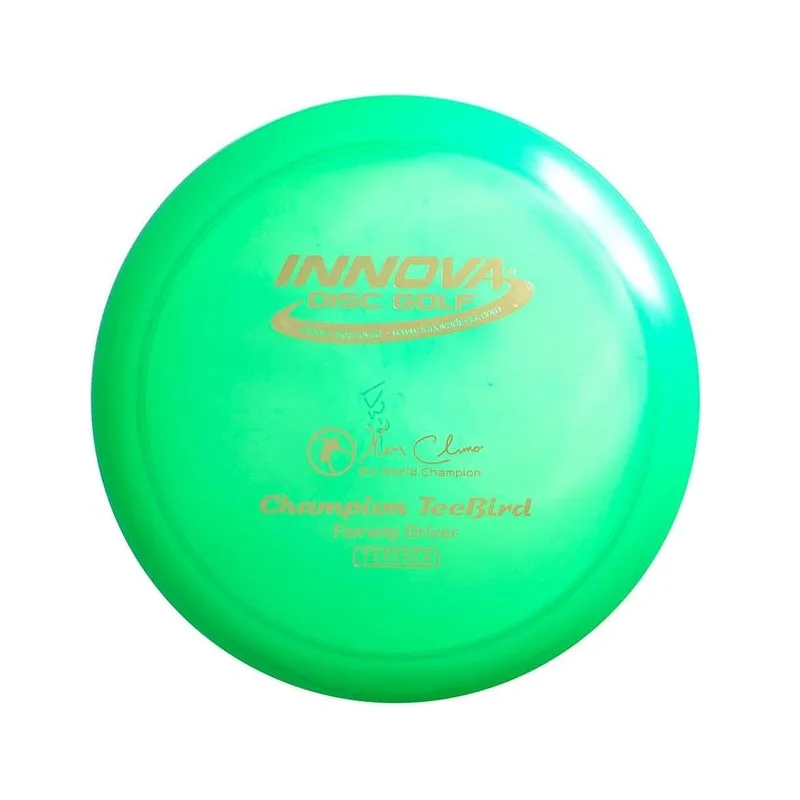
Innova Teebird
5.0/5$9 (DX) – $21 (Star/Champion/Halo) approx. street price
- Flight numbers: 7 / 5 / 0 / 2
- Stability: Stable
- Best for: Accurate fairway drives, utility, flex shots
- Skill level: Intermediate → pro
- Rim width: 1.7 cm
- Approved: 05/03/1999
Pros
- 0 turn and 2 fade — the most predictable line in the fairway driver class
- 5 glide carries farther than the Eagle at the same power
- Sold in more plastics than almost any Innova disc, including StarLite down to 130 g
- Works as a forehand and utility disc once you know its fade
Cons
- Needs roughly 250+ ft of power to fly straight instead of fading early
- Won't hold an anhyzer line the way the Eagle does
- DX beats in fast and becomes a different, flippier disc
If you are buying one of these two and you are not sure which, buy the Teebird. A disc that flies straight is a measuring instrument: when a Teebird finishes left of your target, you know it was your release, not the disc’s design. That feedback is worth more in your first few seasons than any shot shape.
It is also the more versatile of the two once you know it. The same 0/2 profile that makes it a straight driver makes it a usable forehand disc (the fade is predictable rather than sudden), a utility disc for tight gaps where glide would carry you too far, and — thrown hard on an anhyzer by a strong arm — a flex disc in its own right, just with a shallower S than the Eagle’s.
Its weakness is the flip side of its strength: it won’t rescue you. A Leopard will hold an anhyzer and turn a bad angle into a decent result. A Teebird thrown nose-up at 220 feet will simply fade early and land short and left. The Teebird asks for about 250 feet of clean power before it rewards you, and it doesn’t negotiate.
Plastic matters here more than usual because the Teebird comes in almost everything Innova makes — DX, Champion, Star, GStar, StarLite, EchoStar, Halo Star, Glow, Metal Flake. Our full Teebird review goes through the differences, but the short version is Champion or Star if you want the stock flight to stay put for years, DX if you’re happy for the disc to gradually become a Leopard.
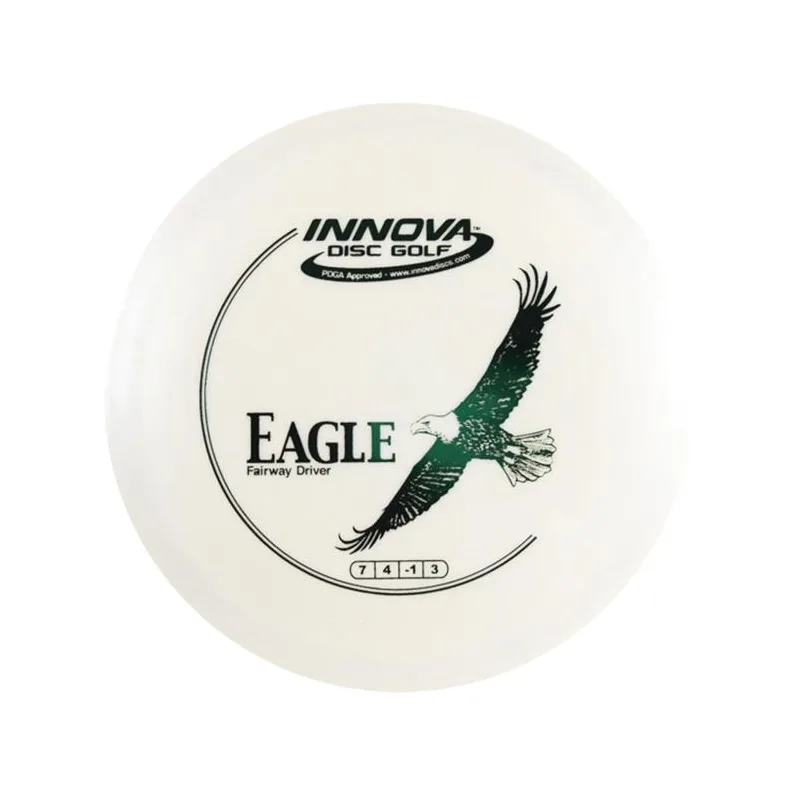
Innova Eagle
4.5/5$9 (DX) – $19 (Star/Champion) approx. street price
- Flight numbers: 7 / 4 / -1 / 3
- Stability: Stable / overstable
- Best for: Headwind drives, flex shots, power turnovers
- Skill level: Intermediate → pro
- Rim width: 1.7 cm
- Approved: 03/12/1999
Pros
- Innova's own use case: first headwind driver, flex shots, power turnover shots
- The −1 turn plus 3 fade is the classic S-curve flex line
- Holds an anhyzer release longer than a Teebird before standing up
- Beats in gracefully — an old Eagle is a straight disc, not a flippy one
Cons
- 4 glide means less float and less distance than a Teebird at the same power
- Below ~300 ft the turn never appears and it just fades early
- Fewer plastic and weight options than the Teebird
The Eagle is the specialist. Buy it when you have identified a shot the Teebird won’t give you — and for most players that shot is one of two things.
The headwind drive. Wind pushes a disc’s nose up and makes it act more understable, which is why a Leopard turns into a roller on a windy day. The Eagle’s extra fade is insurance. Innova explicitly calls it a “first headwind driver,” and that’s the honest use case: when the wind is in your face and your Teebird is turning over, the Eagle is the disc that still finishes where you expect.
The flex line. On an open hole, an Eagle thrown hard on an anhyzer angle will turn right, hold that turn through the fast part of its flight, then fade back left — covering more ground than a straight throw and finishing predictably. This is the shot the Eagle was designed for, and it genuinely needs power. If your fairway drives are under 300 feet, you will not see it.
There’s a third, quieter reason to own one: the Eagle ages well. A beaten-in DX Eagle drifts toward the flight of a fresh Teebird rather than becoming uselessly flippy, so a bag with a new Eagle and an old Eagle covers two distinct lines with the same feel in hand. That’s a common setup among players who throw a lot of fairway.
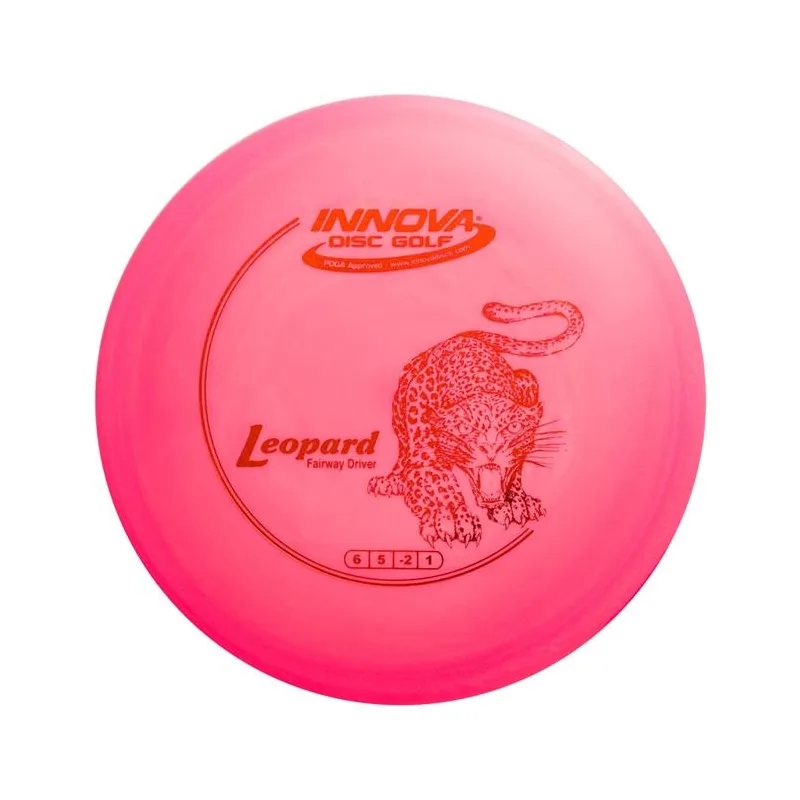
Innova Leopard
4.5/5$9 (DX) – $19 (Star/Champion) approx. street price
- Flight numbers: 6 / 5 / -2 / 1
- Stability: Understable
- Best for: Straight drives under 300 ft, turnovers
- Skill level: Beginner → intermediate
- Rim width: 1.6 cm
- Approved: 1999
Pros
- 6/5/−2/1 — flies straight and long for arms under 300 ft
- One speed slower, so it reaches its design speed on a normal throw
- The driver in the Innova DX Starter Set
Cons
- Turns over for stronger arms and in tailwinds
- Not a headwind disc
We’re including the Leopard because for a large share of the people who search “Teebird vs Eagle,” the honest answer is that neither is the right disc yet.
Speed 7 discs are designed to be thrown around 300 feet. Speed 6 discs are designed for less. The Leopard is one speed slower with −2 turn and 1 fade, and the practical result is that a player throwing 220–260 feet gets more distance and a straighter line out of a Leopard than out of either disc on this page. It’s the driver in the Innova DX Starter Set for exactly this reason, and it’s the first driver we recommend in our first-set guide.
The moment to move on is specific: when your Leopard starts turning over on a normal, comfortable throw — not on your absolute maximum effort — you have outgrown it. That’s when the Teebird earns its place. The Eagle comes later still.
Who should buy which
Buy the Teebird if you throw a fairway driver 250 feet or more and you want one disc that flies the line you pick. It’s the better first speed 7, the better learning tool, and the more versatile disc overall. If you only ever own one fairway driver, own this one.
Buy the Eagle if you already throw a Teebird well and you keep running into two situations: headwinds that turn it over, and open holes where you want the extra ground a flex line covers. It is a genuinely better disc than the Teebird at both of those jobs and a slightly worse disc at everything else.
Buy both if you throw 300+ feet. They pair well precisely because the rim and feel are identical: the same grip, the same release, two different endings. That’s the whole point of building a bag around one brand’s fairway line.
Buy neither if you’re under about 250 feet. Start with a Leopard, spend a season learning what a clean release feels like, and come back. If you’re not sure where you sit, our First Bag Builder picks a driver for your arm speed in two questions.
For what comes after these two, the next step up in speed is covered in Destroyer vs Wraith — and the same “one speed apart” question inside the Leopard family is in Leopard vs Leopard3.
How we evaluated this gear
We have not physically tested every product on this page. Ratings are based on manufacturer specifications, PDGA-approved flight data, and hundreds of aggregated owner reviews and community discussions (r/discgolf, retailer reviews, club forums). Where we describe how something "feels" or "flies", that reflects the consensus of experienced players, not a lab test. We update ratings when the consensus changes.