Innova Leopard Review: The First Driver Most Players Should Throw
The Innova Leopard (6/5/−2/1) is the fairway driver in the DX Starter Set and the classic first driver. Flight, DX vs Star vs Champion, the Leopard3, and when to move on.
This post contains affiliate links. If you buy through them we may earn a commission at no extra cost to you. Learn more.
Table of contents
The Innova Leopard has a specific job in disc golf: it’s the driver you learn on. It’s the fairway driver in Innova’s DX Starter Set, the answer in every “first driver?” thread, and — for a lot of players — the disc that produced their first genuinely straight 200-foot throw. This review covers what makes it work, which plastic to buy, what the Leopard3 changes, and how you’ll know when you’ve outgrown it.
We haven’t flight-tested the Leopard for this review. The flight description is built from Innova’s published flight numbers, PDGA specs, and the very large body of owner and community feedback on one of the longest-running molds in the sport.
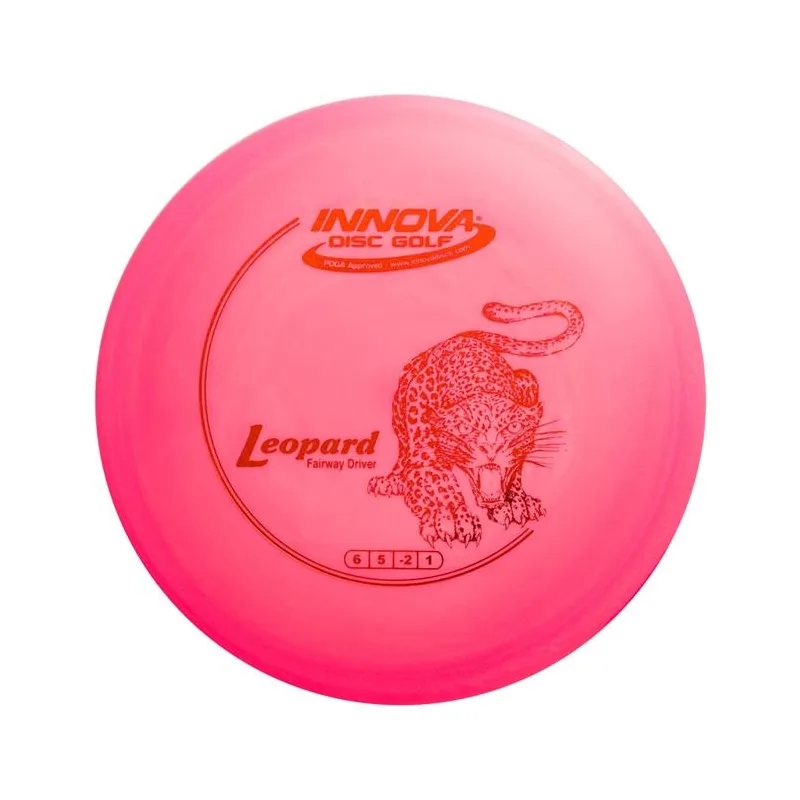
Innova Leopard
4.5/5$9 (DX) – $19 (Star/Champion) approx. street price
- Flight numbers: 6 / 5 / -2 / 1
- Stability: Understable
- Plastic options: DX, Pro, Champion, Star, GStar, Halo Star
- Skill level: Beginner → intermediate
Pros
- Speed 6 with −2 turn and 5 glide — flies straight for slow arms and long for smooth ones
- The driver in the Innova DX Starter Set; the most-recommended first driver in the sport
- Excellent turnover and roller disc later in its life
- Cheap in DX; widely available in every Innova plastic
Cons
- Beats in fast in DX — becomes very flippy after a season of trees
- Stronger arms turn it over immediately; not a distance disc past ~275 ft
- Weak in headwinds
| Product | Our rating | Flight numbers | Stability | Plastic options | Skill level | Price | Buy |
|---|---|---|---|---|---|---|---|
| Best first fairway driver Innova Leopard | 4.5/5 | 6 / 5 / -2 / 1 | Understable | DX, Pro, Champion, Star, GStar, Halo Star | Beginner → intermediate | $9 (DX) – $19 (Star/Champion) | Check Price |
| When you outgrow it Innova Leopard3 | 4.5/5 | 7 / 5 / -2 / 1 | Understable | DX, Champion, Star, GStar, Halo Star | Beginner → advanced | $9 (DX) – $21 (Star/Champion/Halo) | Check Price |
| The stable next step Innova Teebird | 4.5/5 | 7 / 5 / 0 / 2 | Stable | DX, Pro, Champion, Star, GStar, Halo Star | Intermediate → pro | $9 (DX) – $21 (Star/Champion/Halo) | Check Price |
Specs
| Innova Leopard | |
|---|---|
| Type | Fairway driver |
| Flight numbers | 6 / 5 / −2 / 1 |
| Stability | Understable |
| Diameter | 21.2 cm |
| Rim width | ~1.6 cm |
| Weights | 150–175 g (light weights widely available) |
| Plastics | DX, Pro, Champion, Star, GStar, Halo Star, plus limited blends |
How the Leopard flies
Read the four numbers together and the Leopard’s purpose is obvious. Speed 6 means a new player can actually get it up to its designed speed. Glide 5 means it stays up. Turn −2 means that during the fast early part of the flight it drifts right (for a right-handed backhand) — which, for a beginner whose every throw hooks left, is what finally produces a straight line. Fade 1 means the finish is gentle.
For a beginner throwing 150–200 feet: the Leopard flies straight, maybe drifting slightly right, and settles with a small left finish. That is the flight every new player is chasing, and it’s why the Leopard teaches good habits: you’re rewarded for a smooth, flat release rather than punished for a lack of power.
For a smooth intermediate arm throwing 250+ feet: a fresh Star or Champion Leopard flies a long, gentle S-curve — right, then back left — and is one of the best discs for hyzer-flips and controlled turnovers. A beat-in DX Leopard, at that arm speed, is a roller.
In wind the Leopard is weak; a headwind exaggerates the turn. That’s true of every understable disc and is the reason players eventually add a Teebird.
The two shots Innova designed it for
Innova’s own “best choice for” list is short and specific, and it’s worth reading because two of the three entries aren’t “drive straight”:
Tailwind fairway driver · Anhyzer shots · Roller shots
That’s a disc designed to turn. The straight flight a beginner gets is a by-product of not yet throwing hard enough to make it turn — which is genuinely useful, but it isn’t what the mold is for. Two consequences follow.
The hyzer flip. Innova describes the Leopard as good for “distance stretching hyzer flip shots”: release it tilted left, let the −2 turn stand it up to flat, and it flies a long, straight line with the extra distance a flat disc gets. It’s one of the first advanced techniques most players learn, and the Leopard is the standard disc for learning it because it flips up predictably rather than violently.
The roller. Innova calls it “a dependable long range roller.” Turn the Leopard over hard on an anhyzer and it lands on its edge and runs. A beaten DX Leopard is the cheapest roller disc in the sport, which is why players who’ve moved on from the Leopard as a driver often keep the worn one in the bag anyway.
Neither shot is something a first-week player needs. Both are reasons the Leopard stays useful long after you’ve stopped needing an easy driver.
Which plastic?
| Plastic | Feel | Durability | Stability vs DX | Best for |
|---|---|---|---|---|
| DX | Soft, grippy | Low | Baseline; beats in flippy fast | First disc, the starter set, cheapest |
| Pro | Softer, tacky | Low-medium | Similar to DX | Cold-weather grip |
| Star | Firm, grippy | High | More stable | The keeper Leopard for most players |
| Champion | Firm, glossy | Very high | Most stable | Wooded courses; holds flight for years |
| GStar | Flexible | High | Slightly less stable than Star | Players who like a soft premium disc |
| Halo Star | Firm | High | Slightly more stable than Star | Looks, and a touch more fade |
Two honest notes. First, plastic changes this disc a lot. A Champion Leopard is nearly a neutral fairway driver; a beat DX Leopard is a roller disc. If you loved your DX Leopard and buy a Champion one, expect to be surprised. Second, light weights matter here more than with most discs. A 150–160 g DX Leopard is the single easiest driver for a slow arm, a kid or a new player to throw far.
The Leopard3
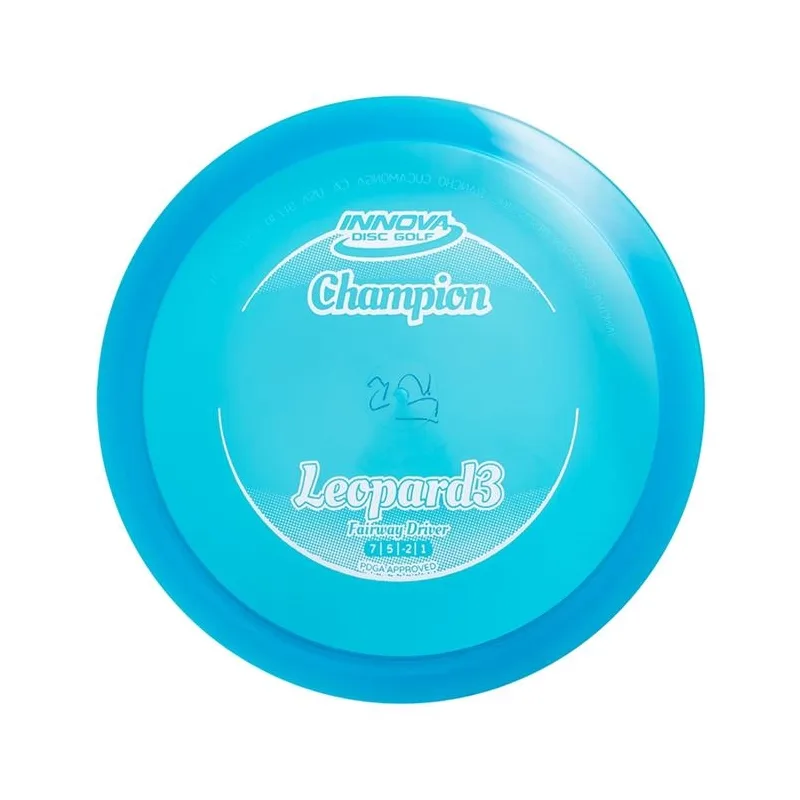
Innova Leopard3
4.5/5$9 (DX) – $21 (Star/Champion/Halo) approx. street price
Pros
- Faster (7), flatter and a little longer; same friendly turn
Cons
- Slightly less forgiving of a weak throw than the original
The Leopard3 (7/5/−2/1) is the same idea one speed faster and flatter. It’s the natural second Leopard: a bit longer, a bit more resistant to turning over at full power, and still forgiving. If you’re buying for someone who already throws 200+ feet — or if your DX Leopard has become too flippy — get a Star Leopard3. We compare the two in Leopard vs Leopard3.
Weight, and why 150 g exists
Innova sells the Leopard from 150 g upwards in Star, Champion, Pro and DX — four of its six plastics go that light, which is unusual and deliberate.
A lighter disc needs less arm speed to reach the speed it was designed for. For a player throwing 200 feet, a 150–160 g Leopard doesn’t just fly farther than a 175 g one, it flies differently: it actually reaches the part of its flight where the glide does the work, instead of fading out early. The trade-off is that light discs are pushed around by wind and turn over more easily once your arm speed catches up.
The practical advice that follows: buy light first and heavy later, not the other way round. A 150 g DX Leopard costs the same as a 175 g one and is the single easiest fairway driver to throw far. When it starts turning over on calm days, buy the next one at 165–170 g — you’ll have learned what the disc does before you have to fight it.
This is also why the Leopard is in the DX Starter Set and the Teebird isn’t: same brand, same company, one speed apart, but only one of them is sold in weights a beginner can use properly.
When you’ve outgrown it
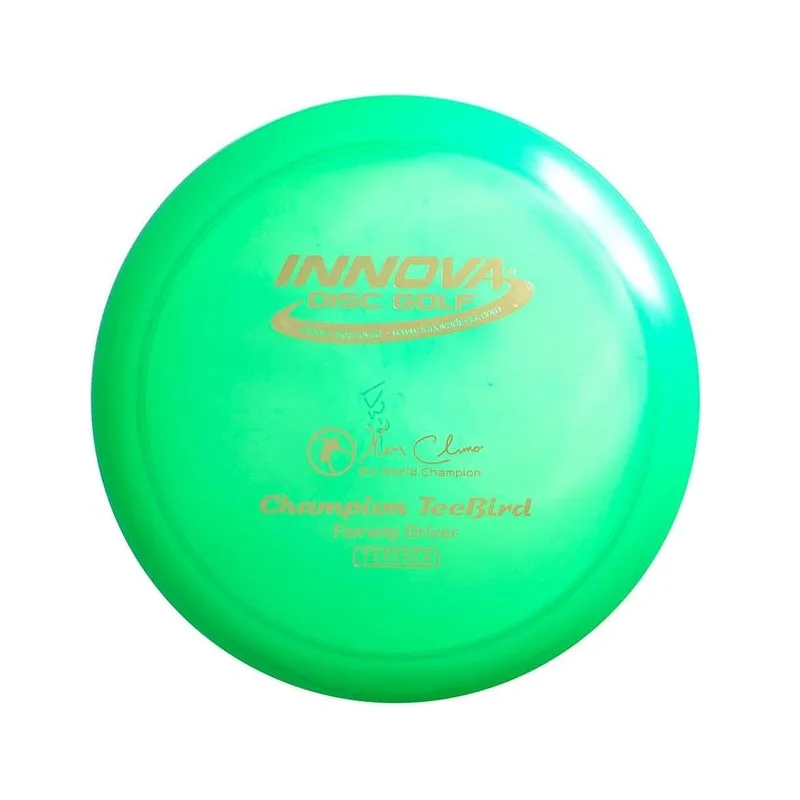
Innova Teebird
4.5/5$9 (DX) – $21 (Star/Champion/Halo) approx. street price
Pros
- The reference stable fairway driver; straight with a reliable finish
Cons
- Needs 250+ ft of power to fly as designed
The sign is simple: when the Leopard turns over on your normal throw, you’ve outgrown it as a primary driver. That usually happens around the 250–275 foot mark with clean form. The next fairway driver is the Teebird (7/5/0/2) — Innova’s reference stable fairway, straight with a dependable finish — and a light Destroyer becomes reasonable once you can throw a Teebird flat.
Keep the old Leopard. Beat DX Leopards are the best roller and turnover discs in most bags, and they cost nine dollars.
Who should buy the Leopard
Buy it if:
- You’re choosing your first driver, or buying for a beginner.
- You throw under about 250 feet and want the straightest possible flight.
- You have a slower arm, smaller hands, or are buying for a junior — get it light.
- You want a turnover or roller disc later.
Look elsewhere if:
- You already throw 250+ feet (→ Leopard3, Teebird).
- You play windy courses (→ Teebird, or a more stable fairway).
- You want one driver for years without changing (→ Star Leopard3 will last longer than DX Leopard).
Verdict
4.5/5The Leopard isn’t the best fairway driver in the world. It’s the best fairway driver to learn on, which is a different and more useful thing, and it’s been that for decades. Buy it in DX, light, and throw it until it turns over — then read about what comes next in our disc types guide and the best beginner sets roundup that includes it.
How we evaluated this gear
We have not physically tested every product on this page. Ratings are based on manufacturer specifications, PDGA-approved flight data, and hundreds of aggregated owner reviews and community discussions (r/discgolf, retailer reviews, club forums). Where we describe how something "feels" or "flies", that reflects the consensus of experienced players, not a lab test. We update ratings when the consensus changes.