Best Disc Golf Sets for Kids in 2026: Light Discs That Actually Fly for Small Arms
Best disc golf sets for kids by age and arm speed: Latitude 64 Zero Gravity (120–130 g, floats), Latitude 64 Light set, Innova DX 150 Class discs, Discraft Z Lite Buzzz.
This post contains affiliate links. If you buy through them we may earn a commission at no extra cost to you. Learn more.
Table of contents
- What matters in a kids set
- Latitude 64 Zero Gravity Starter Set — Best for young kids
- Latitude 64 Light Starter Set — Best for older kids
- Innova DX 150 Class trio — Best value, easiest to find
- Discraft Z Lite Buzzz — One disc for a teen
- Reading the weight on the box
- A first course for a kid
- Two things parents ask that the box doesn’t answer
- Sets we considered but didn’t rank
- How to choose
- Frequently Asked Questions
Hand a nine-year-old an adult starter set and you can predict the afternoon: three throws that hook hard left and land 60 feet away, then a request to go home. The disc isn’t the problem — the weight is. A 170 g disc needs an arm speed most kids don’t have, and below that speed it does nothing but fade. Drop to 130–150 g and the same child throws straight, sees the disc glide, and wants another go. This guide covers the light sets and discs that make that happen, sorted by the age and arm they suit, with the same honest trade-offs as everything else on the site.
We haven’t put these sets in a child’s hands for this guide. Rankings are built from manufacturer specs and weight ranges (Latitude 64, Innova, Discraft), retailer listings and prices (September 2026), and the very consistent advice from coaches, parents and forum threads on what weights work at what ages. Where we describe flight, that’s the aggregate of owner reports.
| Product | Our rating | Discs | Weight | Floats | Best age | Price | Buy |
|---|---|---|---|---|---|---|---|
| Best for young kids Latitude 64 Zero Gravity Starter Set | 5.0/5 | Pure, Fuse, Explorer | 120–130 g | Yes | ~5–10 (or any slow arm) | $33–$36 | Check Price |
| Best for older kids Latitude 64 Light Starter Set (Retro) | 4.5/5 | Ruby, Pearl, Diamond | 150–160 g | No | ~9–13 | $28–$33 | Check Price |
| Best value, easiest to find Innova DX 150 Class trio (Aviar + Shark + Leopard) | 4.5/5 | Aviar, Shark, Leopard (DX) | 140–159 g (150 Class) | No | ~9–14 | $27–$30 for three | |
| One disc for a teen Discraft Z Lite Buzzz | 4.5/5 | Buzzz (Z Lite) | 150–165 g | No | ~12+ | $16–$18 | Check Price |
What matters in a kids set
- Weight, first and last. Everything else is secondary. A disc flies its designed line only when it reaches its designed speed; a lighter disc reaches it with less arm. Adult discs are 165–175 g. Kids should be at 120–160 g depending on size, and the smallest should be under 130.
- Understable molds. Negative turn numbers (−1 to −4) mean the disc resists fading early and flies straight for a slow throw. Every set here uses them.
- Rim size. Smaller hands want narrower rims — putters and midranges, not distance drivers. No child needs a speed-12 disc.
- Durability vs cost. Base plastics (Innova DX, Latitude Retro) are cheap and grippy but scuff; the Zero Gravity and Z Lite plastics cost a little more and survive. Kids lose discs, so cheap has a real argument.
- Floating. Optional, but if the local course has water, Latitude 64’s Zero Gravity line turns a lost disc into a retrievable one.
Age ranges below are guides. The real test is the throw: if a light disc flips over on every throw, the kid has outgrown it.
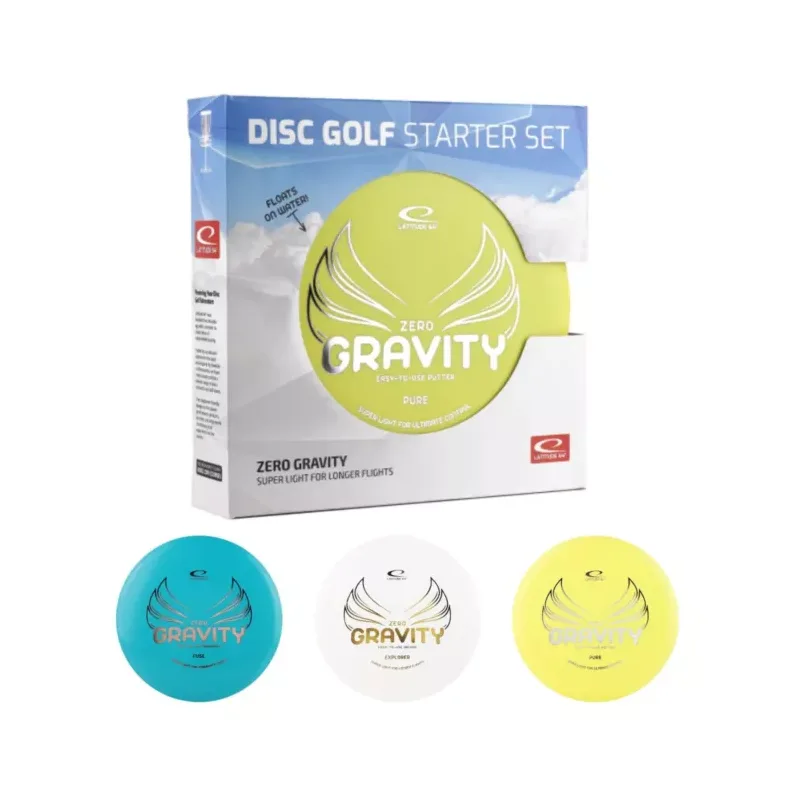
Latitude 64 Zero Gravity Starter Set
5.0/5$33–$36 approx. street price
- Discs: Pure, Fuse, Explorer
- Weight: 120–130 g
- Floats: Yes
- Best age: ~5–10 (or any slow arm)
Pros
- 120–130 g — about 30% lighter than a standard disc; a small arm can get it up to speed
- Real molds, PDGA approved — Pure putter (3/3/−1/1), Fuse mid (5/6/−1/0), Explorer fairway (7/5/0/2)
- Every disc floats — a pond stops being a place discs disappear
- Tacky grip texture and beadless rims for small hands; in stock at Latitude 64
Cons
- Very light discs are wind-sensitive; not for gusty days
- Low-density plastic scuffs faster than premium plastic
- A strong 12-year-old will turn them over and outgrow them in a season
Latitude 64 Zero Gravity Starter Set — Best for young kids
Latitude 64’s Zero Gravity plastic is about 30% lighter than standard, and the starter set puts three real molds in it at 120–130 g: the Pure putter (3/3/−1/1), the Fuse midrange (5/6/−1/0) and the Explorer fairway driver (7/5/0/2). Latitude 64 states the audience plainly — “children, seniors, beginners” — and the goal: throws in the “165–260 foot” range for people who can’t get a standard disc there. Every disc floats, every disc is PDGA approved, the rims are beadless and the surface is tacky for small hands. It’s $34.90 and, unlike most kids-oriented sets, in stock at the manufacturer.
The Pure is one of the best-reviewed putters in the sport in any plastic (4.77/5 across 175 Infinite Discs reviews for the standard version), and the Fuse is a genuinely straight midrange, so the set doesn’t feel like a toy. For a child under about 10, or any player who can’t yet throw 100 feet, it’s the pick — and the Explorer can stay in the bag until the Fuse is going 150 feet.
The trade-offs are the ones that come with 125 g of plastic: wind pushes it around, the low-density plastic scuffs, and a strong 12-year-old will flip these on a flat throw within a season. That’s the point at which to step up.
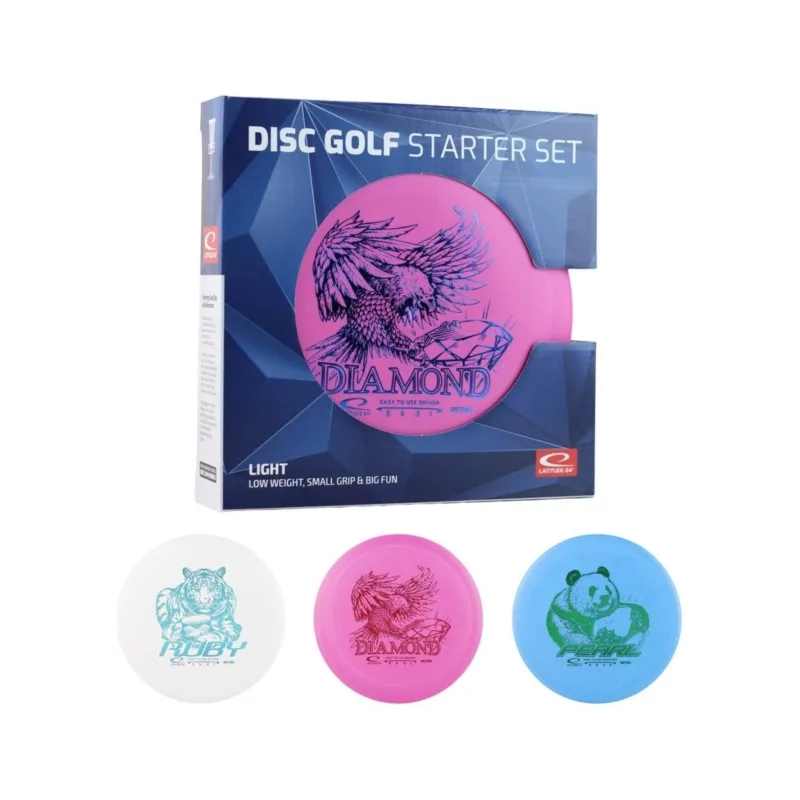
Latitude 64 Light Starter Set (Retro)
4.5/5$28–$33 approx. street price
- Discs: Ruby, Pearl, Diamond
- Weight: 150–160 g
- Floats: No
- Best age: ~9–13
Pros
- 150–160 g Retro plastic with high-friction grip — the step between Zero Gravity and adult weights
- Deliberately understable molds so a developing arm sees a full flight — Ruby (3/5/−3/1), Pearl (4/6/−4/0), Diamond (8/6/−3/1)
- Smaller rim profiles for smaller hands; PDGA approved
- Latitude 64 says it outright — for children, seniors and lower arm speeds
Cons
- Very understable — a strong teen will flip these immediately
- Periodically sold out at Latitude 64; usually available at Amazon and dealers
- Diamond at speed 8 is a lot of driver for a 9-year-old; start with Ruby and Pearl
Latitude 64 Light Starter Set — Best for older kids
This is Latitude 64’s “next step after Zero Gravity,” in their words: the Ruby putter (3/5/−3/1), Pearl midrange (4/6/−4/0) and Diamond fairway driver (8/6/−3/1) in Retro plastic at 150–160 g, with a high-friction grip and smaller rim profiles. The molds are deliberately very understable — the Pearl’s −4 turn is about as flippy as a midrange gets — so a developing arm sees the disc fly straight and glide rather than fade.
It’s the right set for roughly 9–13, or for a smaller adult beginner. Two notes: the Diamond is a lot of driver (speed 8) for the younger end of that range, so start with the Ruby and Pearl; and the set is periodically sold out at Latitude 64’s own store — Amazon and dealers usually have it at $28–$33. When the kid starts flipping the Pearl on every throw, it’s time for standard-weight discs, and our best beginner sets guide takes over.
Innova DX 150 Class trio (Aviar + Shark + Leopard)
4.5/5$27–$30 for three approx. street price
- Discs: Aviar, Shark, Leopard (DX)
- Weight: 140–159 g (150 Class)
- Floats: No
- Best age: ~9–14
Where to buy: The three-disc bundle is an Amazon listing. Disc golf shops sell 150-class DX discs singly instead — checked 24 October 2026 — so buying the same three separately from a specialist shop costs a little more but is always possible.
Pros
- The same three molds as Innova's DX Starter Set, bought individually in the 150 Class (140–159 g)
- $9 a disc, in stock at every disc golf retailer and Amazon; easy to replace one at a time
- Aviar (2/3/0/1), Shark (4/4/0/2) and Leopard (6/5/−2/1) are the most-recommended first molds in the sport
- DX plastic beats in fast into an even friendlier, flippier disc — a feature for a kid
Cons
- You assemble it yourself; the Amazon 'kids starter set' bundles are third-party and vary in weight
- Not as light as Zero Gravity — too heavy for a 6-year-old
- DX scuffs and warps in hot cars
Innova DX 150 Class trio — Best value, easiest to find
Innova doesn’t sell an official kids set, but it does something better: it makes its most-recommended beginner molds in the “150 Class” — discs under 160 g, originally for the Japanese market, now the standard light option. Buy a DX Aviar (2/3/0/1), a DX Shark (4/4/0/2) and a DX Leopard (6/5/−2/1) each in the 140–159 g range and you’ve assembled Innova’s DX Starter Set at kid weight for about $27. Every disc golf retailer stocks them at $9, and when one goes in the creek you replace one disc, not a set.
These are the molds from our Aviar review and Leopard review, and they’re recommended for adults for the same reason they work for kids: straight, forgiving, cheap. DX plastic beats in fast into an even flippier disc, which for a child is a feature.
The Amazon listings called “Kids Starter Set” are third-party bundles of these same DX discs; the good ones are 100–150 g, but weights vary by seller, so check the listing or buy the three discs yourself. At 140–159 g this trio is right for roughly 9–14; it’s too heavy for a small child, who should be on Zero Gravity.
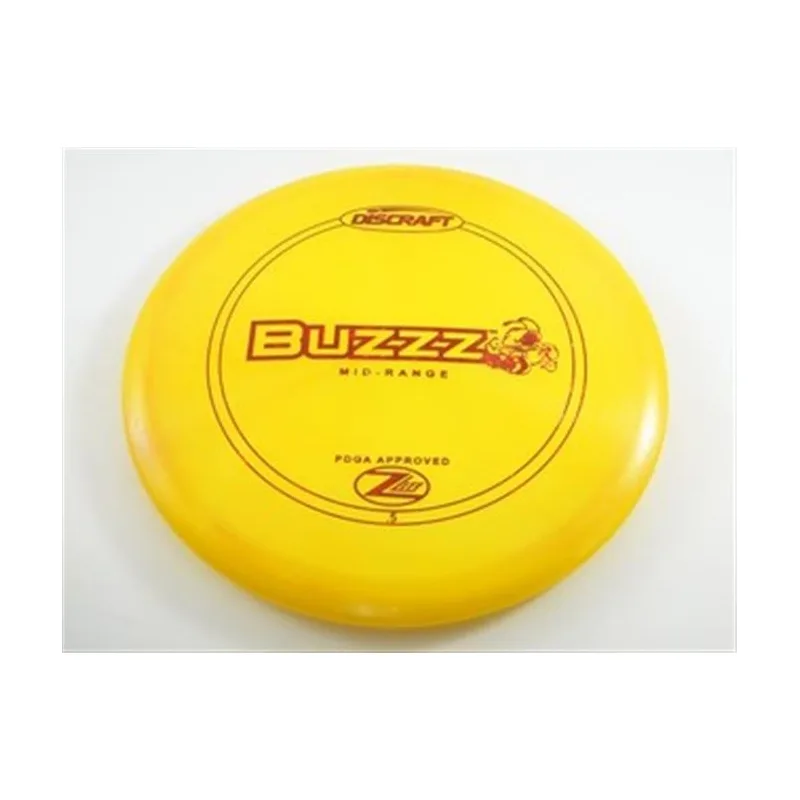
Discraft Z Lite Buzzz
4.5/5$16–$18 approx. street price
- Discs: Buzzz (Z Lite)
- Weight: 150–165 g
- Floats: No
- Best age: ~12+
Pros
- The world's most popular midrange in a 150–165 g air-bubbled Z plastic that lasts for years
- Straight, glidey, forgiving — one disc a teenager can drive, approach and learn with
- Durable enough to survive a season of trees, unlike DX
Cons
- 150 g minimum — still an adult-shaped disc; not for small hands
- One disc, not a set; add a light putter
Discraft Z Lite Buzzz — One disc for a teen
For a 12-plus-year-old who’s going to play a real course, one great disc beats three mediocre ones, and the Z Lite Buzzz is that disc. It’s the Buzzz — the most popular midrange in the world, 5/4/−1/1 — in Discraft’s air-bubbled Z Lite plastic at 150–165 g, so it’s light enough for a developing arm and durable enough to survive a season of trees. A teenager can drive with it, approach with it and learn every throw on it. Add a light putter (a 150 Class DX Aviar, or the Zero Gravity Pure) and that’s a starting bag for under $30.
It’s a full-size disc with an adult rim, so it’s not for small hands, and it’s one disc rather than a set. For a teen, that’s the right trade.
Reading the weight on the box
Every disc has its weight written on the underside in grams, and every reputable listing gives a range. That number is the whole purchase decision for a child, so here’s how to read it:
- Under 130 g — Latitude 64’s Zero Gravity is the only major-brand line here. Ideal for small children; these float.
- 140–159 g — Innova’s “150 Class” and the lightest runs of most DX and base-plastic discs. The sweet spot for 9–13.
- 150–165 g — “Lite” premium plastics (Discraft Z Lite, Innova StarLite, Latitude 64 Retro light runs). Teens and light adult arms.
- 165–175 g — standard adult weight. Not for kids who can’t throw 150 feet.
A listing that says “colors may vary” and gives no weight range is a listing to skip. And a mixed set — a 130 g putter and a 160 g mid, say — is fine; it’s the driver that most needs to be light, because it’s the disc that needs the most speed.
A first course for a kid
The best gear in the world doesn’t help on an 8,000-foot championship layout. Look for a short course — many parks have a 9-hole “family” or “rec” layout with holes under 200 feet — and play from the short tees or from wherever the kid’s drive lands. Three discs, a towel, water, and a phone number written on every disc in permanent marker are the whole kit. If the course has a pond, that’s the strongest argument on this page for the Zero Gravity set.
Two things parents ask that the box doesn’t answer
Do kids need a bag? Not at first. Three discs fit in a small backpack or a $20 Latitude 64 Slim Bag, and a dedicated disc golf bag is a reward for still playing in six months — see our bag buying guide by capacity when that day comes.
Is disc golf safe for young kids? The discs on this list are the safe ones: light, rounded-rim putters and mids at 120–160 g sting far less than a 175 g driver on a mis-throw, and none of them is a distance driver. The real safety rule is the same as for adults — nobody throws until the group ahead is out of range, and nobody walks ahead of a thrower. Teach that on the first hole and the rest is just fun.
Sets we considered but didn’t rank
- Standard starter sets (Innova DX, Discraft, Dynamic Discs Prime Burst, 165–175 g): excellent for adults — see our best beginner sets — and too heavy for most kids under 13. If a set doesn’t list weights under 160 g, it isn’t a kids set, whatever the box says.
- Latitude 64 Zero Gravity 5-disc set (Amazon): the Zero Gravity plastic in Pure, Fuse, Explorer, Saint and Diamond. Good discs, but five is more than a child needs, and the 3-disc set is the better first buy.
- Innova Blizzard and StarLite (130–159 g premium discs): the light versions of adult molds like the Destroyer and Wraith. Great for light adult arms; the wrong molds for children, who don’t need speed-12 discs at any weight.
- Toy-store flying discs and ‘disc golf’ sets from non-disc-golf brands: not PDGA-approved molds, inconsistent weights, and they don’t fly like golf discs. A $9 DX Aviar is a better toy.
How to choose
- Under 10, or can’t throw 100 ft yet: Latitude 64 Zero Gravity Starter Set. Start with the Pure and Fuse.
- 9–13: Latitude 64 Light Starter Set, or three Innova DX discs in the 150 Class.
- Teens: a Z Lite Buzzz plus a light putter, then move to standard weights when those turn over.
- Course has water: Zero Gravity — everything floats.
- On a budget or discs go missing: the Innova 150 Class trio at $9 a disc.
Two last pieces of advice from parents in every thread we read: write a phone number on every disc, and let the kid pick the colors. For what the four disc types do and why a kid doesn’t need a distance driver, our disc types guide explains it; for the adult version of this decision, see how to choose your first disc golf set.
How we evaluated this gear
We have not physically tested every product on this page. Ratings are based on manufacturer specifications, PDGA-approved flight data, and hundreds of aggregated owner reviews and community discussions (r/discgolf, retailer reviews, club forums). Where we describe how something "feels" or "flies", that reflects the consensus of experienced players, not a lab test. We update ratings when the consensus changes.